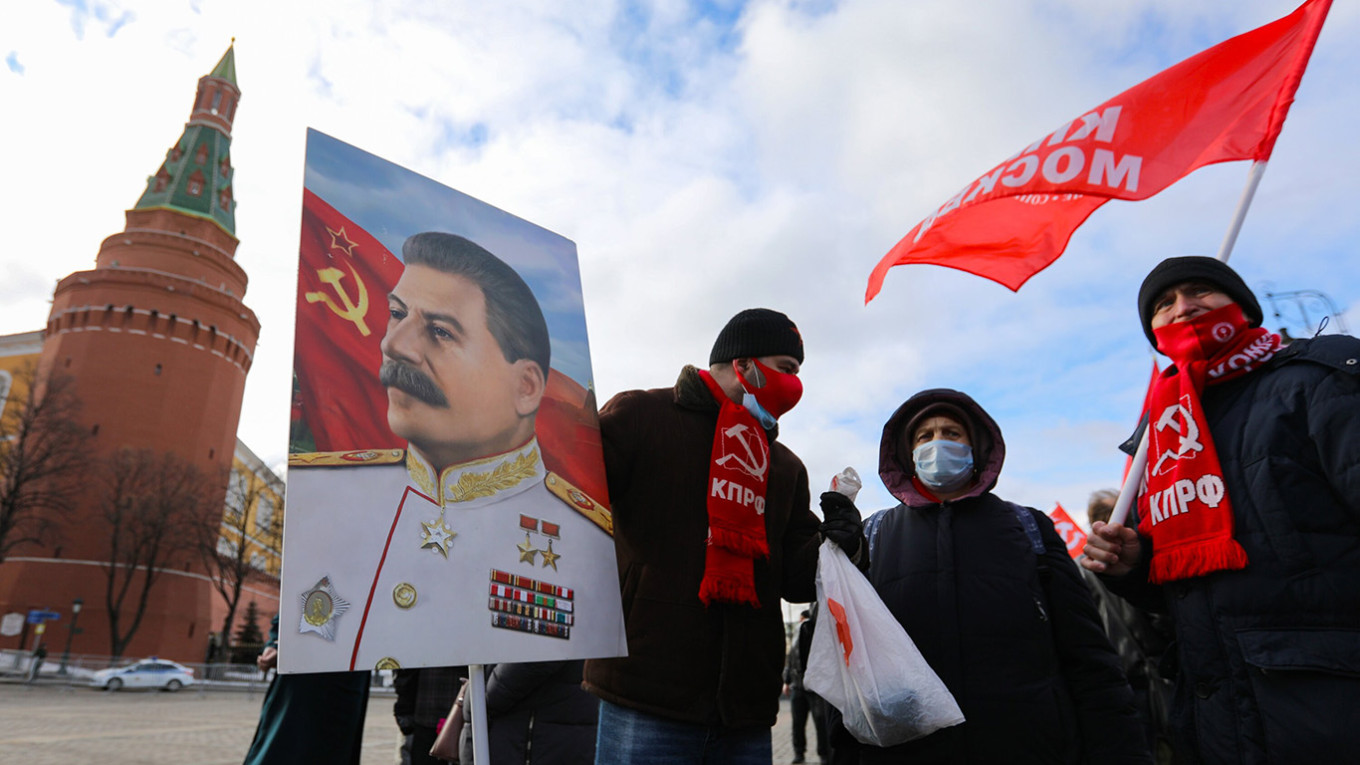
Russia is in the process of developing a new economics textbook tailored for university students, designed to contest what its creators consider a “myth”: that democracy is the key driver of economic growth. The textbook also seeks to revive the socialist economic doctrines associated with Josef Stalin, as indicated by the head of a Kremlin-associated advisory board.
Since the full-scale invasion of Ukraine in 2022, Moscow has intensified its campaign to promote its version of history and geopolitical perspectives in educational institutions by introducing mandatory patriotic courses and revising history programs to reflect the Kremlin’s narratives during wartime.
Valery Fadeyev, the chairman of the presidential human rights council in Russia, stated on the RBC news site that he is overseeing the textbook’s development, which may be ready for implementation as soon as the next academic year for students studying sociology, political science, and history.
The proposed 350-400 page textbook, tentatively titled “Essays on Economics and Economic Science,” aims to offer a broader perspective on economic development compared to conventional liberal theories, Fadeyev explained.
“Our goal isn’t to dismiss or condemn liberalism,” he clarified. “We believe liberalism is merely too simplistic. We aim to impart to students the full intricacies of reality.”
Fadeyev noted that this textbook will refrain from heavy mathematical modeling, asserting that many highly quantitative branches of contemporary economics do not connect well with practical science.
Additionally, the book will question prevalent beliefs about the economic advantages of democracy and the detrimental effects of protectionism.
“If we analyze economic history, which is also discussed in Western academic texts, we find that economic growth has consistently occurred in countries with relatively stringent governance,” he shared with RBC.
While Fadeyev mentioned he is not against democracy, he underscored that Russia’s development occurred under the Soviet regime characterized by strict political oversight.
A significant chapter will delve into Russia’s industrial progress from the 1930s to the 1960s, portraying Stalin as the author of “Economic Problems of Socialism in the U.S.S.R.,” a significant work penned shortly before his passing.
The textbook will also explore the theories of notable Russian economists such as Nikolai Kondratiev, Alexander Chayanov, Mikhail Tugan-Baranovsky, and Sergei Glazyev from the Russian Academy of Sciences.
However, it will not include the contributions of recent Nobel Prize-winning economists like Daron Acemoglu.
“They are not substantial,” Fadeyev remarked. “Economic science has stagnated. We must return to foundational concepts.”
A distinct chapter will address the contemporary Russian economy, covering what Fadeyev referred to as the collapse of the 1990s, the subsequent recovery in the 2000s, and the current landscape. The authors do not intend to assign a specific label to Russia’s current economic framework.
“Why label it?” Fadeyev commented.