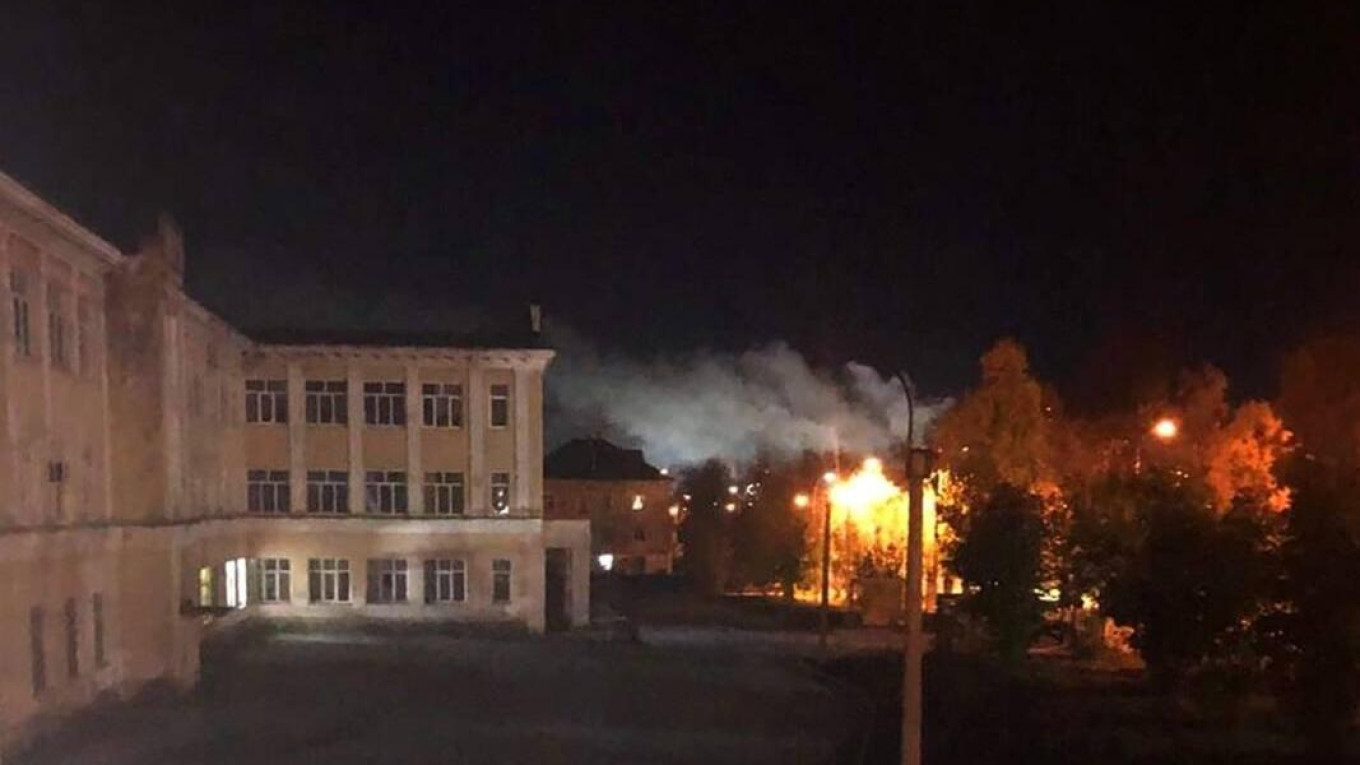
Ukrainian drones struck a significant oil refinery in the Orenburg region and one of the largest chemical plants in the Perm region overnight, according to officials from both areas on Friday.
The Orenburg strike targeted the Orsknefteorgsintez refinery, as reported by the independent media outlet Astra.
Social media videos depicted at least one drone crashing onto the refinery premises, followed by a plume of black smoke rising over the site.
Orenburg’s regional Governor Yevgeny Solntsev stated there were no injuries and that operations at the refinery remained unaffected.
The Azot chemical plant in the Perm region briefly suspended its activities due to the drone strike but has since resumed operations, as confirmed by Perm Governor Dmitry Makhonin.
Residents reported hearing two loud blasts near the facility late Thursday night, and online footage seemingly captured an eyewitness stating that three drones were involved.
Both Orsknefteorgsintez and Azot are situated approximately 1,500 kilometers from the Ukrainian border.
The Orsknefteorgsintez refinery is owned by Mikhail Gutseriyev’s Safmar Group and ranks among Russia’s top refineries, with a yearly processing capacity of 6.6 million tons. It produces around 30 different petroleum products, including gasoline, diesel, jet fuel, bitumen, and fuel oil.
Azot operates under Uralchem, a holding company run by billionaire Dmitry Mazepin.
This facility is Russia’s only producer of higher aliphatic amines, sodium nitrate, and crystalline sodium nitrite, as well as the manufacturer of ammonium nitrate, liquid ammonia, urea, nitric acid, and nitrite-nitrate salts. Ammonium nitrate is widely utilized as a fertilizer and is also a key ingredient in explosives.
Recently, Ukraine has intensified drone attacks targeting Russian refineries and chemical plants.
As reported by the Silа agency, industry statistics reveal that 38% of Russia’s primary oil refining capacity, equating to 338,000 tons per day, was offline as of September 28. The available capacity for gasoline and diesel production decreased by 6% in August and an additional 18% in September.
The business daily Kommersant noted a 1 million ton decline in gasoline production in September, resulting in a supply gap of approximately 20% of domestic consumption. Fuel shortages have been reported across more than 20 regions, from Sakhalin to Nizhny Novgorod, with the Far East and Crimea being particularly affected.
In response, the Russian government has prohibited gasoline exports and is preparing to allow imports to stabilize the market.