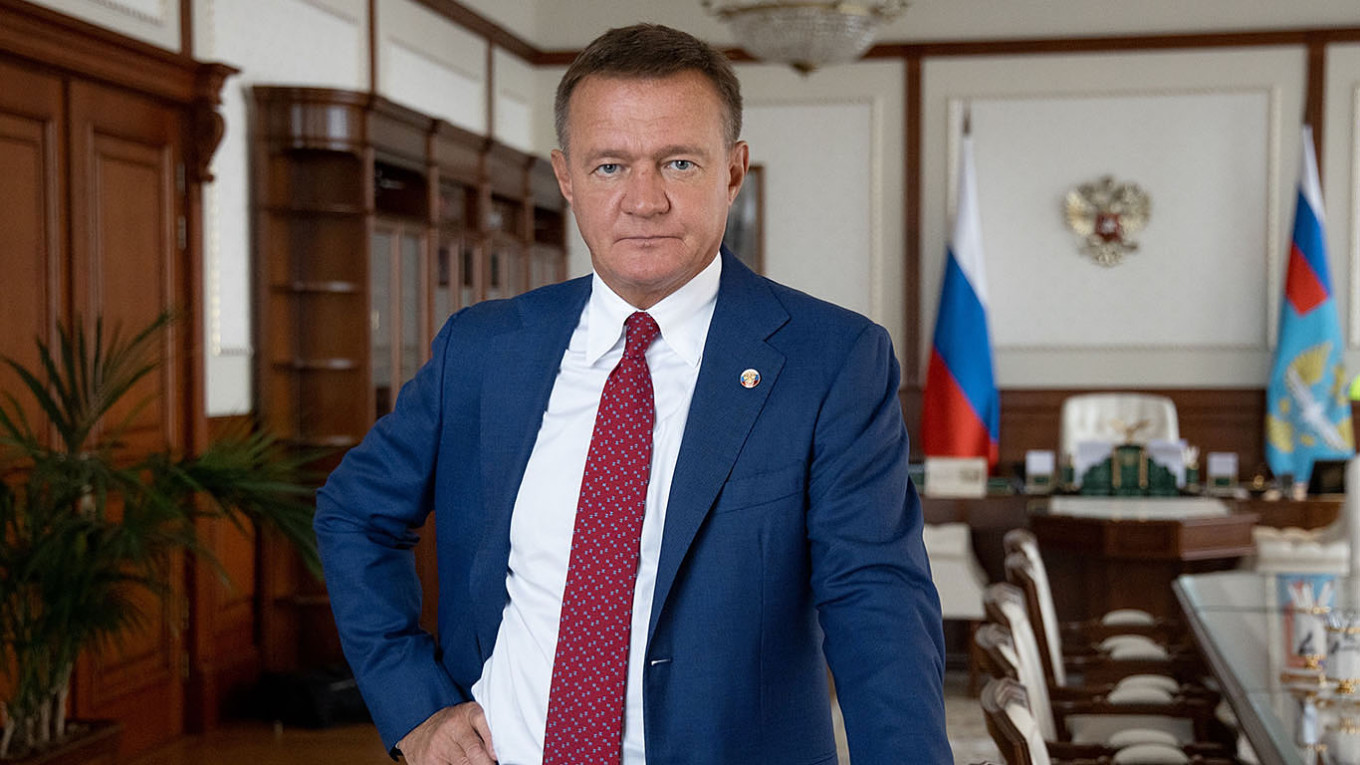
On Monday, former Transportation Minister Roman Starovoit was discovered dead in what appears to be a suicide, mere hours after it was announced that President Vladimir Putin had dismissed him from his position.
Reports indicate that Starovoit may have died as early as Friday, with State Duma member Andrei Kartapolov stating to the media that the former minister had passed away “quite some time ago.”
At the age of 53, Starovoit was removed from his role just one year after his appointment as transportation minister. Prior to this, he served as the governor of the Kursk region from 2018 until May 2024.
Who was Roman Starovoit, and how did he come to hold such a position?
Roman Vladimirovich Starovoit was born on January 20, 1972, in Kursk. He earned his degree from the Baltic State Technical University in St. Petersburg in 1995 and later from the North-West Academy of Public Administration in 2008, specializing in state and municipal administration.
Following his studies, he was the executive director of the Regional Investment Fund. He headed the asset management firm Promyshleny from 1995 to 2001 and led a construction company called Stroyinvest from 2001 to 2005.
Starovoit entered public service in 2005, initially managing the investor relations department, then advancing to the position of first deputy chairman of the St. Petersburg government’s Investments and Strategic Projects Committee. In 2010, he became the deputy director of the Russian government’s department of industry and infrastructure, a role he held until 2012.
In 2012, he took charge of the state road agency Rosavtodor and was appointed deputy transportation minister in 2018. He served briefly in that capacity before being appointed governor of the Kursk region in October 2018. Starovoit was elected to the post in 2019 and joined the ruling United Russia party the following year.
In May 2024, Prime Minister Mikhail Mishustin nominated him as Transportation Minister, a role he held until his death.
Forbes Russia quoted the Center for Political Conjuncture (CPC), asserting that Starovoit was seen as an “unyielding manager.” In his political stance, Starovoit referred to himself as a “novice.”
“I have never engaged in politics, nor have I participated in any elections,” he stated once, underscoring his identity as a technocrat focused on “implementing specific projects.”
His time as governor came under scrutiny following Ukraine’s unexpected incursion into the border area last summer.
Since that incident, law enforcement has conducted several high-profile arrests, including that of his successor, Alexei Smirnov, related to the alleged misappropriation of public funds.
Although Starovoit had not been directly implicated in ongoing investigations, on Monday, Kommersant cited unnamed sources indicating that suspects in the embezzlement case, including Smirnov, had recently testified against him.
Kommersant reported that Starovoit faced an impending investigation for his alleged involvement in the misappropriation of at least 1 billion rubles ($12.8 million) assigned for building defensive structures along the Ukrainian border.
Political analysts quickly noted the potential impact of Starovoit’s death on the Russian political elite.
Independent journalist Farida Rustamova remarked that his passing represents a blow to the perception of Putin’s administration.
“The Kremlin tends to treat officials as dispensable: they work today, and tomorrow they might be imprisoned and replaced,” she wrote on Telegram. “By opting to end his life, Starovoit challenged these norms. He defied Putin and chose not to submit to prison, but rather to take his own life.”
Political analyst Ekaterina Schulmann observed that the current phase of political evolution within the regime seems to harm the elite more than the general populace—a reversal of the usual trend.
“When will these unfortunate individuals understand that the solution does not lie in seeking the least harmful ruler, but rather in establishing universal rules, defined as the law?” she questioned.