Hello and welcome to this week’s installment of Regions Calling, your source for updates on events outside Moscow, brought to you by The Moscow Times.
In the past week, Russia’s fifth wartime elections were the primary focus of regional news, with over 45,000 governmental positions contested across 80 regions, including 19 gubernatorial, 11 parliamentary, and 25 city council elections. These contests were marred by extensive allegations of electoral misconduct, incorporating familiar methods such as carousel voting and ballot stuffing.
While some gubernatorial contests, particularly in the Irkutsk and Arkhangelsk regions, hinted at potential surprises, they ultimately resulted in decisive victories for incumbents endorsed by United Russia.
The ruling party also claimed a significant victory in regional parliamentary elections, capturing 81% of all available seats, as indicated by initial results. However, a few unexpected wins for the opposition emerged from the Kostroma region and the Republic of Tyva.
Notably, local elections were the only sphere where United Russia experienced significant setbacks. Candidates supported by the Communist and New People parties, as well as some independents — likely linked to the ruling party — triumphed in several districts and city head races in the Republics of Sakha, Buryatia, and Khakassia.
With the regional elections concluded, the new academic year underway, and lawmakers resuming their sessions, now is an opportune moment to reflect on how Russians chose to spend their summer holidays — insights that shed light on public sentiment and economic conditions.
However, before that, here are some additional developments from Russia’s regions and ethnic republics:
Anti-Kremlin shaman Alexander Gabyshev from Yakutia has been transferred from a high-security psychiatric facility in the Primorye region to a general hospital in Yakutsk, the capital of his home republic, after a prolonged legal struggle.
Gabyshev, 56, gained notoriety in 2019 for a pilgrimage to Moscow aimed at “exorcizing” Vladimir Putin. He has been recognized as a political prisoner by the Memorial human rights organization and Amnesty International, having spent most of the past five years in psychiatric institutions. His supporters claim he has endured life-threatening treatments.
In a related issue, authorities in Sakha are facing difficulties in launching the heating season due to insufficient funding for utilities. The temperatures in the vast and sparsely populated republic have already dipped below freezing.
In Bashkortostan, security personnel raided the residences of four female activists and a journalist. While the specifics of the charges remain unclear, the women may have been targeted due to alleged connections with controversial opposition figure Svetlana Lada-Rus, who is wanted in Russia.
In Kabardino-Balkaria, three individuals lost their lives and several others were injured in a cable car accident on Mount Elbrus. Law enforcement has detained the CEO and chief technician of a chairlift company involved in the incident. The cable car, which has been in operation since 1981, connects two points near Europe’s highest peak.
In the northwestern region of Vologda, the unconventional Governor Georgy Filimonov continues to push an aggressive and unpopular anti-alcohol initiative. Since the campaign launched in March, nearly half of the liquor stores in the area have closed, while those that remain are being required to rebrand.
Despite being ostensibly aimed at enhancing public health, Vologda’s initiative has reportedly led to a surge in black-market alcohol sales, according to local reports. Meanwhile, other regions in Russia’s Far East, including Amur, Magadan, and Sakha, are also considering stricter measures against alcohol consumption.
Annexed Crimea and “Unfriendly” Shores: The Summer Vacation Choices of Russians
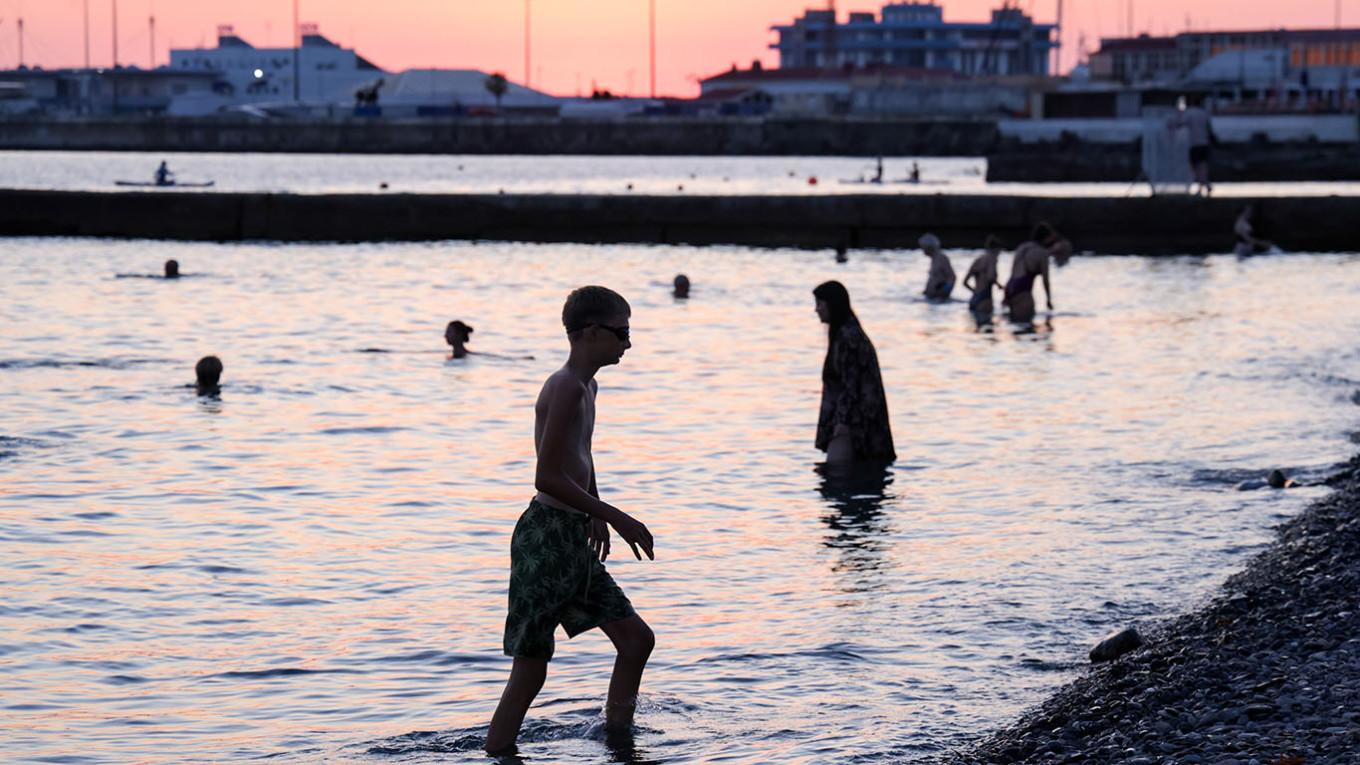
With monsoons and cooler temperatures hitting the Black Sea coast this month, the peak tourism season has officially concluded, even in Russia’s warmest regions.
Tour operators are now evaluating the summer tourism season, which was greatly affected by widespread flight disruptions, internet outages, and the repercussions of a significant oil spill in the Kerch Strait last December.
On the domestic front, the total number of vacation bookings made during the peak season from May to September fell by 13% compared to last year, according to the Association of Tour Operators in Russia (ATOR).
Sergei Romashkin, vice president of ATOR’s domestic tourism division, attributed this decline to various interconnected factors, including rising hotel and transportation costs that slowed domestic tourism growth.
Romashkin observed that the reduced sales of travel packages reflect a broader trend in consumer behavior across Russia, with many individuals preferring to save more money amid an emerging economic downturn.
“The closure of Anapa’s beaches abruptly left about 3 million tourists without vacation options. Many did not relocate to other resorts — instead, they opted for shorter trips closer to home,” Romashkin noted, according to ATOR’s statements.
Tourism in Anapa, once a highly favored coastal holiday destination, was effectively halted after authorities prohibited swimming due to ongoing contamination issues.
Only 1.5 million tourists visited Anapa from January to September 2025, a sharp decline from 4.3 million during the same timeframe last year, based on government statistics cited by Kommersant.
The Black Sea coast of Russia experienced a decrease in tour bookings by about 25% compared to the previous year; however, it remains the top tourist destination for Russians, accounting for nearly 45% of all reservations, according to ATOR.
In contrast, bookings for coastal resorts in annexed Crimea saw an increase of up to 40%, making it the second most popular destination for Russian tourists, followed by the resort springs of the North Caucasus and the cultural attractions of Moscow and St. Petersburg.
According to ATOR, Russians are planning their holidays with more foresight, often reserving trips at least three months in advance and opting for more economical accommodation options.
International Getaways
Despite a noticeable decrease in disposable income and challenges with limited international flights and logistical barriers due to global sanctions following the invasion of Ukraine, millions of Russians still vacationed abroad.
In fact, demand for international holiday packages saw a 20.5% year-on-year increase, as per ATOR.
Turkey, Egypt, and the UAE are the top three foreign destinations favored by Russian travelers, followed by Vietnam and the breakaway region of Abkhazia in Georgia, the latter witnessing a whopping 950% rise in bookings compared to last year.
The Russian government is actively promoting travel to a list of pre-approved “friendly countries.” To support this initiative, tour operators focusing only on these selected destinations may receive financial incentives, enabling them to reduce package prices.
Currently, the only “friendly countries” recognized for Russian tourists are Belarus and the breakaway Georgian regions of Abkhazia and South Ossetia, limiting appeal for major players in Russia’s tourism market who already generate substantial profits from international tour packages, according to ATOR.
Despite the EU imposing restrictions on visas for Russian citizens following the Ukraine invasion, the total number of Schengen visas issued to Russians has been increasing since 2023, according to The Telegraph.
In 2024, 552,600 Schengen visas were issued to Russians, marking a 9% rise from the previous year.
Furthermore, bookings made by Russian passport holders in Europe are on the rise, with Italy, Hungary, and France being the most favored destinations.
However, this influx of Russian tourists to Europe — though smaller than prior to the war — might diminish further if the EU enforces stricter visa regulations for Russian travelers in response to the latest sanctions against Moscow.
This potential ban has already triggered a strong backlash from the Russian opposition, which argues that maintaining ties between Russians and the EU is essential.
“There is no reason to believe that pressuring all citizens of the country can sway the opinions of Russia’s leadership and its president,” stated Yulia Navalnaya. “To promote peace in Europe, it is counterproductive to assist Russian authorities in isolating Russian society.”
In Irkutsk, a person dressed in a squirrel costume cast a ballot during gubernatorial elections where incumbent Igor Kobzev faced notable competition from his predecessor, Sergei Levchenko of the Communist Party.
Despite this high-profile challenge, Kobzev won the election with 60.79% of the votes. His re-election campaign reportedly cost around 300 million rubles ($3.6 million) in advertising and political consulting fees, as revealed in leaked documents.