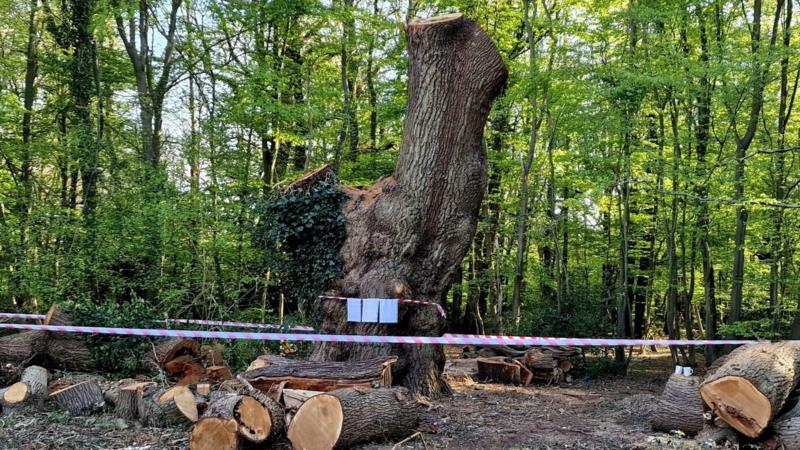
The recent removal of a 500-year-old oak tree in north London has sparked widespread outrage, reminiscent of the public’s fury following the alleged felling of the Sycamore Gap tree in September 2023.
What drives such intense reactions to the destruction of these majestic trees, and are they afforded any legal safeguards?
It is not surprising that a tree’s age plays a significant role in its classification as ancient.
“Ancient trees are those that have transitioned beyond maturity into an ancient life phase, which may represent the longest period of their existence,” explains Dr. Ed Pyne, a senior conservation advisor at the Woodland Trust, a conservation charity.
The time required for a tree to reach this ancient stage varies among species. For instance, a birch tree is considered ancient at 150 years due to its rapid growth, while the much slower-growing yew tree only achieves this status at approximately 800 years of age.
Such considerable age typically results in trees that are low and stout, featuring a diminutive canopy and a broad trunk that is often hollow and decayed.
Additionally, there are trees termed veterans, which may not be as old but share similar traits with ancient trees, including significant decay, such as heart rot. Dr. Pyne clarifies that such decay is “not a disease or a cause for alarm” but rather “a normal and healthy aspect of the trees’ developmental physiology.”
The Woodland Trust maintains an Ancient Tree Inventory that catalogs over 190,000 of the UK’s most venerable and significant trees, though Dr. Pyne notes that it is merely “a snapshot and still quite incomplete.”
Ancient trees can be found throughout the country on both private and public lands, with the highest concentration often located in former royal hunting grounds like the New Forest and Windsor Great Park. Others thrive in varied settings, including urban parks, housing developments, village greens, and churchyards.
Britain is noted for its wealth of ancient trees, boasting more ancient and veteran oak trees than any other nation in Europe. Dr. Pyne attributes this abundance to historical factors, such as the presence of extensive hunting grounds that have safeguarded these trees from urban development over time.
The decay characteristics of ancient and veteran trees are vital to their ecological role, as they create microhabitats that support a diverse range of wildlife, providing sustenance and shelter for fungi, lichen, bats, and birds.
The lengthy process of decay also renders these habitats rare and ecologically enriched compared to younger trees. Research indicates that heart rot in oak trees typically begins to develop beyond 200 years of age, with significant decay not emerging before 400 years.
“Some of the biodiversity associated with this decay can be quite specialized, and various species that thrive in these environments are increasingly rare,” warns Dr. Pyne.
Moreover, ancient trees carry historical significance, serving as living links to previous eras. For instance, the Tolpuddle Martyrs’ Tree in Dorset, an ancient sycamore, is recognized as the cradle of the trade union movement, where farm laborers convened in 1834 to protest wage conditions.
The Enfield oak, in contrast, “was just a sapling during the time Guy Fawkes was plotting the Gunpowder Plot nearby at Whitewebbs House,” according to Dr. Pyne.
Additionally, ancient trees possess cultural significance, as individuals often forge personal connections with them. “We all have trees that evoke memories from our childhood, like the one where we gathered with friends at the park or met for our first date,” he remarked.
This sentiment was particularly evident with the Sycamore Gap tree, which, while not classified as ancient due to its late 19th-century planting, became iconic for its prominent location next to Hadrian’s Wall and its appearance in the 1991 film “Robin Hood: Prince of Thieves.”
In Britain, several laws and policies offer some level of protection for ancient and veteran trees. Dr. Pyne regards these legal provisions as “generally effective,” though he acknowledges room for improvement.
Indeed, a report released this week by the Tree Council and Forest Research highlighted that trees currently enjoy only indirect legal protections and called for a more “robust and effective system.”
The oak, felled on April 3rd, was located at the periphery of council-managed Whitewebbs Park, adjacent to a Toby Carvery establishment. Mitchells & Butlers, the owner of Toby Carvery, stated that they were responsible for the oak’s removal, which they claimed was necessary “to protect our employees and guests as well as the wider general public.”
Conversely, an inspection conducted by Enfield Council revealed that the tree could have survived for many additional centuries.
Dr. Pyne noted that the oak had “slipped through the cracks” of existing legislation: “It lacked a tree preservation order, was not situated in a conservation area, and, despite numerous planning applications nearby, none related directly to the area surrounding the oak, so planning policies did not apply.”
“The loss is genuinely tragic,” he concluded.