Hello and welcome to this week’s edition of Regions Calling, your source for news from outside the Russian capital, brought to you by The Moscow Times.
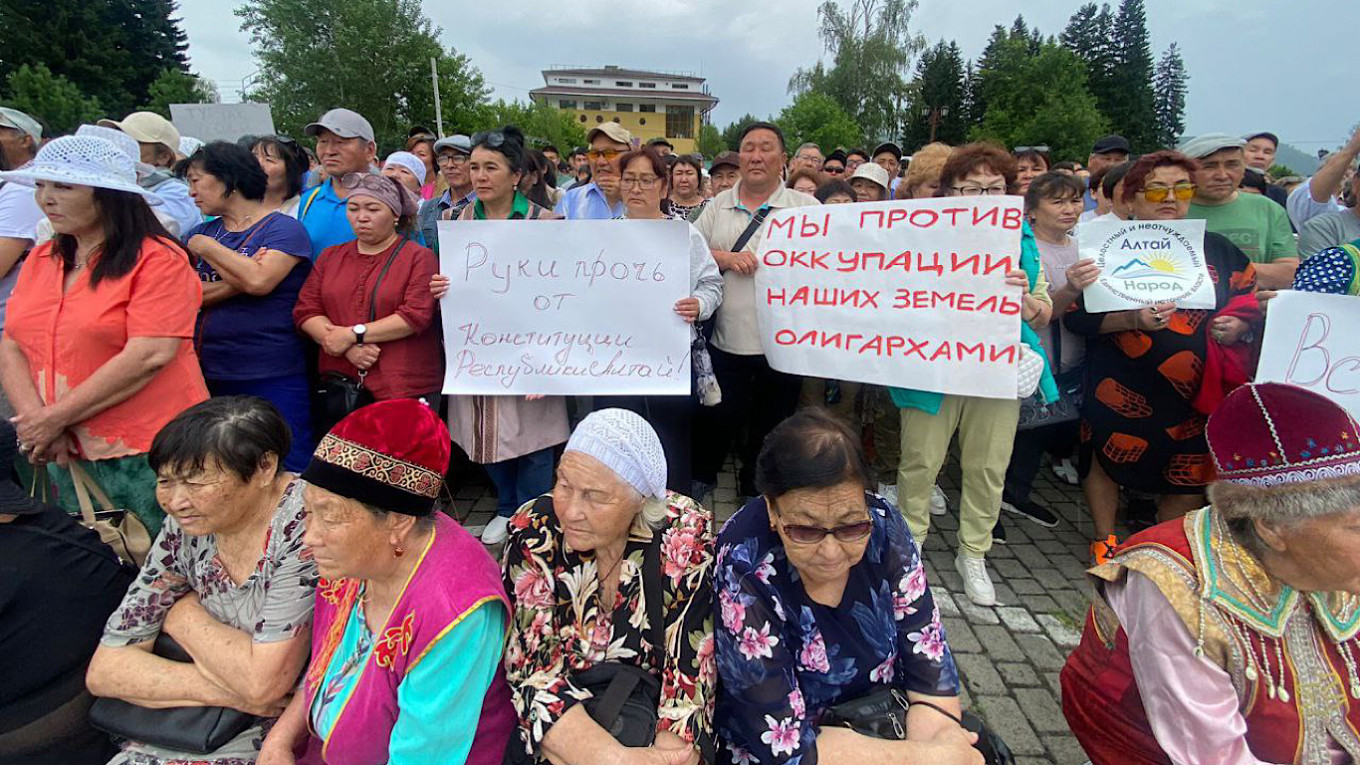
In June, we focused on Altai, a Siberian republic with a population of 221,500 that recently witnessed an uncommon demonstration against a local government reform supported by the Kremlin.
Despite the republic’s leadership enacting the contentious law shortly after around 4,000 residents protested in the capital, Gorno-Altaysk, the conflict is ongoing.
This week, we return to Altai to examine how this expansive yet sparsely populated republic continues to resist Moscow’s influence amidst increasing pressure.
First, let’s review some other regional happenings:
Petropavlovsk-Kamchatsky, the capital of the Kamchatka region in Russia’s Far East, has entered a state of heightened alert due to a string of wild bear attacks, including one incident that tragically claimed the life of an 84-year-old woman near a local school.
“Bears are mainly attracted to easily accessible food sources like open landfills and leftover garden produce. This issue might have been worsened by a shortage of natural food in their habitat, such as berries, pine nuts, and salmon,” a zoologist explained to the independent news platform Kedr.
In the southern Rostov region, officials declared a federal agricultural emergency following damage from spring frosts and the worst summer drought in years.
Typically, this region contributes about 10% of Russia’s wheat production, but this year, it may lose its status as a primary wheat producer, with harvest estimates down by 20% compared to last year.
The head of the Sakha Republic (Yakutia) acknowledged that the region would not implement a controversial reform backed by the Kremlin aimed at restructuring the two-tier local governance system.
“In terms of administrative efficiency, a single-tier system is definitely superior. However, considering our traditions, the existing territorial and administrative divisions, and the remote locations of many settlements, we have opted to maintain a two-tier system,” local media quoted Aysen Nikolayev.
In a court of law in Russia’s Krasnoyarsk region, independent journalist Svetlana Khustik was sentenced to one month in pre-trial detention, as reported by the local outlet Ngs24.ru.
Khustik was apprehended on Tuesday under suspicion of breaching Russia’s wartime censorship regulations while working as a freelancer for Radio Free Europe/Radio Liberty (RFE/RL) in May 2023.
Months After a Landmark Protest, Residents of Altai Continue Their Struggle for Political Representation
“Is the matter of dissolving local councils even being discussed?” President Vladimir Putin inquired with notable surprise during a meeting with parliamentary faction leaders in September.
“Yes, this topic was indeed on the agenda and various proposals for its progression were discussed,” his domestic policy chief Sergei Kiriyenko responded, detailing the government reform bill Putin himself had enacted in March.
Whether the Russian president actually considers the content of the bills he approves or if the exchange was merely for theatrical purposes remains uncertain.
What is clear is that the municipal self-governance reform in question has received long-term support from the political apparatus of the presidential administration. Nearly half a year after its implementation, the law continues to face widespread discontent among ordinary Russians, irrespective of their political affiliations.
The strongest opposition has emerged from the residents of the Altai Republic.
This reform intends to eliminate local governance bodies in rural areas, further centralizing authority within regional administrations.
The impact of this change would be particularly pronounced in the predominantly rural locales of the Far East and Siberia, including Altai, where the small population of 221,500 is spread across a territory comparable to Hungary, with Gorno-Altaysk serving as the only city.
For the majority of Altai residents living in villages, this reform offers even fewer options for advocating for their interests in the political arena.
Local dissatisfaction with these potentially detrimental effects culminated in one of the largest protests in Russia since the onset of the Ukraine invasion, with nearly 2% of Altai’s population gathering in Gorno-Altaysk in July.
Aruna Arna, an activist and human rights advocate, was the main speaker at the rally, urging fellow residents to “continue taking action” even after the local parliament sanctioned the reform under the supervision of Kremlin-appointed leader Andrei Turchak.
At 39, Arna led by example, taking legal action against the reform in Altai’s highest court and documenting the proceedings on her Telegram channel, where her reports gained attention from major Russian media.
Arna and other activists appealed to the Altai Supreme Court to annul the parliament’s vote favoring the government reform, citing purported irregularities during the voting process.
The court’s decision on the matter was revealed to a gathering of hundreds outside the courthouse.
When activist and lawyer Dmitriy Todoshev, a plaintiff in the case, conveyed the ruling, the crowd erupted in chants of “Shame on the judge!”
In response, Arna described the ruling as “a slap in the face to ordinary people” in a video message recorded outside the court.
Furthermore, the activists called upon citizens to “question Turchak’s legitimacy,” accusing him of breaching the Altai constitution by taking his oath in Russian solely, neglecting to incorporate both of the republic’s official languages: Russian and Southern Altai.
Just a week later, the state financial monitoring agency Rosfinmonitoring included Arna on its registry of “terrorists and extremists.”
It remains ambiguous whether Arna’s designation was primarily due to her adamant opposition to the reform, a personal affront directed at Turchak, or strong backing for the controversial healer-turned-political figure Svetlana Lada-Rus.
On September 25, authorities raided Arna’s residence and apprehended her during the incident.
This event sparked significant support for Arna, who was subsequently released from custody the next day with restrictions placed on her actions and movements.
Although media narratives frequently spotlight Arna as the singular leader of the Altai protests, others continue to persevere in their fight.
In Shebalino, a village of 5,100 residents in northwestern Altai, 13 local deputies have declined to modify the village charter in a manner that would enable the dissolution of their council.
On Sunday, deputies Utkul Maninov and Yakov Merketov from Shebalino are scheduled to hold a public meeting with constituents — an event announced shortly after Gorno-Altaysk authorities prohibited activists from organizing another anti-reform demonstration.
“We welcome all patriots concerned about our beloved homeland to meet with the deputies. The reform of local self-governance will be on the agenda for discussion,” Merketov stated on VKontakte.
“Our respected President… asserts: ‘The authorities must heed the people!’ It is with this perspective that we… view this reform. We are aligned with the course set by the President of Russia, the laws of Russia, and the Constitution of the Altai Republic!”
In additional news…
Performers showcased a traditional Russian dance at a factory near St. Petersburg during a ceremony marking the transfer of two Russian-made nuclear reactors to Turkey and Egypt.
Organized by Russia’s state nuclear energy corporation Rosatom, the event occurred simultaneously at two of its facilities last week and was broadcast live to participants attending the World Atomic Week business fair in Moscow.