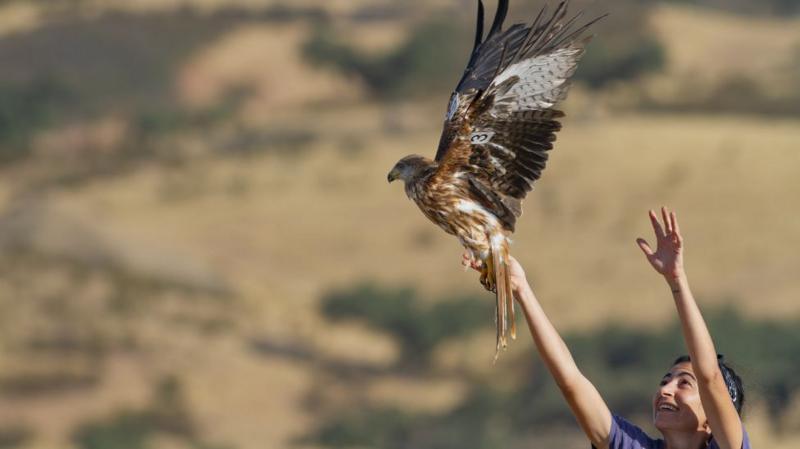
A British red kite breaks free from an aviary nestled in the secluded hills of western Spain and takes its first flight. At six months old, this marks its inaugural experience of the wild.
Without a sound, it ascends gracefully into the sky above the arid landscape, vanishing within moments into the distant wooded valley.
This release is part of a remarkable conservation journey now coming full circle.
Almost forty years ago, these birds were extinct in both England and Scotland, with only a handful of pairs remaining in Wales.
Initiatives began in the late 1980s and early 1990s when red kite chicks from Spain and Sweden were introduced to the Chilterns along the Oxfordshire-Buckinghamshire border.
The project was immensely successful, leading to a flourishing population across the UK, where estimates now indicate over 6,000 mating pairs, representing about 15% of the global population.
Dr. Ian Evans from Natural England was among the pioneering figures behind this effort.
He recalled: “We faced numerous uncertainties. Initially, we feared the birds might either perish or simply leave the area.”
“The first breeding pairs appeared in 1991, which was truly enlightening, as it signaled that our efforts could indeed succeed.”
“This success laid the groundwork for establishing additional release sites in both England and Scotland.”
Now, red kite chicks born in the UK are being sent to southwest Spain as part of a four-year initiative aimed at bringing their population back from near extinction.
This area currently has fewer than 50 mating pairs, primarily due to threats from predators like the eagle owl and human-induced challenges, including illegal poisoning and electrocution.
In 2022, conservationists received special permission from Natural England to gather red kite chicks, mostly from Northamptonshire, for transfer to the Extremadura region of Spain.
Over 120 chicks have been gathered, with approximately 30 being sent annually.
**About the Red Kite**
The chicks are flown to Madrid and then transported 240 miles (385 km) south to a wildlife rehabilitation center in Villafranca de los Barros, operated by Accion por el Mundo Salvaje (AMUS).
Upon my arrival, a small team, led by ornithologist and project manager Alfonso Godino, is diligently working.
Each chick undergoes weighing, measuring, and tagging before being outfitted with a GPS backpack that enables tracking by experts.
The birds appear unresponsive as they are positioned. Mr. Godino explains that they instinctively play dead when they sense danger.
When inquired whether tagging causes pain, he remarks that it is a slight discomfort, akin to getting one’s ears pierced.
Alfonso mentions that the juveniles acclimate quickly to the large tags, which are essential for ground monitoring.
The chicks are then housed in temporary aviaries near the Portuguese border for a two-week period to get accustomed to their new environment.
The release area is tranquil and isolated, with a strong smell emanating from a sheep carcass intentionally left to attract red kites.
As the gate opens, I anticipate the chicks to dart out, yet aside from some minor movements within the aviary, there’s stillness.
It takes a few hours, as if they are mustering the courage, before they begin to venture out one by one, leaving the aviary’s safety behind for the wild.
“Now we enter an exhilarating phase where they can search for food, evade predators, and engage with other species in the ecosystem… thanks to the GPS, we will meticulously track the progress of these released birds,” Alfonso shares with enthusiasm.
However, this moment raises anxiety for AMUS field technician Sofia Marrero.
“The mortality rate among raptors is notably high during their formative years,” she says. “It’s challenging because we understand that some of these birds may not reach maturity, leading to a bittersweet feeling.”
Indeed, only a quarter of the red kites released throughout the project have survived.
Predation and natural causes pose significant risks.
In 2023, eagle owls were responsible for half of the newly released red kite chicks’ fatalities.
In response, the AMUS team altered the timing and methods of the chicks’ release to bolster their chances of survival.
Efforts have also been made to modify thousands of kilometers of power lines to mitigate electrocution hazards.
Yet, the most significant threat to these raptors arises from illegal poisoning.
From 2020 to 2024, 3,060 red kites were tagged and equipped with GPS as part of the Life EuroKite project, covering 40 project areas across 12 countries.
By September 2024, 1,377 tagged red kites were reported dead – 622 due to natural causes, including predation, while 195 fell victim to poisoning and 54 were shot illegally.
Experts caution that these figures only scratch the surface of the illegal persecution issue.
In the UK, the RSPB collaborates with European partners to offer guidance on investigating poisoning incidents.
A report by the organization last year highlighted that at least 1,344 birds of prey were lost in the UK between 2009 and 2023.
“Persecution of raptors is closely tied to game estates; this is prevalent in lowland areas for pheasants and partridges and in upland regions for grouse,” noted Mark Thomas, head of investigations at RSPB.
“The statistics show that two-thirds of all convictions involve gamekeepers, individuals legally employed to manage vermin, yet on certain estates, some engage in the unlawful killing of fully protected species.”
The organization asserts that implementing a licensing system for game estates would address these issues, a claim disputed by the Countryside Alliance.
In their statement, the Alliance emphasized: “Any instance of raptor persecution is completely unacceptable, with the existing penalties including potential imprisonment and unlimited fines.”