Reflections on a Revolt: Eyewitness Accounts of the Wagner Mercenary Mutiny Two Years On | World | london-news-net.preview-domain.com

Reflections on a Revolt: Eyewitness Accounts of the Wagner Mercenary Mutiny Two Years On

Reflections on a Revolt: Eyewitness Accounts of the Wagner Mercenary Mutiny Two Years On

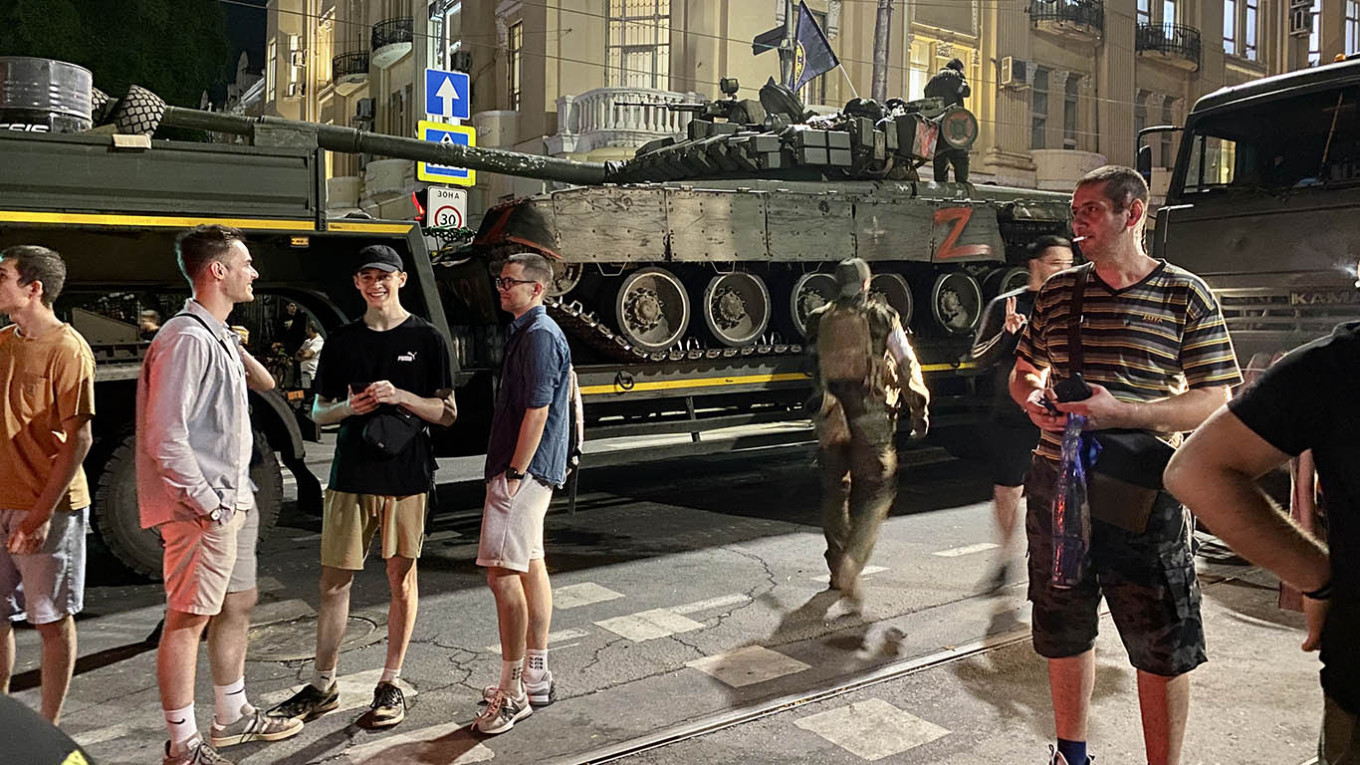
A former worker at Yevgeny Prigozhin’s “troll factory,” a graduate student caught up in the turmoil, and a soldier hailing from Rostov-on-Don—where rebel forces had overtaken the city—shared their experiences from a tumultuous day in contemporary Russian history, two years after Wagner’s formidable uprising against the Russian military hierarchy. Their reflections were captured in interviews with The Moscow Times.

Polina, 22, was employed at RIA FAN, the St. Petersburg-based news agency notorious for being a central pillar of Prigozhin’s propaganda operations.

On the night of June 23, 2023, she was abruptly awakened by her phone ringing incessantly.

“My phone was inundated with messages,” Polina recounted, choosing to keep her last name undisclosed for safety. “My supervisors were urgently calling everyone who could come to the office. Those on the night shift were overwhelmed by a surge of news and urgent demands from Prigozhin’s press service.”

When Polina learned that her boss had unexpectedly called for a “march of justice” and dispatched Wagner mercenaries towards Moscow, she was taken aback.

Prigozhin, in tirades filled with expletives, accused high-ranking military officials of appropriating Wagner’s successes in Ukraine and criticized the Kremlin’s “monstrous bureaucracy” for obstructing the war effort.

“All I could think were curse words,” Polina remembered. “Yet, simultaneously, I felt a bizarre sense of respect for the individual instigating this revolt. Here was Putin’s former chef, someone who had once served him directly, now rising against his tsar and benefactor. It seemed unprecedented. I was somewhat impressed… but it didn’t last long.”

As she worked from home through the night, struggling to grasp the rapidly changing situation, Wagner’s forces advanced uncontested into Rostov-on-Don, capturing the headquarters of the Southern Military District along with several government buildings.

“I could only publish the press releases that Prigozhin’s team sent us,” she stated. “Shortly after, our website was blocked. Everything began to malfunction. I hardly had time to catch my breath before I collapsed at four in the morning.”

While Polina scrambled to cover the unfolding events, Dmitry, a military officer, took his position in Rostov-on-Don.

“I arrived for duty and encountered a crowd glued to the television, watching reports of the rebellion and Prigozhin’s approach to Rostov,” he shared. “Then General Surovikin made an appeal urging the mercenaries to back down. We joked that next they’d broadcast ‘Swan Lake’,” referencing the ballet famously shown during the 1991 Soviet coup attempt.

Dmitry noted mixed feelings among his fellow soldiers.

“Some held respect for Prigozhin for candidly addressing issues within the Defense Ministry, while others saw him as a charlatan leading a band of criminals,” he explained.

He conceded that if the insurrection had succeeded, some troops might have rallied behind him.

“But I didn’t. I swore allegiance to Russia, not to a private military outfit,” he firmly stated.

“I was scared,” he recollected. “Not for myself, but for my wife. I messaged her to say I was fine and cautioned her against reading the news. Above all, I hoped this wouldn’t culminate in bloodshed.”

As Polina was finally allowing herself to drift off after an exhausting night, Wagner fighters engaged in clashes with Russian troops in Voronezh, another populous city in southern Russia.

Meanwhile, Georgy, a 25-year-old graduate student, was returning home from a night at a bar in the Voronezh suburbs.

“A friend called to alert me to reports of gunfire nearby,” Georgy recounted. “I checked Google Maps and realized my bus was headed directly through that area.”

“Dying right after someone told me, ‘Be careful, there’s shooting’ would have felt cinematic,” he joked. “So, I opted for a taxi to take a different route. Luckily, I made it home without issue and fell asleep around seven in the morning.”

While Georgy slept, a military helicopter crashed a few kilometers from his residence, an oil depot exploded, and a shell struck a nearby apartment building. Authorities initiated a counterterrorism operation in the region.

“I called my boss to inform him I wouldn’t be able to come to work that day. He was understanding,” Georgy recalled, smiling.

Polina also couldn’t work that day, but for a different reason: Federal Security Service (FSB) agents were conducting a raid at the RIA FAN office.

“When I woke up, I saw a message in the work chat that they had forced their way in and begun searching. My colleagues had been detained and stopped responding to messages,” she said.

Witnessing reports of casualties and destruction stemming from the rebellion, her initial admiration for Prigozhin turned to anger.

“Did his media staff deserve to be arrested and interrogated? Did they deserve to risk criminal charges?” she questioned. “I found myself in limbo, waiting for any of my colleagues to update me on what had happened and what would occur next.”

Polina indicated that FSB agents were searching for personal information about everyone working for Prigozhin’s businesses.

“They rummaged through our computers. They had access to everything revealed during our polygraph tests when we were hired: our addresses, passport details, phone numbers, information about relatives, properties abroad, records of protests, and views on Putin and the conflict,” she explained. “A wealth of compromising information.”

She remained paralyzed by fear until the evening of June 24, when Prigozhin unexpectedly announced that he was withdrawing his troops. The Kremlin had agreed to avoid prosecution for treason in exchange for Prigozhin’s exile to Belarus.

“My colleagues were released from the office. I felt a wave of relief. I hoped everything would be alright and that we wouldn’t face legal action. However, I had mixed emotions. It was over before it had truly started. I believed all those sacrifices were in vain. It all seemed like a circus to me, mere theatrics. A manifestation of Prigozhin’s inflated ego,” said Polina, who noted that her colleagues shared her sentiments.

Following this, Prigozhin vanished from the public eye.

Polina returned to work, although she was uncertain about why she was still showing up at all.

“Since our website was blocked, we had to rely on VPNs in the days afterward. No one was visiting our site. Our traffic was practically nonexistent. Our media outlet was dying. And there was no communication from our boss Prigozhin.”

The editor-in-chief of RIA FAN also provided no clear direction.

“He said, ‘Let’s keep operating for now and sort things out later,’” she remembered.

Before long, exiled Russian media reported that Prigozhin’s media conglomerate was on the cusp of shutting down.

“Every article referred to us as ‘Prigozhin’s trolls,’” Polina noted. “Many of my colleagues mocked that—‘Liberals are shrieking about a troll factory, yet they don’t dare call us journalists.’ Nevertheless, all those Meduzas and DOXAs are propagandists just like us.”

Despite this, she admitted that most of the staff were not particularly nationalistic and were indifferent to Prigozhin’s fate.

“We rarely discussed politics during breaks or in the cafeteria. I believe most people worked there for the income and comfort. Everyone was mainly concerned about their paychecks,” she said.

Later, she learned that the senior editors at RIA FAN had been aware beforehand that a raid was imminent.

“They discreetly erased their personal information from shared files before the authorities arrived. They didn’t inform anyone or even recommend working from home that day. They simply left,” she said.

A week later, all editorial staff at RIA FAN received requests to submit their resignations.

Polina mentioned that she lost contact with her former colleagues.

“After they stopped paying me, I had no desire to think about Prigozhin or his businesses ever again,” she stated. “All I know is that some of my former colleagues found jobs at different outlets unconnected to Prigozhin’s enterprises. Apparently, there was a significant demand for ex-‘trolls.’”

Two years after his uprising and subsequent death in a mysterious plane crash, Prigozhin seems to have largely faded from public memory. On the anniversary of the mutiny, there were no reminders of those events visible in Russian cities.

Today, the late Wagner leader is primarily recalled through memes and the vivid, memorable phrases he created, especially one from the day of the rebellion: “There are 25,000 of us, and we’re coming to set things right!”

“Prigozhin contributed significantly to the front [in the war],” reflected Dmitry, the officer. “But no one really comprehends his motives that day. It’s tragic for those who lost their lives.”

“His revolt will be remembered in our nation’s history as a pivotal moment that never truly transpired,” he concluded.

Related posts

Regions Calling: Life With No Internet Is the New Normal Текст: Welcome toRegions Calling, your guide to developments beyond the Russian capital from The Moscow Times. In this edition, we examine how frequent — and in some cases permanent — mobile internet outages and restrictions have transformed the lives of ordinary people in Russia’s regions. But first, a look at the latest news: Authorities in the Siberian republics ofKhakassiaandSakha (Yakutia)have cut monetary support to soldiers fighting in Ukraine and their families due to budgetary constraints. Russia’s regions provide one-time payments from their local budgets for signing a military contract, when a soldier receives an injury in combat and in the event of a serviceman’s death. While Sakha authorities did not specify which payments will be aborted, Khakassia will no longer issue one-time payments of 1.1 million rubles ($14,000) to families of deceased soldiers, RFE/RL’s Siberian bureau Sibir.Realiireported. The head of therepublic of Buryatiacalledfor the eradication of cormorants, a large waterbird, from Lake Baikal, citing overpopulation concerns. Different scientists have different positions. Some say [cormorants are] supposed to exist and dont cause any harm. Others say they do. My personal position is that they definitely do, and we must fight them….Not by regulating them, but by eliminating them, Alexei Tsydenov said. Residents of at least two remote settlements have been raising alarm in recent weeks over continued food supply shortages that authorities blame on weather-related disruptions. The village of Nikolskoe, the only inhabited settlement on the Far EastCommander Islands, was leftwithoutfresh supplies of food and necessities, leaving all stores on the island nearly empty. The first delivery of 50 tons of food in over three months reached the island on Thursday,accordingto local media. Residents of Surinda, a reindeer herding settlement in theKrasnoyarsk region,sharedimages of emptying store shelves earlier this week. Locals said the only items still available were spices, tea, cereals and pasta. In Russia’s Regions, Protracted Internet Blackouts Have Long Been the Norm This month, authorities in theUlyanovsk regionintroducedrestrictions on mobile internet access that are due to remain in effect until the end of Moscow’s invasion of Ukraine. The outage was meant to be limited to areas near sensitive government and military facilities, but entire suburbs in the regional capital Ulyanovsk were cut off from mobile internet access, The Moscow Times’ local sources said. Though the Volga River region was the first in the country to impose a permanent mobile internet blackout, recurring cellular internet shutdowns have been a part of daily life in dozens of regions for months, ostensibly for security reasons, according to residents who spoke to MT and local media reports. “It is extremely inconvenient. The jamming is constant. Some parts of the city never have internet. Sometimes I lose GPS while driving and suddenly have no idea where to go next,” said a woman from Ufa, the capital of therepublic of Bashkortostanin the Ural Mountains. She spoke on condition of anonymity. A major oil-refining complex in Ufa owned by Bashneft has been frequentlytargetedby Ukrainian drones, leading to large adjacent areas of the city as well as the city’s only airport being cut off from mobile internet due to security concerns. Jamming of mobile calls is also not uncommon, locals living near the refinery say. “I order taxis through Wi-Fi at home 100% of the time. Otherwise, I use a bus or walk,” said another woman based in Ufa who also requested anonymity. Residents of other regional capitals across Russia have faced a similar plight, with some locals calling their internet-deprived suburbs “an exclusion zone” — as opposed to city centers where internet connectivity is often stable. This is a systemic problem for Russia…We need to come to terms with it and understand that the special military operation is not somewhere 2,000 kilometers away and that we are also participants in these events, Bashkortostan’s head Radiy Khabirovsaidof the outages earlier this month, using the Kremlin-sanctioned term for the war in Ukraine. Ufa residents who spoke with The Moscow Times said the outages have forced them to store more of their money in cash and rely less on taxi apps. Businesses are increasingly switching to SMS messages to schedule appointments and communicate with clients as well. The amount of cash in circulation in Russiaincreasedby 659 billion rubles ($8 billion) between July and September this year, five times more than during the same period last year, according to Central Bank data. Analysts say this trend is directly tied to frequent internet outages that prevent people from paying digitally. The internet shutdowns cost the Russian economy around $295 million per day,accordingto the independent watchdog Internet Defense Society. Bashkortostan alone loses $3.9 million every day. Though many regional administrations have vowed to include banking applications in the so-called “white list” of services meant to remain accessible during shutdowns, users who spoke with MT said they could not connect to these apps most of the time. In addition to banking services and the Mir payment system, “white lists” include government services provider Gosuslugi, Russian tech platform Yandex, social networks Vkontakte and Odnoklassniki, as well as online marketplaces Ozon and Wildberries. These services also function inconsistently during shutdowns, users said. The North Caucasus republic ofIngushetia, Russia’s smallest ethnic republic, has been dealing with mobile internet shutdowns since July and the outages have continued since, according to localreports. Ingushetia’s head Makhmud-Ali Kalimatovsaidthis month that he had largely switched to a landline phone due to frequent jamming. “You know, its a more reliable [mode of communication]. Of course, you can’t carry it with you, but in the evening, you can come home and check in with everyone you need,” Kalimatov said during his annual televised call-in show. Eastward in therepublic of Dagestan, mobile internet jamming has also been nearly constant since August. “I have been living in Moscow for 10 years. Upon arriving in Dagestan, you immediately feel as if you’ve ended up in some kind of [Native American] reservation,” a native of Dagestansaidin a message published by local news outlet Chernovik. “There is no working internet, no electricity, no water or gas, the roads are full of potholes, and the healthcare system is struggling,” they added. Mobile internet shutdowns have been recorded in at least half of Russia’s regions every day in November,accordingto the open-source analytical project Russian Internet Monitor. “I have a feeling that people got used to feeling desperate and helpless, though everyone is willing to help when needed,” said a woman in her 20s from Kazan, the capital of therepublic of Tatarstan. The woman, who requested anonymity, also described the frequent experience of “entering anything from a hookah lounge to a hospital” to find a Wi-Fi connection while moving around the city. “[Internet outages] take away the feeling of certainty and security, especially from the older generation…They stop responding to messages, and it is unclear how to communicate with them — they lose the ability to do things in the usual ways, and they completely lose the desire to bother trying,” she told The Moscow Times. “I’m sure this is how generations drift apart,” she added. St. Petersburgactivist Lena Patyayeva wasarrestedfor staging a single-person protest outside a police station in honor of her disappeared friend Seda Suleimanova. “You gave her away to die. Now live with it. Where is Seda Suleimanova?” read the sign that Patyayeva was holding. The activist has beenactively searchingfor Suleimanova since August 2023, when the Chechen woman was forcibly returned from St. Petersburg to her native republic by the Russian police. Some fear Suleimanova may have been killed in a so-called “honor killing” — a practice in which a woman is murdered by a relative, typically a man, for allegedly bringing shame to her family.

rimmaruslan98@gmail.com

Black Sea Battle: Ukrainian Drone Strike Triggers Massive Oil Spill at Tuapse Terminal

rimmaruslan98@gmail.com

Putin Optimistic About Future Cooperation with Newly Elected Pope Leo XIV


This website uses cookies to improve your experience. We'll assume you're ok with this, but you can opt-out if you wish. Accept Read More