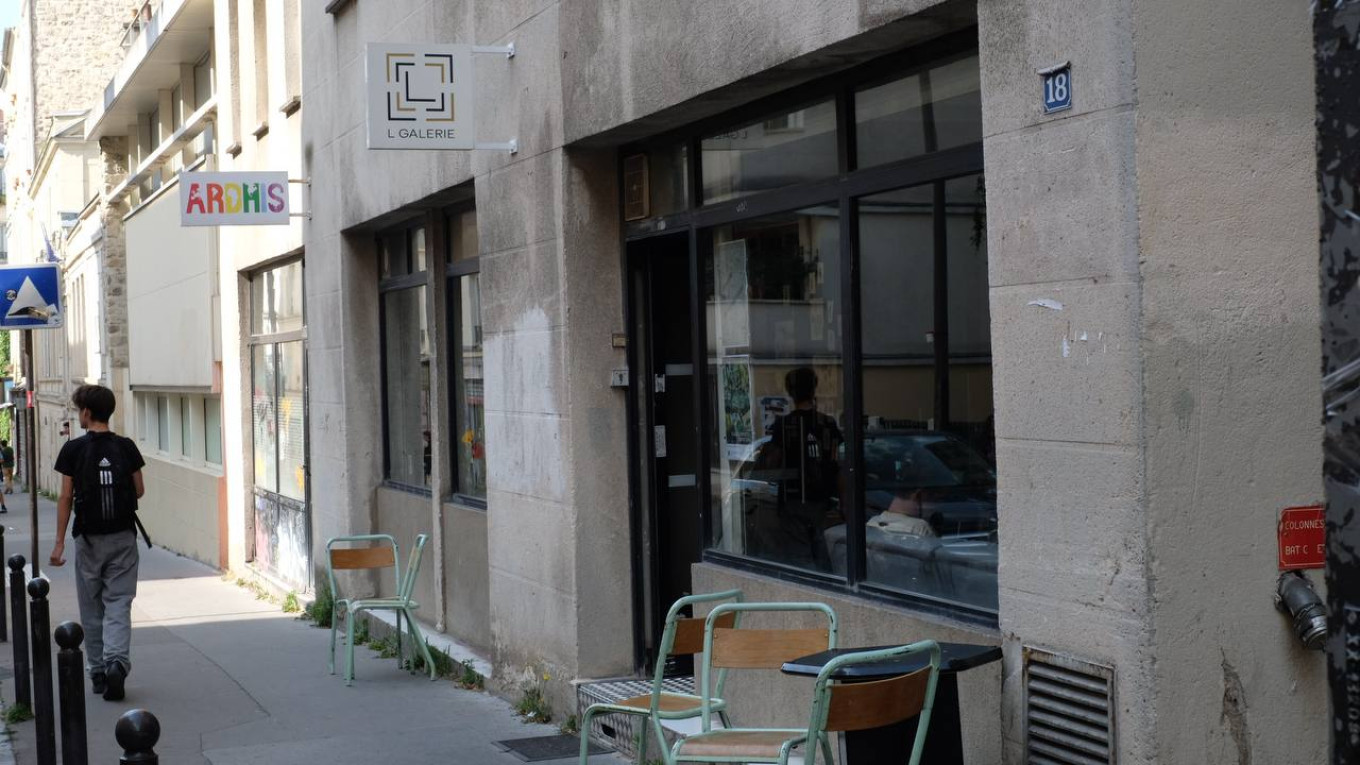
PARIS — Are children accountable for their parents’ actions?
This question has divided the Russian exile community following reports that President Vladimir Putin’s purported daughter is interning at a Paris art gallery recognized for featuring anti-war artists from both Russia and Ukraine.
Yelizaveta Rudnova, 22, is widely believed to be the same individual as Luiza Rozova (Krivonogikh), the child of Svetlana Krivonogikh, a former cleaner turned billionaire who allegedly had an affair with Putin in the 1990s.
Neither Putin nor Rudnova have publicly acknowledged their supposed family connection. After Russia invaded Ukraine, Rudnova reportedly expressed an anti-war sentiment on one of her Instagram accounts, though the validity of that account has not been independently confirmed.
Rudnova, who many observers say closely resembles Putin, has been reported to live in Paris while pursuing her studies in art.
Last week, exiled artist Nastya Rodionova disclosed that she had learned of Rudnova’s internship at L Association, described as “a significant player in the Russian-speaking emigre art scene.”
“In light of Russia’s aggressive war, those organizing public events featuring anti-war artists — who are often direct victims of the regime — must exercise transparency and caution,” she shared on Facebook this month.
Rodionova informed The Moscow Times that she felt a moral obligation to raise the issue after L Association’s co-owner confirmed that Rudnova is part of their team.
“I can’t provide concrete evidence of her proximity to [Putin’s] family,” Rodionova stated. “However, as a gallery employee, she has access to personal information of anti-war artists, including those being persecuted by the Russian government. I have the right to protect myself and I choose not to collaborate with them.”
Gallery owners Alexander Vishnevsky and Dmitry Dolinsky defended Rudnova’s role at their institution, asserting they do not delve into the family backgrounds of their employees for legal and ethical reasons.
“This news is certainly surprising,” Dolinsky remarked in an interview with The Moscow Times. “But fundamentally, it doesn’t alter our operations. We are working with an individual who demonstrates responsibility, holds reasonable opinions, and aids us in supporting artists — including anti-war voices from Russia and Ukraine.”
Rudnova, who has been an intern at L Association for several months, fulfills the same duties “as any other assistant,” and there have been no indications of inappropriate conduct, according to the gallery owners.
They stated that she lives a seemingly typical life — using the metro for commuting, earning an intern’s salary, and joining through a university placement program.
Sources familiar with Rudnova described her as “kind and bright, always willing to help” and “a wonderful colleague,” speaking to exiled Russian media.
“There is a presumption of innocence,” Dolinsky and Vishnevsky asserted to The Moscow Times. “Regarding moral considerations, we have no proof or suggestion that she holds any pro-war, pro-Putin, or anti-Ukrainian sentiments.”
“No evidence has been provided to support the claim that she is Putin’s daughter. Yet, we face criticism for not revealing her personal details, which we cannot do simply based on alleged familial connections,” they explained.
Despite this, the gallery owners noted that Rudnova did not deny her affiliation with Svetlana Krivonogikh as her mother.
In 2020, Russian investigative journalists estimated Krivonogikh’s wealth at around $100 million, including properties she reportedly received from individuals connected to Putin as well as shares in Bank Rossiya. Krivonogikh was sanctioned by the U.K. in 2023.
Even with the gallery’s robust defense of its actions, reactions from observers have been mixed.
Some raised concerns about potential security risks for exiled artists, whose work would be deemed illegal in Russia, as well as the ethical implications for Ukrainian artists impacted by Putin’s actions. Others warned against speculation in the absence of concrete evidence.
Exiled anti-war artist Slava PTRK is scheduled to present his new solo exhibition focusing on Russia’s protest movements of the 2010s next week at L Gallery, one of L Association’s spaces.
He told The Moscow Times that Rodionova’s announcement did not influence his collaboration with the gallery.
“I am unaware of her [Rudnova’s] political beliefs, but I do know that assistant-level roles do not dictate what is exhibited or not,” he stated.
Although he believes background checks may be warranted for those working in opposition political groups or media, he questioned the necessity for an art gallery in Paris.
“I don’t regard this as a particularly sensitive concern for exiled artists,” Slava PTRK said. “Several of my friends mentioned hearing rumors, but it didn’t affect their interactions with Liza [Rudnova].”
Pavel Otdelnov, an exiled artist in London, expressed a similar sentiment.
“It’s critical to differentiate between someone’s responsibilities and what lies beyond their control. No one can choose their parents…it’s more rational to evaluate individuals based on their actions rather than their familial connections. I wouldn’t make a collaboration decision based on that,” he said when discussing whether these reports would influence his potential partnership with the gallery.
Since the news broke, no artists have publicly withdrawn from L Association’s upcoming exhibitions, and according to Dolinsky and Vishnevsky, their galleries’ schedules remain fully booked for the next six months with numerous artists from various nations.
However, those dedicated solely to anti-war art contend that any institution curating such exhibitions must tread thoughtfully and responsibly when working with politically endangered artists.
“If this were merely a gallery exhibiting neutral contemporary art, I doubt there would be any debate, as someone entering the job could be assessed solely on their professional qualifications,” remarked Vladimir Shalamov, curator of All Rights Reversed, a Berlin-based gallery aiding artists facing reprisals in Russia.
“But I believe there’s no issue here since this information is now public, allowing artists to make informed decisions about collaboration,” Shalamov noted in his comments to The Moscow Times.
The Moscow Times reached out to Rudnova for a comment but received no response.
Rodionova, the artist who initially revealed these details last week, stated she stands by her choice to go public despite experiencing backlash for it.
“Artists — Russian, French, and of course Ukrainian — can now decide for themselves whether to work with the gallery, informed by the full context,” she concluded.