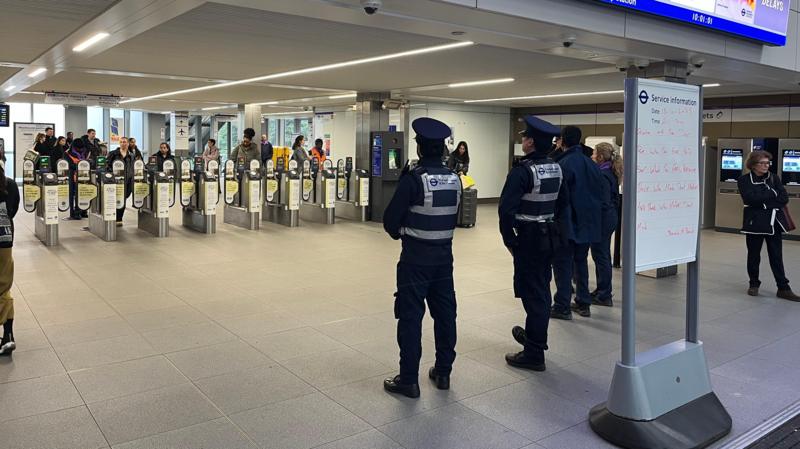
The commuter is visibly frustrated and begins to argue with the officials. We find ourselves in the concourse of the Ealing Broadway station on the Elizabeth line, an area notorious for fare evasion. The Transport for London (TfL) enforcement team has requested that he show his ticket after the barriers alerted them to his use of a child fare, which he does not appear to qualify for.
The dispute escalates as the passenger stubbornly claims that the barrier machine has swallowed his ticket, explaining his inability to present it. In a somewhat humorous gesture, he empties his pockets, attempting to charm his way out of the predicament.
However, the humor fades as the reality of his situation sinks in.
Without warning, he darts out of the station. The officers call out to him and move to guide him away from the exit, yet their options are limited. They are not permitted to physically restrain him or make an arrest, adhering to a hands-off policy that prioritizes their own safety.
This scenario illustrates the challenges faced in combating fare evasion in London.
The officers have encountered a wide range of evasion tactics. They witness individuals vaulting over barriers or even crawling underneath them. There’s also a common tactic known as “double gating,” where an evader slips in behind another passenger passing through the gates.
Stationed at Ealing Broadway, these officers aim to curb fare evasion, a significant issue for TfL, costing approximately £190 million annually. Since the launch of the Elizabeth line, fare evasion has surged as more people are using the TfL network, especially since several stations along this line lack staffed barriers.
This loss accounts for 3.5% of overall fare revenue, with TfL setting a goal to reduce this to 1.5% by 2030, a target that is acknowledged to be quite ambitious.
Officer Nasir Ahmadi shared with BBC London, “Commonly, we hear excuses like, ‘It’s too expensive, I can’t afford it.’ They claim that ‘transport should be free,’ or mention forgetting their Oyster card or bank card at home.
“The reality is that everyone else is paying their fare, and they should too. It creates an unfair burden on law-abiding passengers who are paying while others cheat the system.”
Another revenue protection officer, Tomi Ogunsuyi, has also encountered his share of justifications: “Daily, we see individuals trying to push through barriers or even crawling under them.
“Our main focus is to prevent aggression and violence and support our front-line staff.”
“We often hear justifications like, ‘I don’t have any money,’ or ‘I wasn’t aware. Why can’t transport be free?’ While we hear many excuses, we handle them regularly, explaining why it’s important for everyone to pay for their trip.”
In a recent three-month period, TfL had nearly 10,000 fare evasion cases pending prosecution, encompassing both first-time and repeat offenders.
Since April, more than 30,000 fixed penalty notices have been issued, recently raised to £100, with over 9,000 individuals reported for potential prosecution.
TfL is also enhancing its on-board checks, claiming that its enforcement teams have performed over 2.8 million inspections on Tube and train services.
They leverage a mix of data analysis, travel patterns, and CCTV footage to identify habitual offenders.
Anand Nandha, TfL’s head of compliance, mentioned the recent hiring of a specialized team of investigators dedicated to tracking down repeat offenders.
While he refrained from revealing specifics about their tracking strategies, he expressed confidence that they would catch more individuals avoiding fares.
“This is certainly not a victimless crime,” he emphasized. “Passengers who pay their fare end up incurring higher costs because of the lost revenue on the network. Therefore, we need to ensure that this revenue supports public services and helps maintain low fare levels.
“We have up to 500 revenue inspectors deployed throughout the network, employing various detection methods.
“We’ve also brought on board a new team of investigators tasked with using diverse strategies to pursue habitual offenders, including covert operations.
“We’re exploring technological advancements, analyzing multiple data sources to understand fare evasion patterns, and evaluating network infrastructure to identify further measures to decrease fare evasion.”