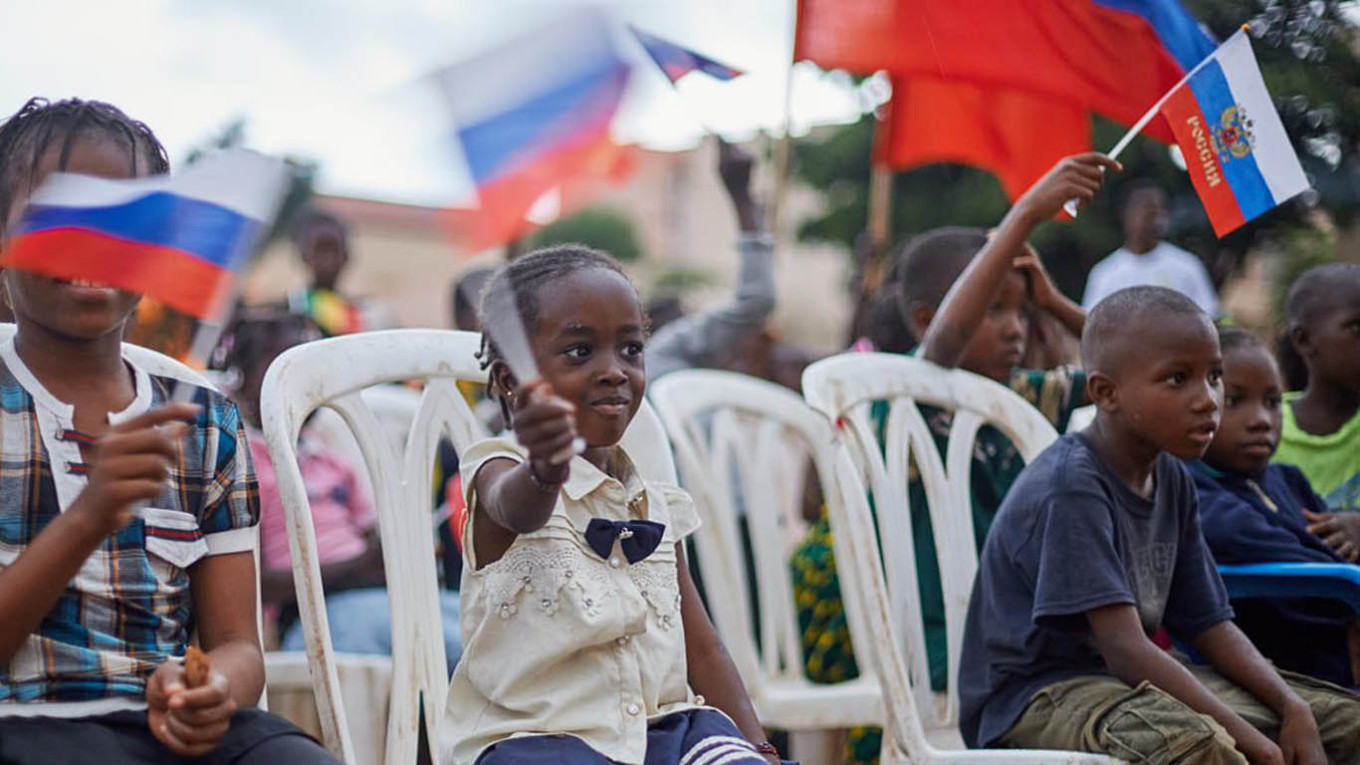
The room was filled with over 30 attendees, as the curtains were closed, chairs arranged, and a projector lowered. A video commenced, sharing a narrative that Moscow has echoed for years: the “reunification” of Crimea with Russia in 2014, the local support for this annexation, and the allure of the peninsula as a sought-after tourist location.
For many in attendance, the geopolitics surrounding Russia’s conflict with Ukraine seemed distant from their daily lives. However, at this local branch of the cultural agency known as Russian House in Mali’s capital, the primary focus was conveying the Kremlin’s perspective on the situation.
As Russia’s extensive invasion of Ukraine extends into its fourth year, Moscow is increasingly aiming to cultivate alliances and gain backing from nations outside the Western sphere.
Africa has become central to this initiative, with over a dozen so-called Russian Houses established in major cities in recent years, according to an analysis by The Moscow Times, which reviewed press releases, social media activity, and pro-Russian media.
These organizations serve as a pivotal component of Russia’s diplomatic and cultural outreach to non-Western nations, an endeavor that critics argue essentially disseminates pro-Russian propaganda.
Joseph Siegle, a senior research associate at the University of Maryland’s Center for International and Security Studies, explained to The Moscow Times that the recent rise in Russian Houses should be viewed in the context of Russia’s larger strategic objectives.
At the Russia-Africa Expo held in October, the leader of Rossotrudnichestvo, the cultural agency managing the program, announced plans to expand, noting that agreements for 14 new Russian Houses in various African nations had been made.
Evidence collected by The Moscow Times indicates that both official and “partner” Russian Houses are currently operational or set to open in at least 22 African nations. There was no response to inquiries from the U.S. embassies in these countries.
Many of these centers trace their origins back to cultural outreach initiatives from the Soviet era.
“They are often headquartered in the same buildings used during the Cold War,” commented Ivan Klyszcz, a research fellow at the International Center for Defense and Security in Tallinn, Estonia.
Typically, these venues were utilized to showcase national achievements—a goal that remains subtly influential in all of Russia’s public relations and diplomatic endeavors, especially in these establishments, Klyszcz added.
It is not surprising that some of the most prominent Russian Houses are located in large cities of historical allies such as Egypt and Tanzania.
The creation of a Russian cultural center can also signify strengthening relationships.
In recent years, there has been a surge in agreements with Sahel countries like Burkina Faso, Mali, and Chad, as well as with sub-Saharan nations such as Equatorial Guinea and the Central African Republic.
Yevgeniya Tikhonova, who leads the Russian House in Burkina Faso’s capital, Ouagadougou, told The Washington Post that the organization aims to demonstrate that Russians are not aggressors but rather come to assist and be welcoming. She asserted that the organization is funded privately.
Burkina Faso, like other Sahel nations, shifted its foreign policy course following a military coup that displaced the pro-France government in late 2022. Russia stepped in to fill the gap, offering humanitarian and military support.
In Equatorial Guinea, the announcement of a new partner Russian House being established in late 2024 came alongside reports of the Kremlin dispatching up to 200 military advisors to the nation, purportedly to train the presidential guard of Teodoro Obiang Nguema Mbasogo, the long-time authoritarian leader.
“Russia is not attempting to exert its influence through traditional statecraft such as increasing investments, trade, or conventional security cooperation,” Siegle remarked. “Instead, it is employing asymmetric strategies to elevate its global position.”
In this regard, he mentioned that Russia has indeed succeeded in gaining influence.
While Moscow works to attract allies through military and political avenues, experts highlighted to The Moscow Times that Russian Houses provide a different set of incentives.
The concept of a Russian House—a space for promoting a nation’s cultural presence internationally—has parallels in other nations. For instance, China has the Confucius Institute, the UK has the British Council, and Germany has the Goethe-Institut, each operating hundreds of centers worldwide.
In contrast, Russian Houses maintain a modest presence, with Rossotrudnichestvo claiming to govern 87 “foreign missions” across 71 countries.
While these cultural centers can aim to propagate a Russian perspective on current affairs, that may not be their only function.
The primary mission of Rossotrudnichestvo, as stated, is to enhance “Russia’s humanitarian influence globally.”
Publicly accessible information reveals that this is predominantly achieved through organizing language classes, hosting events centered on Russian literature and history, and supporting the arts.
The Russian House in Alexandria, Egypt, frequently features musical and theatrical performances.
In Tunisia, last year saw 400 local students participate in a science and robotics exhibition.
Chess tournaments are regularly organized at many of these centers.
However, perhaps the most attractive aspect of these cultural centers is the guidance they provide on studying in Russia—often accompanied by scholarship opportunities.
Recently, Yevgeny Primakov, the head of Rossotrudnichestvo, announced that the government would fund over 5,000 African students to attend universities in Russia.
According to Siegle, the prospect of educational opportunities is particularly compelling for locals seeking engagement with the organization.
“For Africa, where youth face significant limitations in educational opportunities, scholarships and access to education are greatly valued,” he remarked. “These initiatives have generally been received very positively across Africa.”
Nonetheless, some analysts have criticized the efforts to attract young Africans to Russia, arguing that such cultural and diplomatic outreach may inadvertently support job placements related to Russia’s military engagements.
Philani Mthembu, director of the Institute for Global Dialogue in Pretoria, South Africa, conveyed to The Moscow Times that people in the region find many factors appealing about Russia.
Some cherish their nations’ historical connections with the Soviet Union, which was seen as an ally in Africa’s decolonization efforts. Others respect what they perceive as Russia’s strength on the global stage and its continued relevance due, in part, to the full-scale invasion of Ukraine.
For Mthembu, the surprise regarding Russia’s ability to forge new relationships highlights misconceptions among Western officials about how to engage with African counterparts.
In a recent exchange, Mthembu recounted a European Parliament member questioning: “‘Why would anyone be interested in Russia? It’s a dictatorship and lacks a sophisticated economy,’” among other remarks.
Mthembu countered that this perspective reflects a significant “blind spot.”
“To assume that [Russia] would hold no appeal to individuals from a continent where nations often lack full sovereignty over their territories, where citizens demand a more prominent role from the state because they feel its absence…”
He left his thought unresolved.
“In other parts of the globe,” he concluded, “the dynamics are quite different.”