Massive Russian Air Assault Ignites Chaos as Ukrainian Drone Strike Claims Life in Rostov | World | london-news-net.preview-domain.com

Massive Russian Air Assault Ignites Chaos as Ukrainian Drone Strike Claims Life in Rostov

Massive Russian Air Assault Ignites Chaos as Ukrainian Drone Strike Claims Life in Rostov

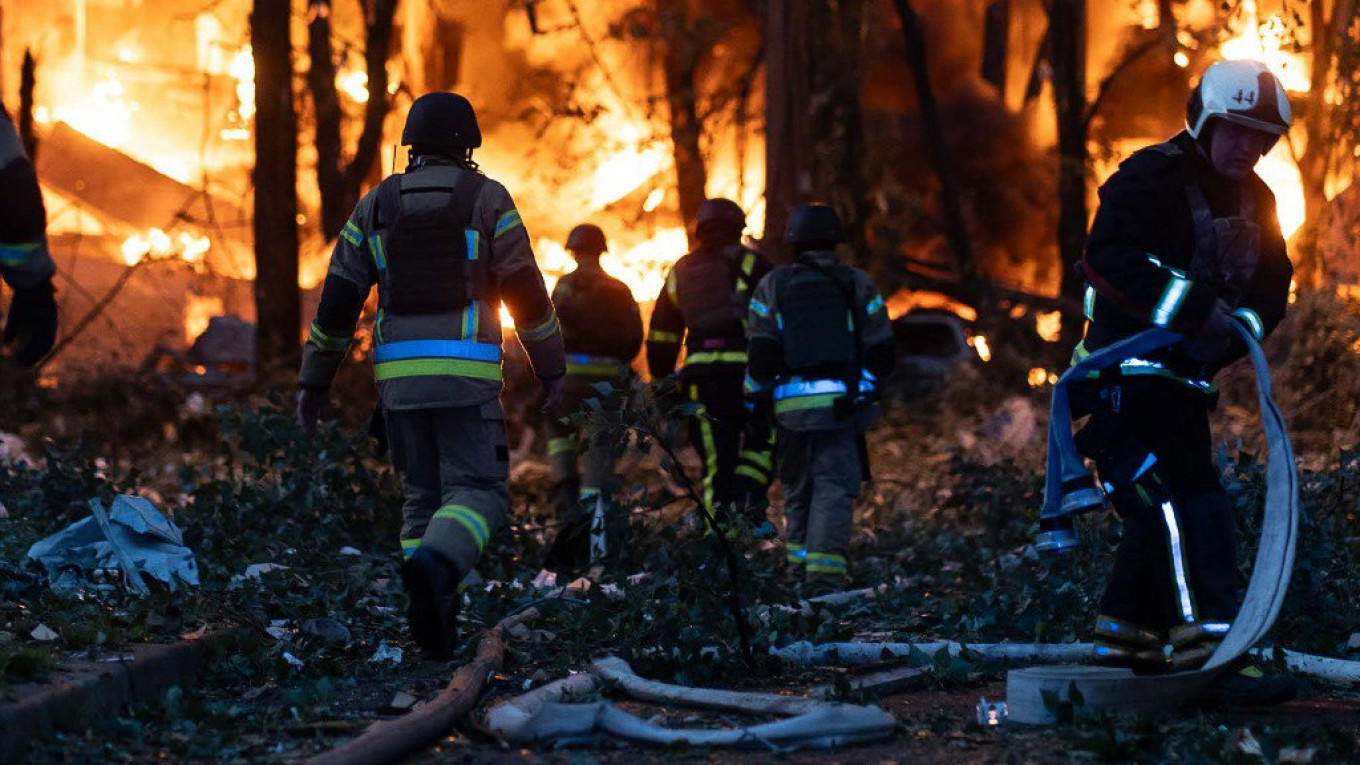
Authorities in Kyiv reported that Russia conducted its most extensive aerial assault of the conflict late Thursday night, leading to the death of an elderly woman in Russia and leaving tens of thousands without power due to Ukrainian drone attacks on southern and central regions.

A drone impacted a two-story apartment building in the village of Dolotinka within the Rostov region, resulting in the death of a retired school teacher, according to acting Governor Yury Slyusar’s post on Telegram.

In the nearby town of Shakhty, another attack caused power outages for 2,000 homes, but no injuries were reported, Slyusar stated.

In the Moscow region, Governor Andrei Vorobyov reported that four drones crashed in the Sergiyev Posad area, injuring two individuals and causing damage to a power substation.

Sergiyev Posad authorities indicated that 42,000 residents experienced power outages. The regional utility company Rosseti Moscow Region later announced that power had been partially restored.

The Russian Defense Ministry claimed its air defenses shot down 48 Ukrainian drones across five regions overnight, stating that 26 drones were intercepted over the Rostov region, but no downings occurred in the Moscow area.

Civil aviation authorities temporarily halted flights in Volgograd, Samara, Saratov, Yaroslavl, Kazan, and Nizhnekamsk as a safety measure.

Meanwhile, Ukraine characterized Russia’s overnight aerial offensive as its largest since the full-scale invasion commenced. Yuriy Ihnat, a spokesperson for the Ukrainian Air Force, noted that Russia deployed a total of 550 drones and missiles in one nighttime onslaught.

In Kyiv, Russian strikes injured at least 23 individuals and caused damage to railways, which led to delays of up to two hours for passenger trains, as reported by Mayor Vitali Klitschko and Ukraine’s national railway entity.

Ukrainian President Volodymyr Zelensky remarked that the strikes served as “evidence that without substantial pressure, Russia will not alter its reckless, destructive actions.”

“For every attack on individuals and human lives, they must face corresponding sanctions and other impacts on their economy, revenues, and infrastructure,” Zelensky posted on X.

The Russian Defense Ministry subsequently characterized the overnight air strike against Ukraine as a “precision” retaliation for what it termed “the terrorist actions of the Kyiv regime.”

These attacks on both sides occurred shortly after a phone conversation between Russian President Vladimir Putin and U.S. President Donald Trump, where Trump stated he “didn’t make any progress” in his efforts to end the war in Ukraine during their hour-long dialogue.

Since assuming office in January, Trump has aimed to mediate a peaceful resolution between Kyiv and Moscow, facilitating the first direct peace negotiations between the opposing sides since the early days of the full-scale invasion.

However, despite agreeing on multiple prisoner exchanges, Ukraine and Russia have yet to agree on a temporary ceasefire, which the White House has been advocating for over recent months.

Last week, Putin stated that Moscow and Kyiv are far from a peace agreement, describing the peace demands from both countries as “completely contradictory.”

Reporting by AFP contributed to this article.

Related posts

Putin Expresses Willingness to Rebuild European Ties Amid Ongoing Tensions

rimmaruslan98@gmail.com

Vologda Governor Calls for Cooperation with Billionaire Mordashov to Resolve Tensions Over Investments

Russian Ruble Dips After EU Unveils New Sanctions on Energy and Banks Текст: The Russian ruble tumbled sharply on Wednesday, erasing part of its recent gains as investors reacted to fresh concerns over Western sanctions and weakening oil export revenues. The dollar surged nearly 3% in a few hours on the Moscow Exchange, climbing from 78.2 rubles in early trading to 80.49 by 1:45 p.m. local time. The euro jumped above 91 rubles, while the Chinese yuan rose almost 2% to 11.04 rubles. By late afternoon, the ruble had regained some ground, with the dollar retreating to 79.65 and the euro to 91.39. The ruble has been one of the world’s best-performing currencies in 2025, gaining roughly 40% since January. But analysts say the sharp pullback may signal a turning point. Its decline on Wednesday “may be tied to discussions in the EU about a new package of sanctions targeting Russian financial institutions and energy exports,” said Natalia Milchakova, a senior analyst at Freedom Finance Global. A proposed 18th round of EU sanctionsintroducedby the European Commission on Tuesday includes plans to disconnect 22 more Russian banks from the SWIFT global payment system, blacklist dozens of tankers involved in circumventing oil trade restrictions and ban transactions with the Nord Stream gas pipelines. The measures would also lower the price cap on Russian crude exports from $60 to $45 per barrel. Under the cap mechanism, oil sold above the limit would be ineligible for Western insurance and transport services — a move aimed at squeezing revenue from Russian energy exports. Experts warn that these measures, if adopted by the United States and G7 allies, could deliver the most serious blow to Russian oil exports since the European embargo imposed in late 2022. Sanctions have already sidelined much of the Kremlin’s “shadow fleet,” and if the price cap is lowered, Greek shipping firms — which have been instrumental in transporting Russian oil — may exit the market altogether, the Moscow-based Institute for Energy and Finance said. As a result, a noticeable reduction in seaborne oil exports from Russia is likely … and the Russian budget may face an even greater reduction in oil revenues in the second half of this year, the IEF wrote. The ruble is also under seasonal pressure, as exporters appear to have slowed their conversion of foreign currency earnings ahead of the Russia Day holiday weekend, Reuters reported. At the same time, Yevgeny Kogan, a Russian investment banker, said demand for foreign currency may have risen ahead of the long weekend. Adding to the pressure is a decline in oil revenues, which remain the backbone of Russia’s export economy. The average price of Urals crude fell to $52 per barrel in May compared to $66 in January, according to the Economic Development Ministry. That figure represents the lowest level in more than two years. Some analysts believe the ruble’s current weakness may be a harbinger of a more prolonged decline. Kogan predicted the currency could continue to weaken in June and July. Sofya Donets, chief economist at T-Investments,saidpressures could intensify into August, potentially pushing the exchange rate beyond 90 rubles to the dollar. The government-linked Center for Macroeconomic Analysis and Short-Term Forecastingwarnedthat the ruble could experience an “overshoot” in the opposite direction, reversing its earlier gains with a potentially steep depreciation. “The more overvalued the ruble is now,” the group said, “the more vulnerable it is to a sharp correction.”


This website uses cookies to improve your experience. We'll assume you're ok with this, but you can opt-out if you wish. Accept Read More