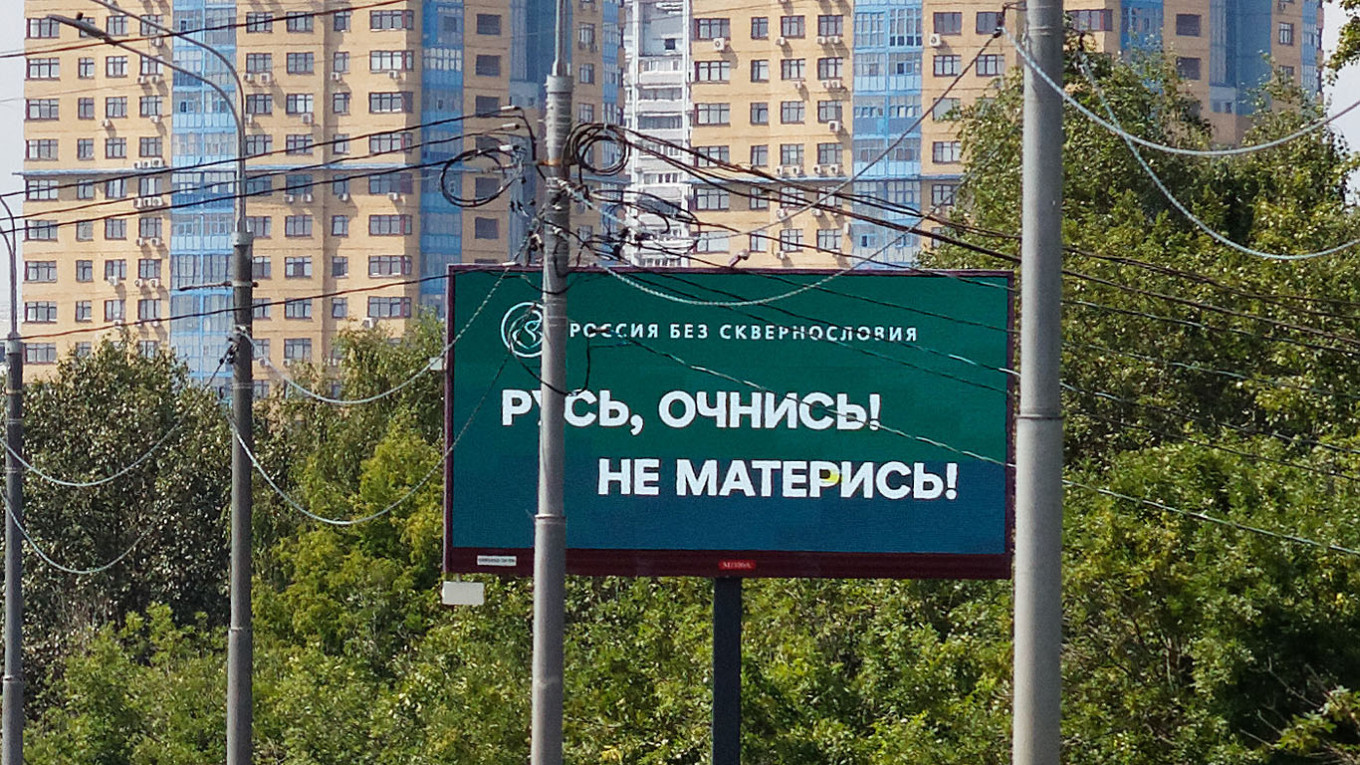
Linguists from the Russian Academy of Sciences are advocating for the protection of swear words following a call from the head of the Russian Orthodox Church for lawmakers in the State Duma to tackle what he views as a rise in the use of vulgar language in society.
“There’s no doubt that the frequency of cursing has increased,” stated Vladimir Pakhomov, a researcher at the V.V. Vinogradov Institute of Russian Language within the Academy, in comments to the state-run news outlet RIA Novosti published on Monday.
“It may sound contradictory, but linguists are now proposing that swear words should be safeguarded and preserved,” Pakhomov explained. “We should aim to limit the usage of obscene language so that we don’t lose this distinctive category of words, which hold significant expressive power.”
Although he supported the recent request from Patriarch Kirill, the leader of the Russian Orthodox Church, to place restrictions on public swearing, Pakhomov emphasized the importance of “protecting and preserving” such language rather than attempting to eliminate it altogether.
He proposed that education on the appropriate context and timing for using curse words should be part of Russian language instruction.
On Friday, Patriarch Kirill addressed lawmakers in the State Duma, encouraging them to “develop a strategy” to reduce the rising acceptance of what he termed the “spiritual affliction of foul language” in Russia.
“Even though public profanity is classified as a minor offense under the law, it is becoming increasingly normalized in society,” he remarked.
According to Russian legislation, which leaves it to law enforcement and prosecutors to define what counts as obscene, public swearing can result in a fine or up to 15 days of detention.
“We must discover a way to diminish the popularity of swearing. This is a struggle for the hearts and minds of the people,” Patriarch Kirill asserted.
“If we could combat obscenity with the same vigor we apply to tackling alcoholism, it would… help break the cycle of a tradition that has tarnished and distorted Russian culture and negatively impacted human communication,” he told the lawmakers.