Hello and welcome to this week’s edition of Regions Calling, your source for updates on developments outside of Russia’s capital, brought to you by The Moscow Times.
Last week, President Vladimir Putin announced the establishment of two new holidays aimed at honoring Indigenous minority groups and the various languages spoken by the peoples of Russia.
In this edition, we delve into the Kremlin’s underlying motives behind these holidays and evaluate whether they will genuinely benefit the numerous Indigenous and marginalized communities residing in Russia.
Before that, let’s look at the recent news from the regions:
Mobile internet access has been restricted in certain areas of the central Ulyanovsk region for the duration of the conflict in Ukraine, marking the first official internet blackout in the country.
At least 20 regions in Russia, including Bryansk and Kursk near the Ukrainian border, are forming special military units composed entirely of reserve personnel to protect strategic infrastructure. In the republics of Bashkortostan and Tatarstan, these units will be responsible for countering drone attacks from Ukraine targeting local oil refineries and petrochemical facilities.
In Dagestan, a republic in the North Caucasus, five individuals lost their lives when a private helicopter crashed into a house near the Caspian Sea last week. Initial investigations indicate that pilot error caused the tragic incident.
Regional lawmakers in the Siberian republic of Buryatia passed a contentious law on Thursday that dismantles the two-tier system of local self-governance, despite pushback from some local officials. Meanwhile, residents in the nearby Irkutsk region are actively opposing a similar reform with petitions and video messages directed at Putin.
In Krasnodar, activists are campaigning to remove Mayor Yevgeny Naumov from office due to his support for constructing an Orthodox cathedral in a designated natural preserve.
Kremlin’s New Indigenous Holidays: Activists View Them as a ‘Distraction from Systemic Problems’
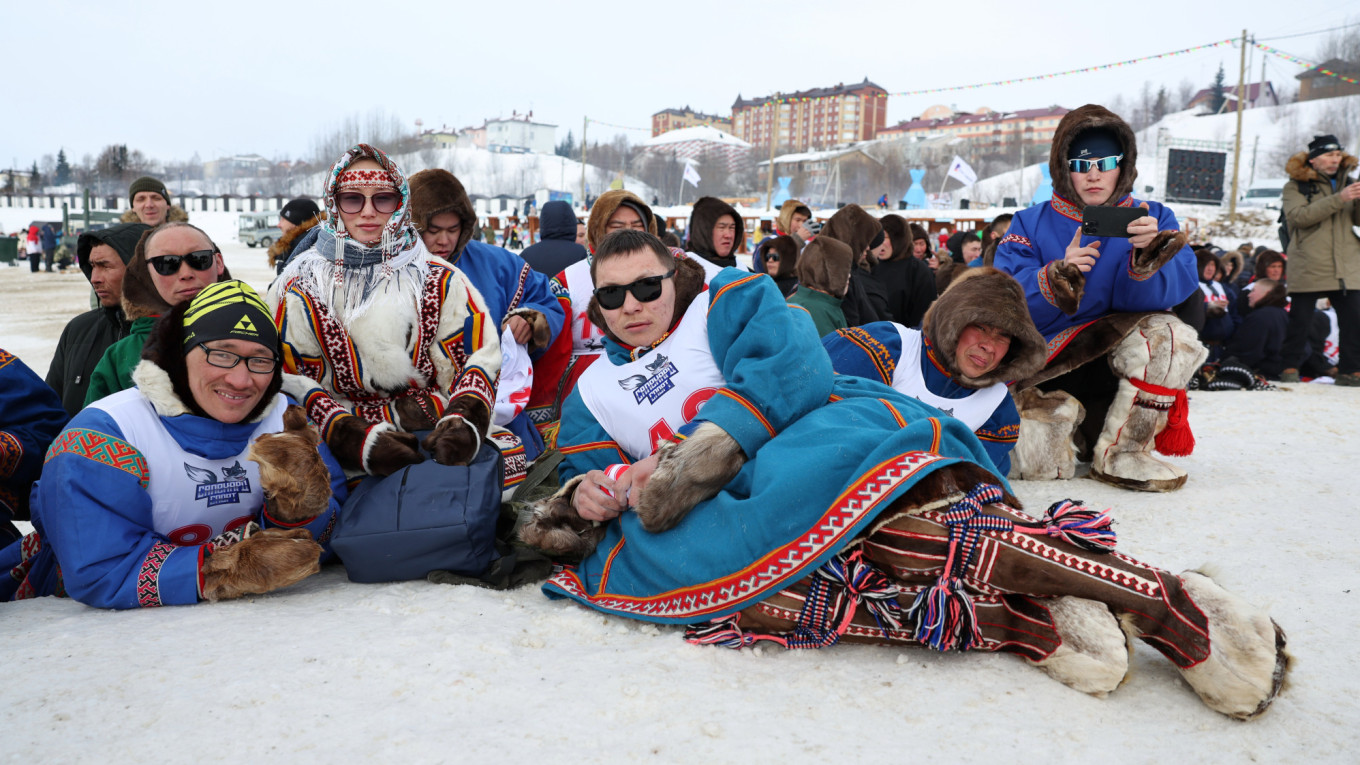
President Vladimir Putin signed decrees last week to create two new public holidays: the Day of the Languages of the Peoples of Russia and the Day of the Indigenous Minority Peoples of Russia.
The Kremlin states that these new holidays are part of its initiative to preserve Russia’s linguistic diversity and to promote the traditional lifestyles and unique cultures of the recognized Indigenous groups.
However, independent experts and activists representing Indigenous communities believe that these holidays serve as a façade to obscure ongoing efforts at russification and the erasure of Indigenous identities, particularly as independent movements gain traction.
“A mere symbolic act… diverts attention from deeper issues,” stated Khandama Tudebei, a language activist and Buryat teacher.
“With the backdrop of conflict, military recruitment, and demographic decline, it reinforces the propaganda narrative of ‘people’s unity’ while simultaneously restricting the political expression of language and cultural activists,” she explained to The Moscow Times.
Tudebei characterized the Kremlin’s decision to dedicate a day to honor the multitude of languages spoken in the country as “an illusion of concern” that does not compensate for the lack of Indigenous language classes and education in native tongues throughout Russia.
According to the Linguistics Institute of the Russian Academy of Science, Russia is home to 155 living languages and 15 that have gone extinct.
The last census in 2021 revealed that nearly all these languages are experiencing a rapid decline in the number of speakers.
“Preserving languages demands systematic support: training teachers, developing textbooks, producing films and multimedia content, as well as supporting independent media projects in these languages, rather than simply adding new ‘holidays’ to the calendar,” Tudebei remarked, pointing out that current government initiatives for minority languages have often been superficial and unhelpful for learners and educators.
The newly established Day of the Languages of the Peoples of Russia will be annually celebrated on September 8, aligning with the birthday of the famed Soviet Avar poet Rasul Gamzatov.
“He regarded two languages as his own: Avar, in which he created his literary works, and Russian, which helped those works gain international recognition,” Putin commented on Gamzatov earlier this year.
The 1968 Russian translation of Gamzatov’s Avar poem “The Cranes” became one of the most celebrated Russian ballads about World War II. Although inspired by his visit to the Hiroshima Peace Memorial, the poem has now been co-opted to support Russia’s propaganda-infused annual commemorations of the Soviet victory in World War II.
“Connecting this holiday to Rasul Gamzatov’s birthday is an insult to all Avars and other Indigenous people of Dagestan,” said Avar activist Zarema Gasanova.
“It is yet another instance of Russia attempting to appropriate an external culture and poet, distorting the essence of his work,” she stated, noting that while Gamzatov’s works have been widely translated into Russian, Avar was the sole language in which he composed his poetry.
The Avar language, classified as a Northeast Caucasian language and an official language in Dagestan, is deemed “vulnerable” by UNESCO, having lost over 60,000 speakers between Russia’s last two censuses.
Global Isolation
Rather than observing the UNESCO-designated International Mother Language Day on February 21, Moscow also opted not to celebrate the UN’s World Indigenous Peoples Day on August 9.
Instead, Russia’s new Day of the Indigenous Minority Peoples will coincide with the adoption of the national law concerning Indigenous peoples’ rights on April 30, 1999.
“This decision aims to demonstrate to the international community and global actors involved with Indigenous issues that Russia has its own interpretation of Indigenous identity and is not interested in engaging within the international context,” said Dr. Ekaterina Zibrova, an associate researcher at The Wits Center for Diversity Studies in Johannesburg.
Russia is home to over 180 ethnic groups, most of whom have lived in their current territories long before and during periods of Russian colonization.
However, the overwhelming majority of these groups are denied recognition as Indigenous under Russian legislation. Only minority groups of fewer than 50,000 people residing in parts of the Far North, Siberia, and the Far East who “maintain a traditional lifestyle” are officially recognized as Indigenous by Russia.
Designating a holiday for communities that represent less than 1% of the total population “only reinforces Russia’s isolationist political stance” and “serves as a means of self-justification” for its distorted view of indigeneity, according to Zibrova.
Viktoria Maladaeva, a notable Buryat activist and founder of the Indigenous of Russia collective, cautioned that the holiday — along with associated government funding — “is likely to be misappropriated or used to generate more propaganda rather than provide real assistance to Indigenous peoples.”
Zibrova remarked that both holidays were introduced less than a year after Moscow classified numerous independent Indigenous organizations as “terrorist.” This action is seen as another attempt by Moscow to transform any public display of non-Russian ethnic identities into a matter of state security.
“I perceive these new holidays as part of an ongoing and quite successful initiative by Moscow to control the narrative surrounding Indigenous peoples,” Zibrova told The Moscow Times.
Similarly, Gasanova observed that the Kremlin’s decision is a response to the emergence of a variety of decolonial and Indigenous rights movements that have arisen since Russia’s invasion of Ukraine.
“Establishing symbolic holidays like these is a counter-strategy aimed at undermining the efforts of Indigenous activists,” she stated to The Moscow Times.
Buryat language advocate Tudebei echoed this sentiment.
“This is a reaction to the increasing national consciousness and self-organization among Indigenous peoples, who are progressively asserting their claims to language, territory, and resources,” she noted.
On Friday, dozens gathered in the small village of Ust-Kan in the republic of Altai to commemorate the anniversary of the October Revolution of 1917.
Supported by local Communist Party members, the gathering was a rare sanctioned demonstration in the southern Siberian republic, which has experienced widespread arrests of activists following mass protests against an unpopular reform of self-government.
Last week, a local court sentenced lawyer Dmitry Todoshev, a leading opponent of the reform, to 12 days in jail for allegedly disobeying police orders.
Additionally, on Sunday, the pre-trial detention of prominent activist Aruna Arna was extended until January 15, according to supporters. Arna, often referred to in media as the “leader of Altai protests,” was added to Russia’s registry of “terrorists and extremists” earlier this year.