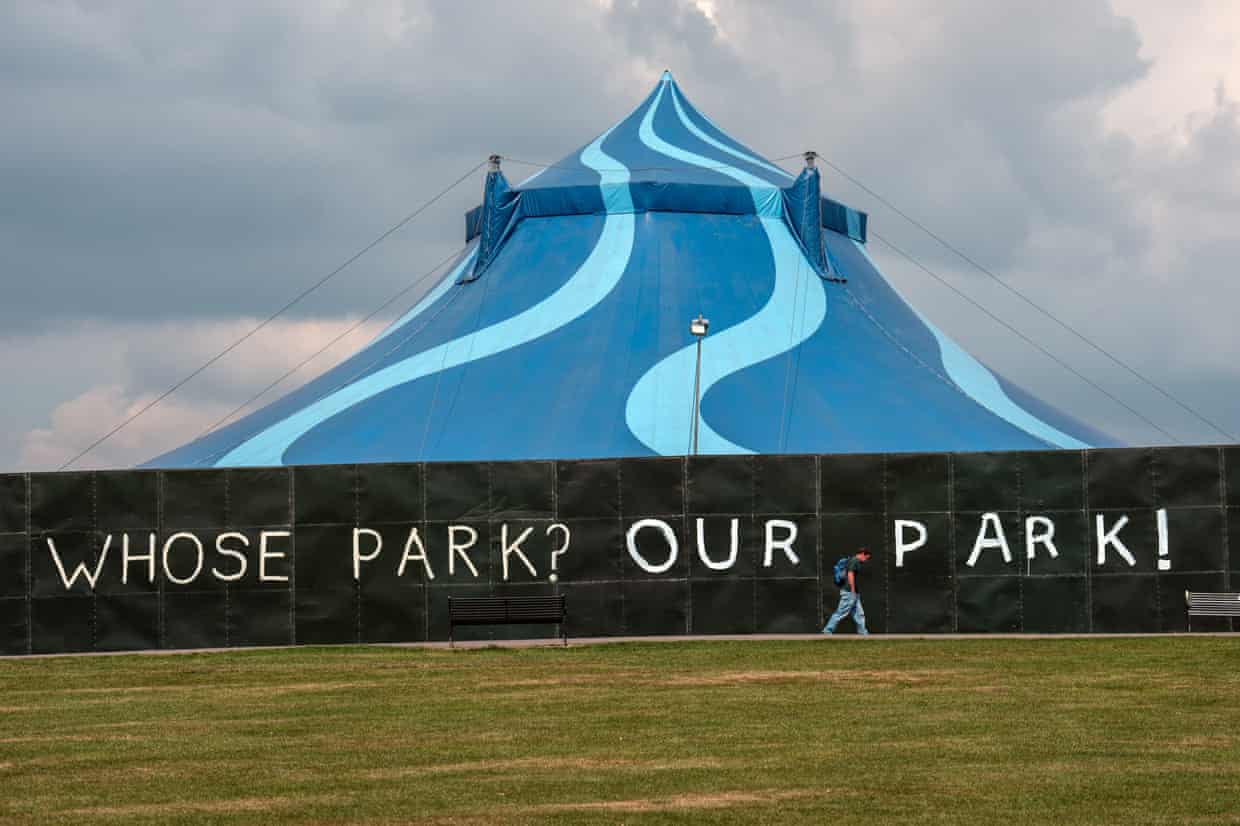
In south London, a tranquil green space turned battleground this week as tensions flared over Brockwell Park. Visitors to the park since Monday have encountered graffiti tags from both sides amidst a heated dispute. The center of the controversy? A robust 3-meter-high fence enclosing substantial areas of the 50-hectare (125-acre) park, slated for music festivals this summer. The fence bore messages echoing dissent: stark white graffiti declaring, “You messed with our park,” alongside a response, “We messed with your wall.”
Brockwell is now the focal point of a seasonal conflict that emerges in London each summer. Just a week prior, it dominated headlines following a significant high court decision against Lambeth council. This local authority faced a lawsuit from Protect Brockwell Park (PBP), a coalition of local citizens and park advocates who contended that the council had not secured the necessary planning permissions for the series of events set to occur behind the contentious fence.
The council had used permitted development regulations to expedite the approval of these events, claiming they would only restrict park access for 28 days. However, residents argued this was misleading; accounting for the setup and dismantling of festival infrastructure, access would be limited for approximately 37 days. The court found that the council should have subjected these events to a comprehensive planning process that includes public input. The judge ruled in favor of PBP.
Nevertheless, the festivals remained scheduled. As the date approached for the first event—Wide Awake, an alternative music festival featuring the rapper Kneecap—Lambeth hastily approved a certificate of lawfulness with an opportunity for public feedback, and the festival commenced on Friday.
This clash has captured public interest, igniting a familiar narrative of local residents versus nightlife. Some are portraying PBP campaigners as out-of-touch “gentrifiers,” akin to affluent newcomers who advocate for shutting down a cherished local pub or an independent music venue because they prefer their tranquility by 10 PM. As a left-leaning millennial, I would typically be inclined to support the festivals, recognizing the need to safeguard our dwindling cultural landscape against encroachments.
However, the situation is far from straightforward. In recent years, many of the city’s parks have increasingly been made available for hire. The summer festival season has become a fixture in London, with a noticeable increase in commercial events concentrated in major parks like Victoria, Finsbury, and Brockwell.
Behind each seasonal festival series lurks a disgruntled community. Residents living near these green spaces feel excluded from public land that should serve everyone, favoring what they view as commercial gains. Many criticized events bear little resemblance to the accessible, community-oriented vibe of a neighborhood pub.
At the core of this issue lies the predicament of cash-strapped councils becoming overly reliant on commercial endeavors to the detriment of public access. A festival attracting 50,000 attendees can generate around £500,000 for local authorities. Councils assert that this revenue returns to the public, enabling them to fund free community events like Lambeth’s beloved Country Show, even though there is little transparency around the actual funds generated or their allocation.
In essence, this scenario reflects the privatization of local parks. Beyond ecological concerns, campaigners highlight that these developments often occur in boroughs where many residents lack access to private green spaces. In Lambeth, where a significant portion of the population lives in flats, approximately 60% of households fall into this category. Adding insult to injury, residents have limited opportunities for input. In contrast, Southwark’s council actively engages in public consultations for events proposed in their parks, allowing community voices to be heard.
While the claim that gentrifiers are stifling enjoyment seems misguided, the objectors are indeed local residents; the festivals act as outsiders, attracting tens of thousands of predominantly young attendees who come to revel for a day (with ticket prices starting around £80) before departing. Concerns regarding these events have shifted from being merely nimby sentiments to a broader grassroots movement, in response to the increasing duration and impact of park takeovers.
Nonetheless, it’s worth noting that festivals do provide benefits. They create stable summer job opportunities in a precarious employment landscape and help small businesses, such as food vendors catering to attendees. Their popularity speaks volumes—large corporations have acquired events like Field Day and Mighty Hoopla for good reason. Yet, the involvement of such corporations raises significant existential questions.
The primary concern revolves around how private interests have positioned themselves as the arbiters of cultural opportunities. The prevailing belief seems to be that cultural activities can only occur if public spaces are monetized, that local services depend on private funding, and that we should tolerate the ongoing privatization of taxpayer assets as a necessary trade-off for recreational enjoyment. Should we really accept this model as the norm?
While London may be the epicenter, what’s unfolding here could serve as a harbinger for cities across the UK in the years ahead. Few advocate for the complete abolition of festivals, yet a troubling precedent is being established. One long-standing Brixton resident and seasoned party organizer recently told me, “I’d support smaller, well-managed events that preserve access and protect the park, all while benefiting the borough. But the current scenario has become unbearable.”
Moya Lothian-McLean is the associate editor at Mill Media.