In February, athletes from across the globe will converge in northern Italy for the Winter Olympics, where ski jumping is anticipated to be one of the headline events.
Typically, British participation in this sport has been characterized by underdog stories, most notably exemplified by Eddie the Eagle.
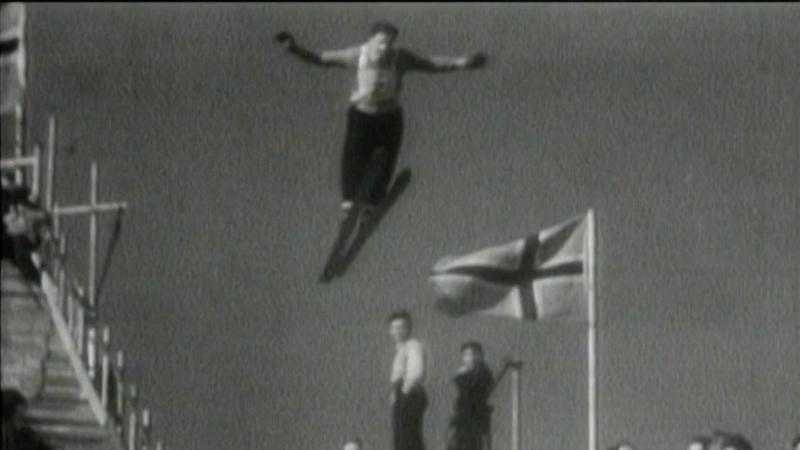
However, rewind to the early 1950s, and one would find ski jumpers gracefully gliding through the air over Hampstead Heath in London, attracting an audience of 100,000 locals eager to witness the spectacle.
The inaugural competition, collaboratively organized by the Ski Club of Great Britain and the Oslo Ski Association, occurred during the weekend of March 24-25, 1950.
Event planners erected an 18-meter (59-foot) high jump using scaffolding in the northern section of the heath.
As is true today, snow in London was hard to come by.
To tackle this challenge, 45 tons of snow had to be transported from Norway, securely packed in wooden crates and insulated with dry ice, then moved to the heath via refrigerated barges and trucks.
Norwegian skiers traveled to the UK to participate and brought the snow along with them.
Ingrid Christophersen, a former British alpine skier who grew up in Norway, recalls her father’s trip to the UK as he provided commentary for the Hampstead Heath event.
She reflected on how challenging the post-war years were for the Norwegian people.
“It astonishes me that Norway had not just the funds but also the resources to send massive amounts of snow and a group of ski jumpers to London,” she noted.
“Norway was in dire straits. With 400,000 soldiers occupying the nation for five years, the country was depleted—there were no goods in stores and nowhere suitable to live.”
A 10-centimeter layer of snow was tightly packed over a foundation of straw, but there wasn’t enough to cover the entire jump.
Thus, a narrow strip could only be created down the center of the ramp.
According to Ms. Christophersen, although the jump was relatively modest in size, this made it particularly perilous.
“What concerns me when I view the footage is the extremely narrow landing area, which made it difficult to land safely, not to mention the surrounding scaffolding.
“Had there been any wind and the jumpers drifted left or right, it could have led to a disaster.”
On the day of the competition, around 100,000 fans flocked to the heath, causing traffic congestion and overwhelming the Hampstead Tube station.
Despite an unusually warm March, with steam rising from the melting snow, the event was a triumph.
The highlight was the London Challenge Cup, won by 23-year-old Norwegian Arne Hoel, who achieved a jump of 28 meters (91 feet 10 inches).
He was among Norway’s most accomplished jumpers of that period, having secured victories in the prestigious Holmenkollen Ski Festival in Oslo in 1948, 1951, and 1959.
“At that time, Arne Hoel was a national hero in Norway,” Ms. Christophersen remarked.
The event returned in 1951, featuring a slope that was 6 meters (19 feet 8 inches) taller than before and an additional 15 tons of snow.
Unfortunately, this year marked the wettest beginning to the year in 80 years, resulting in heavy rains that turned the snow into slush.
Nonetheless, staying true to British resilience, the organizers pressed on despite the unfavorable weather, and Hoel successfully defended his title with a jump of 35.5 meters (116 feet 6 inches).
This would be the last instance of ski jumping at Hampstead Heath, but not the last for either Britain or London.
In April 1951, the Norwegians hosted another exhibition in Edinburgh, and in 1960, two Norwegian students at the University of Manchester coordinated their event.
The sport made its return to London in 1961 with a landmark contest at Wembley Stadium, the largest skiing event held on British soil (or snow) up to that point.
Led by Eastbourne MP Sir Charles Taylor, a towering scaffolding jump of 46 meters (150 feet 11 inches) was constructed, utilizing 50 tons of artificial snow for the International Ski Jumping Contest.
Forty of the best ski jumpers from Europe participated, with proceeds benefiting the Ski Club of Great Britain.
Surprisingly, this event took place at the beginning of summer, specifically on May 31 and June 1, 1961.
Finland’s Veikko Kankkonen emerged victorious and would later clinch Olympic gold in 1964.
A British contingent was also present at Wembley, with Alex Sykes achieving the longest jump among his peers at 27.4 meters (90 feet).
Since then, Eddie the Eagle has become the face of British ski jumping, overshadowing both Hampstead Heath and Wembley Stadium.
Nevertheless, there’s hope that Norway might consider exchanging its customary Christmas tree gift for another ski jumping event in London next year, potentially revitalizing the UK’s status as a legitimate ski jumping destination.