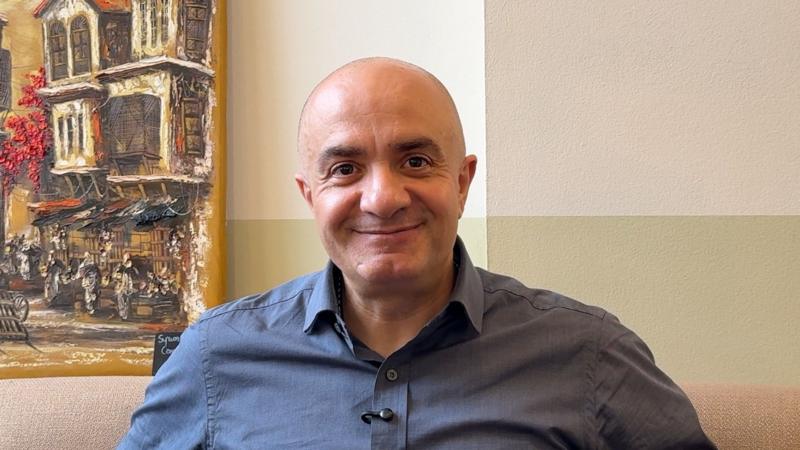
When chef Imad Alarnab escaped from Syria to London in 2015, he was convinced he would never set foot back in his homeland.
“When I departed from Damascus, I was certain that I had made the Assad regime’s blacklist. I had no intention of returning, as doing so would likely result in my death or abduction,” he recalled.
However, just last month, Mr. Alarnab traveled back to Syria for the first time after Bashar al-Assad was ousted by opposition forces last December.
“I fled Syria like a fugitive, but returned as a hero. The list of names that once threatened me is now a badge of honor,” he expressed.
Bashar al-Assad had governed Syria since 2000, succeeding his father Hafez, who seized power in 1971.
The Syrian civil war ignited in 2011, fueled by Assad’s ruthless crackdown on pro-democracy demonstrations during the Arab Spring.
“In 2013, Damascus was dominated by Assad’s presence. His images filled the city, and his forces were omnipresent. It was quite terrifying,” Mr. Alarnab recounted.
“Carrying a camera was riskier than wielding a gun because they feared free expression far more than violence.”
While Assad’s grip on power seemed unshakeable, a swift offensive by the Hayat Tahrir al-Sham (HTS) opposition group brought his regime down in a matter of days.
“I was apprehensive about returning to find the same old Damascus, but it wasn’t. In fact, it was even better than I had imagined,” Mr. Alarnab said with relief.
“It’s a city striving to rebuild itself with a refreshed identity—one of freedom, rejuvenation, and a new government that, crucially, is devoid of dictatorship.”
From 1999 to 2013, Mr. Alarnab operated restaurants in Damascus until Assad’s forces obliterated them within a week.
Fearing for his safety, he journeyed across Europe to establish a new life in London, initially working as a car salesman before returning to the culinary scene with a pop-up restaurant.
He now owns two establishments in central London, one in Kingly Court in Soho and another at Somerset House, expressing equal pride in his British and Syrian identities.
“Damascus is the city where I was born, and the love I have for it resembles that a person has for their mother—the old city, my first love.
“I will always be my mother’s son, just as I will always be a son of Damascus.
“But London is my sweetheart. I rebuilt my existence there; it welcomed me with open arms.”
During his visit to Damascus, Mr. Alarnab paid his respects at the Cathedral of St. George, England’s patron saint, who is believed to have had Syrian ancestry through his mother.
“I may never achieve the status of England’s saint like St. George, but I will forever be London’s beloved,” Mr. Alarnab remarked.
“Refugees are often perceived as a burden, but that’s not the case. We arrived from Syria with love, just like St. George.”
Dr. Ammar Azzouz pursued his architecture studies in Homs until 2011, when he relocated to the UK to further his education.
He currently serves as a lecturer and research fellow in geography at the University of Oxford, with a focus on architecture and conflict.
“Syria still bleeds; the wounds remain fresh,” he noted, highlighting the recent violence that has affected communities such as the Alawites and Druze.
“Yet, we must envision a different tomorrow—one rooted in justice, freedom, dignity, and democracy for all Syrians.”
In March, Dr. Azzouz returned to Syria for the first time in 14 years, marking the first of three visits planned for this year.
“Death was pervasive in Homs. In every building on my street, there is a tale of someone who has disappeared or faced torture.
“I remember encountering a graveyard filled with numbered graves—no names. It felt as if Homs had become a realm of death.”
The United Nations estimates that over 580,000 individuals have perished during the Syrian civil war, with 13 million displaced.
Since 2011, Dr. Azzouz had seen his parents only sporadically and was unable to invite them to the UK for his graduation.
“Seeing them again was absolutely heartbreaking. They exist in an extremely challenging situation.
“The healthcare system has disintegrated, leading to a struggle for medicine and adequate treatment.
“You can witness the war’s toll in the people’s bodies, their expressions, their homes—and I doubt it will ever leave them.”
Dr. Azzouz stated that the Assad regime had “instilled an enforced silence and erased public expressions of grief.”
“While some seek to move forward and embrace a new future, we cannot do so without recognizing what transpired.
“We have a duty to document the atrocities of war, not just as a monument to sorrow but as a foundation for a hopeful future.”
He emphasized the necessity for Syrians to spearhead the reconstruction of their nation.
“There is enthusiasm for renovation, but numerous international firms are hurriedly seeking their share of the reconstruction profits, viewing it merely as an investment opportunity.
“My homeland and my suffering are not commodities.”