Cultural Wave: The Chinese Influence Transforming Daily Life in Russia | World | london-news-net.preview-domain.com

Cultural Wave: The Chinese Influence Transforming Daily Life in Russia

Cultural Wave: The Chinese Influence Transforming Daily Life in Russia

During a recent meeting in Beijing, President Vladimir Putin praised the relationship between Russia and China, declaring it to be at an “unprecedented level.”

Beyond high-profile diplomatic engagements, the influence of China in daily Russian life is becoming ever more significant, permeating areas such as language, art, tourism, and consumer products.

One year ago, amidst enthusiastic applause at the National Grand Theatre in Beijing, Putin and Xi Jinping declared 2024-2025 as the Cultural Years of China and Russia, coordinating over 230 events in nearly 100 cities in both nations.

The State Tretyakov Gallery in Moscow is currently featuring works by contemporary Chinese artist Han Yuchen, who is recognized for his oil paintings, photography, and calligraphy.

This past April, the Shenzhen Opera and Dance Theatre performed “Wing Chun” at Moscow’s renowned Bolshoi Theatre, which reciprocated with a tour to Beijing and Shenzhen in May.

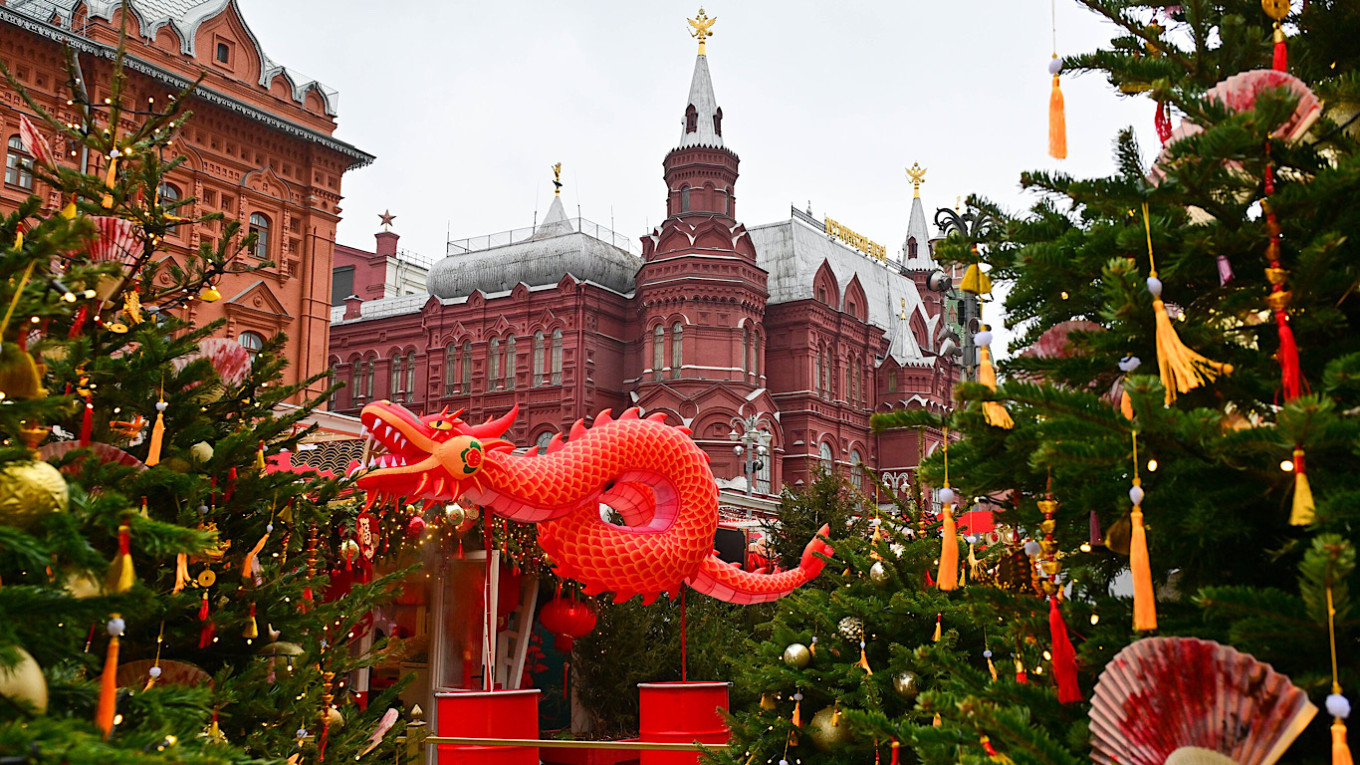
This year’s Chinese New Year celebrations at Manezhnaya Ploshchad in central Moscow drew such large crowds that attendees began lining up well before the gates opened.

Following the onset of Russia’s extensive military campaign in Ukraine in 2022, Western countries severed cultural ties with Moscow alongside imposing economic and political sanctions.

Russia’s pivot towards China was already in progress before this event. However, the Ukraine conflict—along with the consequent deterioration of Russia’s relations with the West—has made China’s influence in Russian society more visible than ever, as noted by Temur Umarov, a fellow at the Carnegie Russia Eurasia Center.

“Through this approach, Russia wishes to showcase its connections with the global community—not necessarily with the West, but with China,” he stated.

An increasing number of Russians are eager to learn Chinese, considering it a valuable asset for their careers, alongside English.

Chinese is now the second most popular foreign language among affluent Russians, only behind English. The number of schools in Moscow offering Chinese language classes has surged by 123%.

According to a survey by the job search website SuperJob, demand for professionals fluent in Chinese has increased by over 1.6 times from 2023 to 2024, with the transport and logistics sectors showing the highest demand.

“Chinese is indeed gaining popularity,” said a Russian woman who is studying the language, speaking under the condition of anonymity for her safety. “Initially, I was attracted to its distinctiveness, but I later realized its potential due to the growing interest in China and its market.”

Another learner mentioned that greater job opportunities motivated her to pursue the language.

“There are numerous positions available that require Chinese language skills, particularly in logistics and economics,” she remarked.

Currently, at least 80,000 individuals in Russia are engaged in learning Chinese.

Putin also announced that Russia and China will celebrate the Cross Years of Education in 2026-2027, with over 51,000 Chinese students currently studying in Russia and about 21,000 Russians enrolled in Chinese educational institutions.

Temur Umarov highlighted that while China’s visibility in everyday Russian life has increased, it could be perceived as somewhat “artificial.”

“As Russia’s relations with European and Western nations grew worse, China’s presence in Russia intensified,” Umarov shared with The Moscow Times.

Many Russians have been exposed to Chinese consumer culture for quite some time. The “Made in China” tag is prevalent on various products, ranging from smartphones to footwear, particularly since Western sanctions limited access to certain goods.

According to a poll by the independent Levada Center, 71% of Russian respondents reported having worn Chinese clothing, while 57% indicated they had worn Chinese shoes.

Tourism contributes another dimension. Although only about 6% of Russians have visited China—much lower than those who travel to Europe or the United States—this figure is considerably higher in Russia’s Far East, where close to half the population has crossed the border, according to Levada.

The impending introduction of a visa-free regime, which will allow Russians to travel within China for up to 30 days starting September 15, is anticipated to further boost tourism, shopping, and interpersonal interactions. Putin has assured that a similar arrangement for Chinese citizens will be implemented by Russia.

Levada Center surveys indicate that public perceptions of China have notably transformed over the past twenty years.

Currently, two-thirds of respondents regard China as a “major power,” a significant increase from just one-fifth two decades ago.

Levada noted that Russians’ views of China were largely shaped during Russia’s tensions with the West surrounding Ukraine in the mid-2010s. In 2014, the year Russia annexed Crimea and supported eastern Ukrainian separatists, the percentage of Russians viewing China as a friendly country doubled from 20% to 40%.

A similar increase occurred following the full-scale invasion of Ukraine, with 65% of respondents now considering China a friendly nation and favorable views reaching a record high of 92%.

According to Levada, some view the current Russo-Chinese relationship as one-sided, with China benefiting more, casting Russia as a “raw materials appendage” and market for Chinese products.

Nonetheless, when directly asked if they perceive China as a threat to Russia, only 20% of respondents agreed, while the overwhelming majority—72%—disagreed.

Umarov remarked that changes in survey responses can be attributed not just to actual geopolitical circumstances but also to their portrayal in the media.

“At present, China is seen as an ally,” he explained to The Moscow Times. “Thus, survey results tend to reflect a favorable attitude toward China—these responses are primarily shaped by what is communicated to the public through official channels.”

Related posts

Polands Jets Respond to Russian Drone Incursion, Prompting NATO Article 4 Invocation

rimmaruslan98@gmail.com

Zelensky Urges Allies for Stronger Air Defense Amid Renewed Russian Attacks

rimmaruslan98@gmail.com

‘Plush Troops’: The Pro-War Children’s Toys Taking Over Russia’s Online Marketplaces Текст: “In this strategy game, you lead a battalion aiming to liberate Ukraine from Nazi rule,” reads the description of Russia’s first board game about the war in Ukraine. The game,called“Special Operation on the Outskirts,” sells for about 1,600 rubles ($20) on Russian online marketplaces. Inspired by Monopoly and designed for two to six players, the game challenges participants to occupy as many Ukrainian cities as possible. Instead of Monopoly money, players use a fictional currency featuring the faces of President Vladimir Putin, Foreign Minister Sergei Lavrov and former General Sergei Surovikin. In the fourth year of the full-scale invasion, toys and merchandise featuring the pro-war Z symbol have become increasingly common on Russian marketplaces and social media. Listings include everything from car dashboard decorations to toy soldiers for children. “The plot grabs you from the first minutes. It’s great that part of the proceeds go to support participants of the special military operation. The perfect gift for patriots!”writesYekaterina, a recent buyer. Other reviewers share that they gave the game to their sons on Defenders of the Fatherland Day. Another board game, “Couch Expert,” promises to educate players about the invasion. Players have 30 seconds to answer questions about the progress of the “special operation.” Questions range from the late ultranationalist politician Vladimir Zhirinovsky’s position on the war to the roles of figures like Elon Musk and propagandist Olga Skabeyeva in shaping сoverage of the invasion. “I ordered 11 of them for school as gifts for the boys. But I got lucky — the boxes came wrapped in film, so it’s not embarrassing to give them. Thanks,”writesa woman named Natalia in a review. These toys span all price ranges, from an acrylic Z-minionto aroly-polytoy bearing the pro-war slogan “You can’t knock us down.” The latter sells for about 500 rubles ($6). “The idea to create a patriotic roly-poly toy came five years ago, when the Russian team was banned from competing under the national flag at the Olympics in Korea,”saysDmitry Zavidov, director of the Kotovsky Roly-Polies company. On VKontakte, Yulia from Moscowsells“knitted fighters” shaped like a tiger, mouse or dog. Each animal, stitched with a Z or V,costs1,500 rubles ($18). For an extra 250 rubles, Yulia offers to embroider a soldier’s callsign on the toy’s flak vest. “Any other inscription of your choice is also possible (price depends on the size),”readsthe product description. On some marketplaces, similar toys arepricedat around 1,100 rubles ($14). Another item on the market is a stuffedraccoonmarked with the Z symbol, a reference to the raccoon that Russian troops infamously stole from a zoo during their retreat from the southern Ukrainian city of Kherson. Sellers alsoofferstuffed bears in military uniforms with Z and V insignia. In some cases, the toys arehandmadeby widows of Russian soldiers. For younger children, “patriotic”coloring bookssell for about 300 rubles ($3.73). “My child is four. He liked it,” says one mother in a review. Some parents post videos of their children coloring tanks and other Russian military equipment. For about the same price, sellers alsooffera set of toy soldiers called the “Special Operation Recon Soldiers Set.” “Toy figures of the Russian Armed Forces will delight children with their quality and design. They’re perfect for role-playing games and help develop creativity and imagination,” the manufacturer claims. War-related games and toys may hold particular appeal for children,explainspsychologist Michael Brandl, a member of the German toy evaluation group Spiel Gut. One reason for their appeal, he says, is that they offer positive reinforcement of the media and propaganda messaging that children encounter daily. “From these sources, children form an image of a person they then try to imitate and act out in roleplay. Weapons and how to use them become part of the child’s perceived reality and a key attribute of the supposed image of the ‘ideal’ man,” Brandlwrote. A child psychologist from Russia, whose name has been withheld for safety reasons, voiced a similar view. “This is a protracted war, so the state and Vladimir Putin need boys, even from kindergarten, to already be preparing for the future battlefield,” the psychologist told The Moscow Times. “First, the state turns poor women into mothers who buy these toy soldiers. Then this Z-patriotism is nurtured with a mother’s milk. They’ll buy it without even noticing the Z, especially if it’s on sale.” Marketplaces also offer stuffed cat car decorations in camouflage colors that cost about 500 rubles ($6.20). In addition to a toy with the Russian tricolor and the letter Z, the manufacturer alsooffersa version bearing the Wagner mercenary group’s skull emblem. “You sent me a female cat, apparently — no male features and no Z. I specifically needed a male cat with a Z on it! I refused the order at pickup,”complainsa buyer named Elena. Other buyers note that the toy’s tail fell off quickly. Even toy robots are marked with the Z symbol. A set of these toys costing 784 rubles ($9.70) includes a robot with a Russian flag and weapons. For an extra 200 rubles, itcomeswith a glow-in-the-dark Z. “Satisfied with the purchase. Russia will win! Russia always wins!”saysMaria, who bought the Z-robot for her son, in her review.


This website uses cookies to improve your experience. We'll assume you're ok with this, but you can opt-out if you wish. Accept Read More