On Saturday, Ukraine and four European leaders urged Russia to agree to a 30-day unconditional ceasefire beginning Monday, warning of coordinated sanctions from the West if Moscow does not comply.
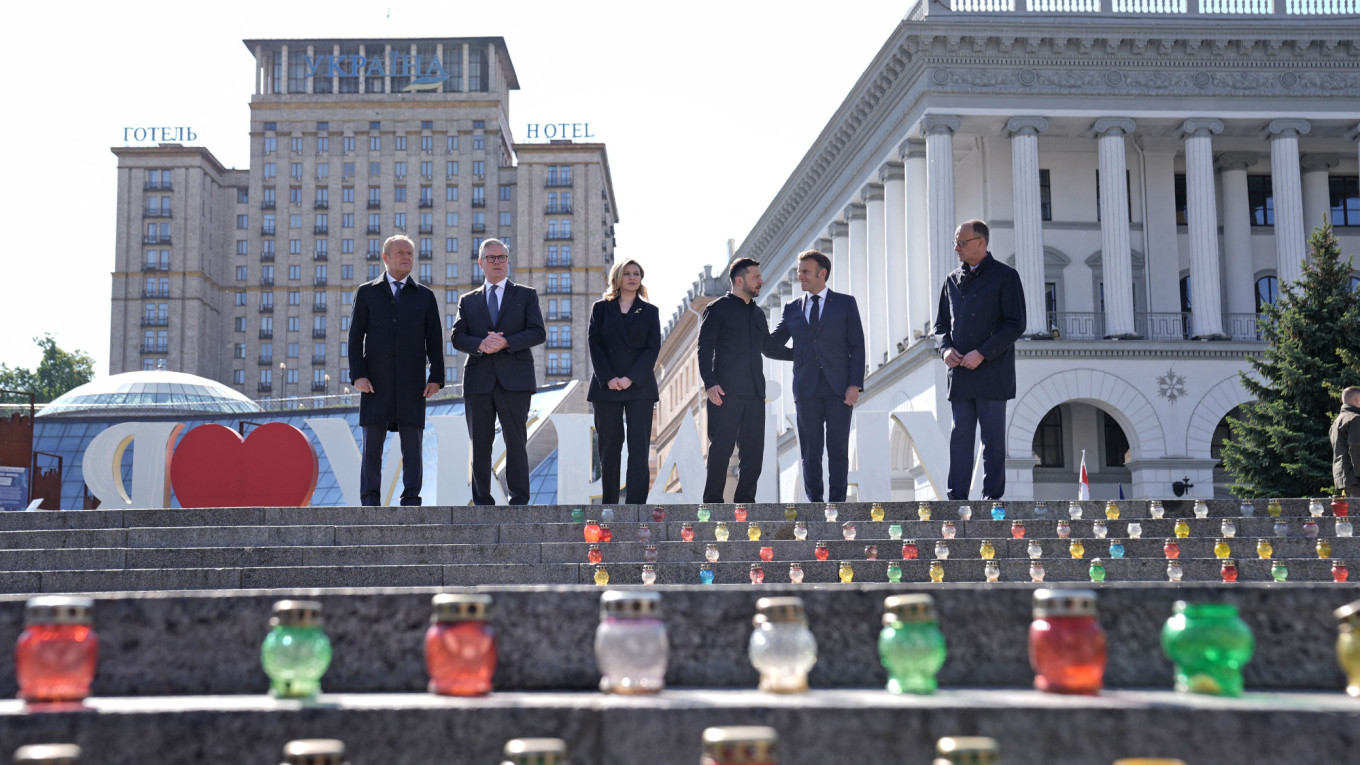
This ultimatum came following discussions in Kyiv, attended by President Volodymyr Zelensky along with the leaders of Britain, France, Germany, and Poland.
They indicated that the United States and various other nations support this proposal.
A spokesperson for the Kremlin responded to CNN that Moscow would “consider” the proposal but emphasized that there are “many questions” surrounding it and reiterated that Russia is “unreceptive to any form of pressure.”
President Vladimir Putin did not provide an immediate response.
This rare trip marked the first occasion when the leaders of these four European countries visited Ukraine together.
“We have just decided to support a ceasefire that will take effect next Monday, without any preconditions,” stated French President Emmanuel Macron at a press conference.
Kremlin spokesperson Dmitry Peskov noted that Russia is “unreceptive to any kind of pressure” shortly after the European leaders in Kyiv called for an unconditional 30-day ceasefire in Ukraine. “Europe is confronting us quite openly,” he remarked. “We can feel it and are fully aware…”
Leaders from around 20 other member countries of the “coalition of the willing” supporting Ukraine held a videoconference with Macron, German Chancellor Friedrich Merz, British Prime Minister Keir Starmer, Polish Prime Minister Donald Tusk, and Zelensky.
Macron stated, “If this ceasefire is violated, we have collectively agreed to prepare and coordinate extensive sanctions between Europeans and Americans.”
For weeks, both the U.S. and Ukraine have been advocating a similar proposal, which Russia has rejected.
Former U.S. President Donald Trump had previously threatened to withdraw from discussions due to the lack of progress in resolving the conflict. During his election campaign, he pledged to end the war within a day of taking office.
Kyiv and its allies had been concerned that Trump was shifting towards aligning with Moscow’s stance, amid conflicts with Zelensky. However, he has recently shown increasing frustration with Putin.
“The outcome we have reached today showcases absolute unity among many countries worldwide, including the United States, in advocating for this 30-day unconditional ceasefire,” Starmer declared.
The five leaders in Kyiv had a “productive” conversation with Trump to update him on the conference, according to Ukrainian Foreign Minister Andrii Sybiha.
“For the first time in a long while, we felt that the entire free world is genuinely united,” remarked Poland’s Tusk.
“We understand the real challenge lies ahead for both us and Putin. We will be awaiting Russia’s response.”
European Commission President Ursula von der Leyen also expressed her support for the truce, insisting it must be enacted without any conditions to facilitate meaningful peace negotiations.
Macron indicated that the ceasefire would be monitored mainly by the United States, but added that “Europeans will also play a role.” He emphasized that a truce would allow for “immediate discussions and negotiations among involved parties to establish a robust and lasting peace.”
This visit marked Macron’s first trip to Kyiv since June 2022, when he accompanied the leaders of Italy and Germany.
Later, the European leaders were seen embracing Zelensky and lighting lanterns at a memorial for fallen soldiers in Kyiv.
For Merz, who just assumed the chancellorship this week, it was his inaugural visit to Ukraine.
This significant display of European unity came a day after Putin adopted a defiant stance during a military parade in Moscow celebrating 80 years since the victory in World War II.
He announced a unilateral three-day ceasefire from Thursday through Saturday. However, a Ukrainian brigade operating in the east reported to AFP that the intensity of fighting had remained “essentially unchanged.”
Serhiy, head of an evacuation unit in the eastern Donetsk region, noted that the number of injuries remained “the same as before the ceasefire.”
Viktor, a driver for an evacuation ambulance in the Donetsk area, reported ongoing fighting, though he noted a reduction in artillery and missile activity.
He expressed skepticism about whether Russia would adhere to a 30-day ceasefire, stating, “They are not a country one can trust.”