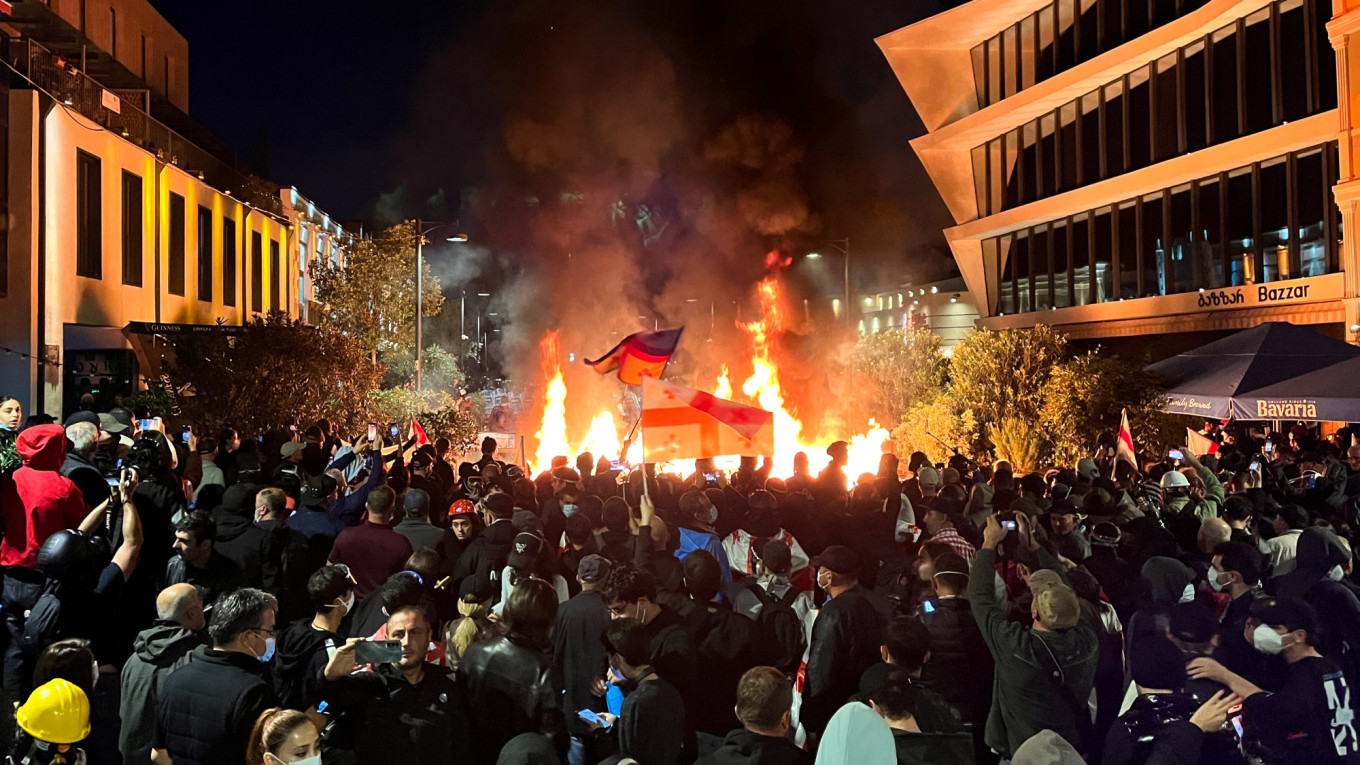
The ruling party of Georgia secured victory in local elections held on Saturday, as police responded with tear gas and water cannons against anti-government demonstrators attempting to breach the presidential palace. Tens of thousands rallied in support of the opposition’s call to uphold democracy.
These elections marked the first test for the ruling populist party, Georgian Dream, following a controversial parliamentary election last year that threw the Black Sea nation into chaos and led Brussels to effectively pause its EU membership application.
With nearly 75% of precincts reporting, the Central Election Commission announced that Georgian Dream had attained majorities in municipal councils across all localities, garnering over 80% of the votes.
Candidates from the ruling party achieved significant victories in mayoral contests throughout the cities, according to the commission’s reports.
Prior to the protests, the authorities vowed to take stern action against what they labeled as “revolutionary” efforts.
Waving flags of Georgia and the EU, tens of thousands of protesters gathered in Tbilisi’s Freedom Square for an event organizers referred to as a “national assembly,” as noted by an AFP reporter.
Typically seen as unremarkable, these local elections took on heightened importance following months of crackdowns on independent media, curbs on civil society, and the imprisonment of numerous opposition members and activists.
Renowned opera singer and activist Paata Burchuladze participated in the demonstration at Freedom Square, where he received a warm reception while declaring that “power returns to the people” and denouncing the government as “illegitimate.”
Following this, demonstrators marched towards the presidential palace and attempted to enter the premises, prompting the police to deploy tear gas and water cannon. Protesters set up and ignited barricades.
The crowd dispersed shortly after midnight.
“Every individual involved in these violent actions will face prosecution,” Prime Minister Irakli Kobakhidze informed the press.
He claimed the government had thwarted a coup attempt allegedly orchestrated by foreign intelligence agencies, though without providing specifics.
Kobakhidze accused EU representatives of supporting a “plot to overthrow the constitutional order” and called on the bloc’s ambassador to denounce the unrest, asserting shared accountability.
The Interior Ministry announced the initiation of an investigation into “calls for violent alteration of Georgia’s constitutional order or the overthrow of state authority,” leading to the arrest of five protest leaders, including Burchuladze.
Pro-opposition Pirveli TV reported that the 70-year-old world-famous operatic bass, who was hospitalized due to a heart issue, was detained in a Tbilisi ICU.
The five individuals apprehended face potential prison sentences of up to nine years, according to Deputy Interior Minister Alexandre Darakvelidze.
Imprisoned reform-minded ex-president Mikheil Saakashvili urged his supporters to protest on election day, describing it as the “last chance” to preserve democracy in Georgia.
He warned that inaction would lead to “more arrests and the rest being forced into exile,” resulting in widespread despair and the West abandoning support for the nation.
“Anyone concerned about the fate of Georgia should be here,” stated 77-year-old protester Natela Gvakharia to AFP. “We are here to defend our democracy, which is being eroded by Georgian Dream.”
Human rights organizations report that approximately 60 individuals, including key opposition leaders, journalists, and activists, have been imprisoned over the past year.
Amnesty International noted that the elections were occurring “in the context of severe political reprisals against opposition figures and civil society.”
Georgian Dream has been in control since 2012 and is led by billionaire former Prime Minister Bidzina Ivanishvili, who cast his vote in Tbilisi surrounded by media.
Originally, Georgian Dream positioned itself as a liberal alternative to Saakashvili’s reformist faction. However, critics assert that since Russia’s full-scale invasion of Ukraine in 2022, the party has shifted closer to Moscow, adopting far-right policies and implementing measures reminiscent of the Kremlin aimed at suppressing independent media and NGOs.
The party claims it is ensuring “stability” for the nation of 4 million while alleging that a Western “deep state” is trying to pull Georgia into the conflict in Ukraine with the support of opposition parties.
Analysts indicate that the party’s straightforward narrative — suggesting that the opposition desires war while it seeks peace — finds resonance in rural areas and is bolstered by disinformation.
A recent poll by the Institute of Social Studies and Analysis indicated that Georgian Dream’s approval rating stands at around 36%, compared to 54% for opposition factions.
The European Union has previously sanctioned several officials from the Georgian Dream party due to earlier crackdowns on protesters, and it has warned that it might suspend Georgia’s visa-free access to the EU if the government does not enhance the rule of law and safeguard fundamental rights.