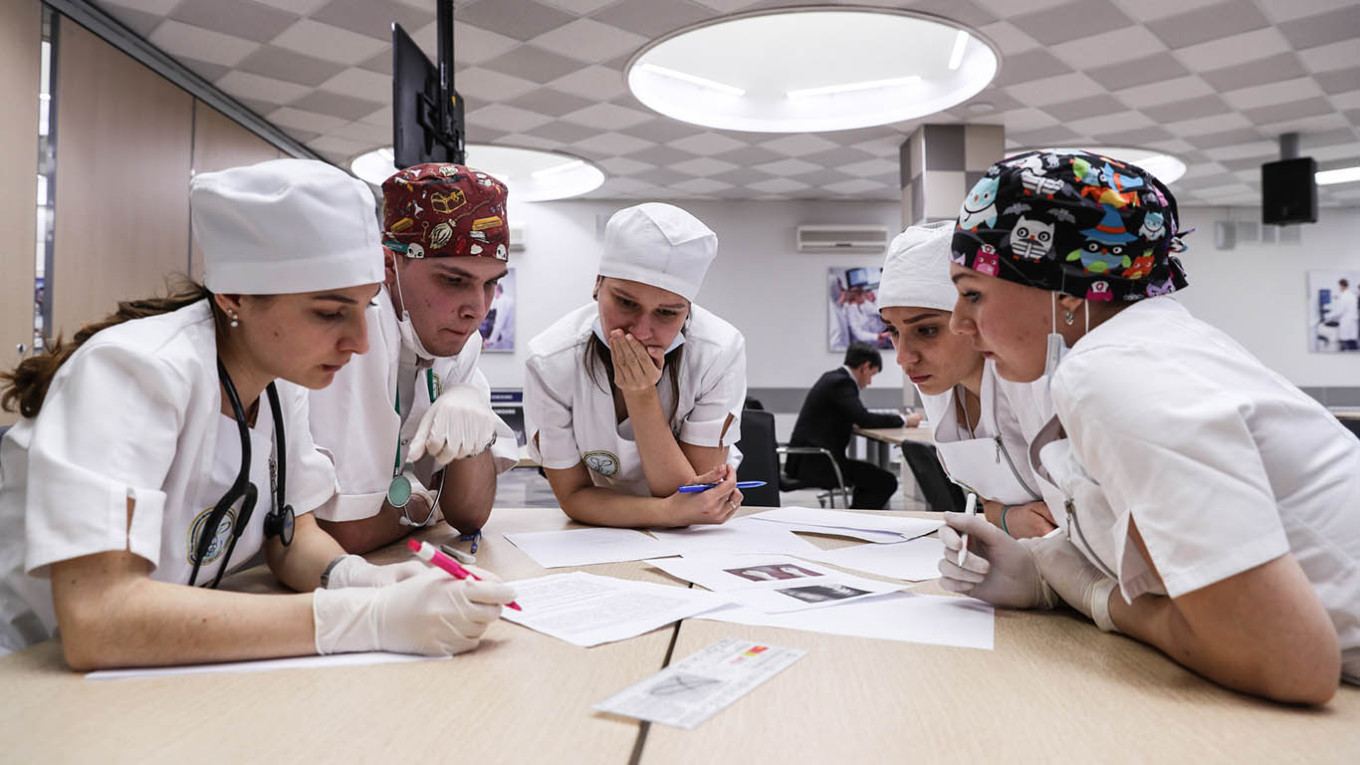
On Monday, President Vladimir Putin enacted a law mandating that students in state-sponsored residency programs at medical universities must complete a work placement at public healthcare facilities for a duration of up to three years. This initiative is designed to address the ongoing shortage of personnel within the country’s healthcare system.
The legislation, which partially reinstates a practice from the Soviet era, stipulates that students entering or currently participating in state-funded residency programs are required to undergo a period of “mentorship” at a state or municipal clinic that is part of Russia’s mandatory health insurance network.
Students who choose a government-supported residency position at a medical university or college must now sign a contract committing them to work at a designated healthcare facility, typically a regional clinic or hospital. If they opt out of this requirement, they may pursue their training on a fee-paid basis, contingent upon the availability of spots at their institution.
This law, which received unanimous approval in the State Duma last week after minor procedural adjustments, is set to take effect on March 1, 2026, impacting graduates from that year onward.
Vyacheslav Volodin, the speaker of the State Duma, mentioned last week that the overburdened staff in hospitals and the overwhelming number of patients beyond the recommended limits are straining Russia’s public health system, resulting in diminished quality of care. He referenced statistics indicating a shortfall of approximately 23,300 doctors and 63,600 mid-level healthcare workers anticipated by early 2025.
The work requirement legislation was approved unanimously by the lower house of parliament last Tuesday, according to independent journalist Farida Rustamova, who also noted that some lawmakers expressed concerns that these work obligations might deter young medical professionals from finishing their residencies, particularly if they were required to relocate to rural or remote regions without assurance of housing or other social support.
In the Soviet healthcare framework, newly graduated doctors were assigned to specific hospitals or clinics for a commitment period ranging from three to five years.
Correction: An earlier version of this article inaccurately suggested that the new law would impact all medical school graduates. It has been corrected to indicate that the legislation specifically affects students in state-funded residency programs.