‘Plush Troops’: The Pro-War Children’s Toys Taking Over Russia’s Online Marketplaces Текст: “In this strategy game, you lead a battalion aiming to liberate Ukraine from Nazi rule,” reads the description of Russia’s first board game about the war in Ukraine. The game,called“Special Operation on the Outskirts,” sells for about 1,600 rubles ($20) on Russian online marketplaces. Inspired by Monopoly and designed for two to six players, the game challenges participants to occupy as many Ukrainian cities as possible. Instead of Monopoly money, players use a fictional currency featuring the faces of President Vladimir Putin, Foreign Minister Sergei Lavrov and former General Sergei Surovikin. In the fourth year of the full-scale invasion, toys and merchandise featuring the pro-war Z symbol have become increasingly common on Russian marketplaces and social media. Listings include everything from car dashboard decorations to toy soldiers for children. “The plot grabs you from the first minutes. It’s great that part of the proceeds go to support participants of the special military operation. The perfect gift for patriots!”writesYekaterina, a recent buyer. Other reviewers share that they gave the game to their sons on Defenders of the Fatherland Day. Another board game, “Couch Expert,” promises to educate players about the invasion. Players have 30 seconds to answer questions about the progress of the “special operation.” Questions range from the late ultranationalist politician Vladimir Zhirinovsky’s position on the war to the roles of figures like Elon Musk and propagandist Olga Skabeyeva in shaping сoverage of the invasion. “I ordered 11 of them for school as gifts for the boys. But I got lucky — the boxes came wrapped in film, so it’s not embarrassing to give them. Thanks,”writesa woman named Natalia in a review. These toys span all price ranges, from an acrylic Z-minionto aroly-polytoy bearing the pro-war slogan “You can’t knock us down.” The latter sells for about 500 rubles ($6). “The idea to create a patriotic roly-poly toy came five years ago, when the Russian team was banned from competing under the national flag at the Olympics in Korea,”saysDmitry Zavidov, director of the Kotovsky Roly-Polies company. On VKontakte, Yulia from Moscowsells“knitted fighters” shaped like a tiger, mouse or dog. Each animal, stitched with a Z or V,costs1,500 rubles ($18). For an extra 250 rubles, Yulia offers to embroider a soldier’s callsign on the toy’s flak vest. “Any other inscription of your choice is also possible (price depends on the size),”readsthe product description. On some marketplaces, similar toys arepricedat around 1,100 rubles ($14). Another item on the market is a stuffedraccoonmarked with the Z symbol, a reference to the raccoon that Russian troops infamously stole from a zoo during their retreat from the southern Ukrainian city of Kherson. Sellers alsoofferstuffed bears in military uniforms with Z and V insignia. In some cases, the toys arehandmadeby widows of Russian soldiers. For younger children, “patriotic”coloring bookssell for about 300 rubles ($3.73). “My child is four. He liked it,” says one mother in a review. Some parents post videos of their children coloring tanks and other Russian military equipment. For about the same price, sellers alsooffera set of toy soldiers called the “Special Operation Recon Soldiers Set.” “Toy figures of the Russian Armed Forces will delight children with their quality and design. They’re perfect for role-playing games and help develop creativity and imagination,” the manufacturer claims. War-related games and toys may hold particular appeal for children,explainspsychologist Michael Brandl, a member of the German toy evaluation group Spiel Gut. One reason for their appeal, he says, is that they offer positive reinforcement of the media and propaganda messaging that children encounter daily. “From these sources, children form an image of a person they then try to imitate and act out in roleplay. Weapons and how to use them become part of the child’s perceived reality and a key attribute of the supposed image of the ‘ideal’ man,” Brandlwrote. A child psychologist from Russia, whose name has been withheld for safety reasons, voiced a similar view. “This is a protracted war, so the state and Vladimir Putin need boys, even from kindergarten, to already be preparing for the future battlefield,” the psychologist told The Moscow Times. “First, the state turns poor women into mothers who buy these toy soldiers. Then this Z-patriotism is nurtured with a mother’s milk. They’ll buy it without even noticing the Z, especially if it’s on sale.” Marketplaces also offer stuffed cat car decorations in camouflage colors that cost about 500 rubles ($6.20). In addition to a toy with the Russian tricolor and the letter Z, the manufacturer alsooffersa version bearing the Wagner mercenary group’s skull emblem. “You sent me a female cat, apparently — no male features and no Z. I specifically needed a male cat with a Z on it! I refused the order at pickup,”complainsa buyer named Elena. Other buyers note that the toy’s tail fell off quickly. Even toy robots are marked with the Z symbol. A set of these toys costing 784 rubles ($9.70) includes a robot with a Russian flag and weapons. For an extra 200 rubles, itcomeswith a glow-in-the-dark Z. “Satisfied with the purchase. Russia will win! Russia always wins!”saysMaria, who bought the Z-robot for her son, in her review. | World | london-news-net.preview-domain.com

‘Plush Troops’: The Pro-War Children’s Toys Taking Over Russia’s Online Marketplaces Текст: “In this strategy game, you lead a battalion aiming to liberate Ukraine from Nazi rule,” reads the description of Russia’s first board game about the war in Ukraine. The game,called“Special Operation on the Outskirts,” sells for about 1,600 rubles ($20) on Russian online marketplaces. Inspired by Monopoly and designed for two to six players, the game challenges participants to occupy as many Ukrainian cities as possible. Instead of Monopoly money, players use a fictional currency featuring the faces of President Vladimir Putin, Foreign Minister Sergei Lavrov and former General Sergei Surovikin. In the fourth year of the full-scale invasion, toys and merchandise featuring the pro-war Z symbol have become increasingly common on Russian marketplaces and social media. Listings include everything from car dashboard decorations to toy soldiers for children. “The plot grabs you from the first minutes. It’s great that part of the proceeds go to support participants of the special military operation. The perfect gift for patriots!”writesYekaterina, a recent buyer. Other reviewers share that they gave the game to their sons on Defenders of the Fatherland Day. Another board game, “Couch Expert,” promises to educate players about the invasion. Players have 30 seconds to answer questions about the progress of the “special operation.” Questions range from the late ultranationalist politician Vladimir Zhirinovsky’s position on the war to the roles of figures like Elon Musk and propagandist Olga Skabeyeva in shaping сoverage of the invasion. “I ordered 11 of them for school as gifts for the boys. But I got lucky — the boxes came wrapped in film, so it’s not embarrassing to give them. Thanks,”writesa woman named Natalia in a review. These toys span all price ranges, from an acrylic Z-minionto aroly-polytoy bearing the pro-war slogan “You can’t knock us down.” The latter sells for about 500 rubles ($6). “The idea to create a patriotic roly-poly toy came five years ago, when the Russian team was banned from competing under the national flag at the Olympics in Korea,”saysDmitry Zavidov, director of the Kotovsky Roly-Polies company. On VKontakte, Yulia from Moscowsells“knitted fighters” shaped like a tiger, mouse or dog. Each animal, stitched with a Z or V,costs1,500 rubles ($18). For an extra 250 rubles, Yulia offers to embroider a soldier’s callsign on the toy’s flak vest. “Any other inscription of your choice is also possible (price depends on the size),”readsthe product description. On some marketplaces, similar toys arepricedat around 1,100 rubles ($14). Another item on the market is a stuffedraccoonmarked with the Z symbol, a reference to the raccoon that Russian troops infamously stole from a zoo during their retreat from the southern Ukrainian city of Kherson. Sellers alsoofferstuffed bears in military uniforms with Z and V insignia. In some cases, the toys arehandmadeby widows of Russian soldiers. For younger children, “patriotic”coloring bookssell for about 300 rubles ($3.73). “My child is four. He liked it,” says one mother in a review. Some parents post videos of their children coloring tanks and other Russian military equipment. For about the same price, sellers alsooffera set of toy soldiers called the “Special Operation Recon Soldiers Set.” “Toy figures of the Russian Armed Forces will delight children with their quality and design. They’re perfect for role-playing games and help develop creativity and imagination,” the manufacturer claims. War-related games and toys may hold particular appeal for children,explainspsychologist Michael Brandl, a member of the German toy evaluation group Spiel Gut. One reason for their appeal, he says, is that they offer positive reinforcement of the media and propaganda messaging that children encounter daily. “From these sources, children form an image of a person they then try to imitate and act out in roleplay. Weapons and how to use them become part of the child’s perceived reality and a key attribute of the supposed image of the ‘ideal’ man,” Brandlwrote. A child psychologist from Russia, whose name has been withheld for safety reasons, voiced a similar view. “This is a protracted war, so the state and Vladimir Putin need boys, even from kindergarten, to already be preparing for the future battlefield,” the psychologist told The Moscow Times. “First, the state turns poor women into mothers who buy these toy soldiers. Then this Z-patriotism is nurtured with a mother’s milk. They’ll buy it without even noticing the Z, especially if it’s on sale.” Marketplaces also offer stuffed cat car decorations in camouflage colors that cost about 500 rubles ($6.20). In addition to a toy with the Russian tricolor and the letter Z, the manufacturer alsooffersa version bearing the Wagner mercenary group’s skull emblem. “You sent me a female cat, apparently — no male features and no Z. I specifically needed a male cat with a Z on it! I refused the order at pickup,”complainsa buyer named Elena. Other buyers note that the toy’s tail fell off quickly. Even toy robots are marked with the Z symbol. A set of these toys costing 784 rubles ($9.70) includes a robot with a Russian flag and weapons. For an extra 200 rubles, itcomeswith a glow-in-the-dark Z. “Satisfied with the purchase. Russia will win! Russia always wins!”saysMaria, who bought the Z-robot for her son, in her review.

‘Plush Troops’: The Pro-War Children’s Toys Taking Over Russia’s Online Marketplaces

Текст: “In this strategy game, you lead a battalion aiming to liberate Ukraine from Nazi rule,” reads the description of Russia’s first board game about the war in Ukraine.

The game,called“Special Operation on the Outskirts,” sells for about 1,600 rubles ($20) on Russian online marketplaces.

Inspired by Monopoly and designed for two to six players, the game challenges participants to occupy as many Ukrainian cities as possible. Instead of Monopoly money, players use a fictional currency featuring the faces of President Vladimir Putin, Foreign Minister Sergei Lavrov and former General Sergei Surovikin.

In the fourth year of the full-scale invasion, toys and merchandise featuring the pro-war Z symbol have become increasingly common on Russian marketplaces and social media.

Listings include everything from car dashboard decorations to toy soldiers for children.

“The plot grabs you from the first minutes. It’s great that part of the proceeds go to support participants of the special military operation. The perfect gift for patriots!”writesYekaterina, a recent buyer. Other reviewers share that they gave the game to their sons on Defenders of the Fatherland Day.

Another board game, “Couch Expert,” promises to educate players about the invasion.

Players have 30 seconds to answer questions about the progress of the “special operation.” Questions range from the late ultranationalist politician Vladimir Zhirinovsky’s position on the war to the roles of figures like Elon Musk and propagandist Olga Skabeyeva in shaping сoverage of the invasion.

“I ordered 11 of them for school as gifts for the boys. But I got lucky — the boxes came wrapped in film, so it’s not embarrassing to give them. Thanks,”writesa woman named Natalia in a review.

These toys span all price ranges, from an acrylic Z-minionto aroly-polytoy bearing the pro-war slogan “You can’t knock us down.” The latter sells for about 500 rubles ($6).

“The idea to create a patriotic roly-poly toy came five years ago, when the Russian team was banned from competing under the national flag at the Olympics in Korea,”saysDmitry Zavidov, director of the Kotovsky Roly-Polies company.

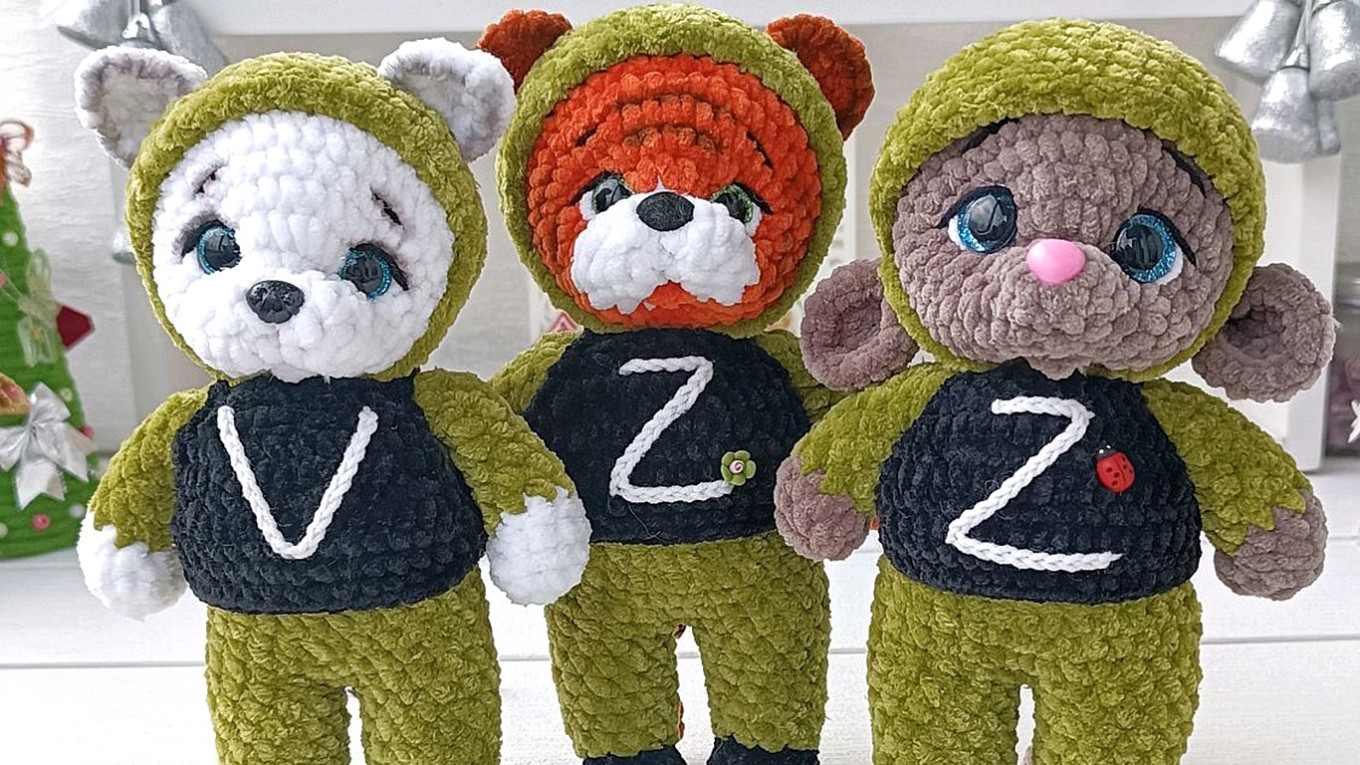
On VKontakte, Yulia from Moscowsells“knitted fighters” shaped like a tiger, mouse or dog. Each animal, stitched with a Z or V,costs1,500 rubles ($18). For an extra 250 rubles, Yulia offers to embroider a soldier’s callsign on the toy’s flak vest.

“Any other inscription of your choice is also possible (price depends on the size),”readsthe product description. On some marketplaces, similar toys arepricedat around 1,100 rubles ($14).

Another item on the market is a stuffedraccoonmarked with the Z symbol, a reference to the raccoon that Russian troops infamously stole from a zoo during their retreat from the southern Ukrainian city of Kherson.

Sellers alsoofferstuffed bears in military uniforms with Z and V insignia. In some cases, the toys arehandmadeby widows of Russian soldiers.

For younger children, “patriotic”coloring bookssell for about 300 rubles ($3.73).

“My child is four. He liked it,” says one mother in a review. Some parents post videos of their children coloring tanks and other Russian military equipment.

For about the same price, sellers alsooffera set of toy soldiers called the “Special Operation Recon Soldiers Set.”

“Toy figures of the Russian Armed Forces will delight children with their quality and design. They’re perfect for role-playing games and help develop creativity and imagination,” the manufacturer claims.

War-related games and toys may hold particular appeal for children,explainspsychologist Michael Brandl, a member of the German toy evaluation group Spiel Gut.

One reason for their appeal, he says, is that they offer positive reinforcement of the media and propaganda messaging that children encounter daily.

“From these sources, children form an image of a person they then try to imitate and act out in roleplay. Weapons and how to use them become part of the child’s perceived reality and a key attribute of the supposed image of the ‘ideal’ man,” Brandlwrote.

A child psychologist from Russia, whose name has been withheld for safety reasons, voiced a similar view.

“This is a protracted war, so the state and Vladimir Putin need boys, even from kindergarten, to already be preparing for the future battlefield,” the psychologist told The Moscow Times. “First, the state turns poor women into mothers who buy these toy soldiers. Then this Z-patriotism is nurtured with a mother’s milk. They’ll buy it without even noticing the Z, especially if it’s on sale.”

Marketplaces also offer stuffed cat car decorations in camouflage colors that cost about 500 rubles ($6.20). In addition to a toy with the Russian tricolor and the letter Z, the manufacturer alsooffersa version bearing the Wagner mercenary group’s skull emblem.

“You sent me a female cat, apparently — no male features and no Z. I specifically needed a male cat with a Z on it! I refused the order at pickup,”complainsa buyer named Elena. Other buyers note that the toy’s tail fell off quickly.

Even toy robots are marked with the Z symbol. A set of these toys costing 784 rubles ($9.70) includes a robot with a Russian flag and weapons. For an extra 200 rubles, itcomeswith a glow-in-the-dark Z.

“Satisfied with the purchase. Russia will win! Russia always wins!”saysMaria, who bought the Z-robot for her son, in her review.

“In this strategy game, you lead a battalion aiming to liberate Ukraine from Nazi rule,” reads the description of Russia’s first board game about the war in Ukraine.

The game,called“Special Operation on the Outskirts,” sells for about 1,600 rubles ($20) on Russian online marketplaces.

Inspired by Monopoly and designed for two to six players, the game challenges participants to occupy as many Ukrainian cities as possible. Instead of Monopoly money, players use a fictional currency featuring the faces of President Vladimir Putin, Foreign Minister Sergei Lavrov and former General Sergei Surovikin.

In the fourth year of the full-scale invasion, toys and merchandise featuring the pro-war Z symbol have become increasingly common on Russian marketplaces and social media.

Listings include everything from car dashboard decorations to toy soldiers for children.

“The plot grabs you from the first minutes. It’s great that part of the proceeds go to support participants of the special military operation. The perfect gift for patriots!”writesYekaterina, a recent buyer. Other reviewers share that they gave the game to their sons on Defenders of the Fatherland Day.

Another board game, “Couch Expert,” promises to educate players about the invasion.

Players have 30 seconds to answer questions about the progress of the “special operation.” Questions range from the late ultranationalist politician Vladimir Zhirinovsky’s position on the war to the roles of figures like Elon Musk and propagandist Olga Skabeyeva in shaping сoverage of the invasion.

“I ordered 11 of them for school as gifts for the boys. But I got lucky — the boxes came wrapped in film, so it’s not embarrassing to give them. Thanks,”writesa woman named Natalia in a review.

These toys span all price ranges, from an acrylic Z-minionto aroly-polytoy bearing the pro-war slogan “You can’t knock us down.” The latter sells for about 500 rubles ($6).

“The idea to create a patriotic roly-poly toy came five years ago, when the Russian team was banned from competing under the national flag at the Olympics in Korea,”saysDmitry Zavidov, director of the Kotovsky Roly-Polies company.

On VKontakte, Yulia from Moscowsells“knitted fighters” shaped like a tiger, mouse or dog. Each animal, stitched with a Z or V,costs1,500 rubles ($18). For an extra 250 rubles, Yulia offers to embroider a soldier’s callsign on the toy’s flak vest.

“Any other inscription of your choice is also possible (price depends on the size),”readsthe product description. On some marketplaces, similar toys arepricedat around 1,100 rubles ($14).

Another item on the market is a stuffedraccoonmarked with the Z symbol, a reference to the raccoon that Russian troops infamously stole from a zoo during their retreat from the southern Ukrainian city of Kherson.

Sellers alsoofferstuffed bears in military uniforms with Z and V insignia. In some cases, the toys arehandmadeby widows of Russian soldiers.

For younger children, “patriotic”coloring bookssell for about 300 rubles ($3.73).

“My child is four. He liked it,” says one mother in a review. Some parents post videos of their children coloring tanks and other Russian military equipment.

For about the same price, sellers alsooffera set of toy soldiers called the “Special Operation Recon Soldiers Set.”

“Toy figures of the Russian Armed Forces will delight children with their quality and design. They’re perfect for role-playing games and help develop creativity and imagination,” the manufacturer claims.

War-related games and toys may hold particular appeal for children,explainspsychologist Michael Brandl, a member of the German toy evaluation group Spiel Gut.

One reason for their appeal, he says, is that they offer positive reinforcement of the media and propaganda messaging that children encounter daily.

“From these sources, children form an image of a person they then try to imitate and act out in roleplay. Weapons and how to use them become part of the child’s perceived reality and a key attribute of the supposed image of the ‘ideal’ man,” Brandlwrote.

A child psychologist from Russia, whose name has been withheld for safety reasons, voiced a similar view.

“This is a protracted war, so the state and Vladimir Putin need boys, even from kindergarten, to already be preparing for the future battlefield,” the psychologist told The Moscow Times. “First, the state turns poor women into mothers who buy these toy soldiers. Then this Z-patriotism is nurtured with a mother’s milk. They’ll buy it without even noticing the Z, especially if it’s on sale.”

Marketplaces also offer stuffed cat car decorations in camouflage colors that cost about 500 rubles ($6.20). In addition to a toy with the Russian tricolor and the letter Z, the manufacturer alsooffersa version bearing the Wagner mercenary group’s skull emblem.

“You sent me a female cat, apparently — no male features and no Z. I specifically needed a male cat with a Z on it! I refused the order at pickup,”complainsa buyer named Elena. Other buyers note that the toy’s tail fell off quickly.

Even toy robots are marked with the Z symbol. A set of these toys costing 784 rubles ($9.70) includes a robot with a Russian flag and weapons. For an extra 200 rubles, itcomeswith a glow-in-the-dark Z.

“Satisfied with the purchase. Russia will win! Russia always wins!”saysMaria, who bought the Z-robot for her son, in her review.

Related posts

Woody Allen Brings Cinematic Legacy to Moscow International Film Week

Uzbekistan Urges Russia to Respect Its Citizens Amid Migrant Crackdown Текст: Uzbekistans Foreign Ministry on Wednesday urged Russia to treat its citizens with respect as authorities in Moscow tighten migration laws and carry out mass inspections targeting foreign workers Over the past year, Russia has introduced tighter migration rules, including new laws to locate and expel migrants more easily. The changes have sparked protests from several Central Asian countries, including Uzbekistan. Roughly 4 million migrants from the five former Soviet republics of Central Asia — Uzbekistan, Kyrgyzstan, Tajikistan, Kazakhstan and Turkmenistan — currently live in Russia, according to government data. Many work in low-wage sectors and send home remittances critical to their domestic economies. Uzbekistans Foreign Ministry said it had received reports of unauthorized inspections and cases of disrespectful and rude treatment of its citizens in Russia. It called on Moscow to treat Uzbek citizens with respect and to prevent actions that humiliate their honor and dignity, according to a statement published by state media. Tashkent also submitted a formal protest note to Russia requesting clarification about the reports. Russias Foreign Ministry said it was studying the note and described Uzbekistan as a strategic partner, the state-run news agency TASS reported. In recent months, Kyrgyzstan and Tajikistan have issued similar protests, denouncing mass detentions of their citizens in Russia. The crackdown follows the deadly 2024 terrorist attack at Crocus City Hall, which Russian officials blame on gunmen from Central Asia. Since then, Moscow has stepped up its efforts to police and repatriate foreign nationals. The war in Ukraine has further complicated matters for Central Asian migrants, with Russian authorities accused of pressuring some to enlist in the military. Russias Investigative Committee said last year that 10,000 foreign nationals with Russian citizenship had been sent to the front lines. Ukraines military estimates that around 3,000 Central Asians are fighting for Russia. Local media report that several dozen have been killed or imprisoned upon returning home. Despite a decline in migration, remittances remain vital to Central Asian economies. According to the World Bank, they account for 45% of GDP in Tajikistan, 24% in Kyrgyzstan and 14% in Uzbekistan.

ICC Faces Calls for Inquiry into Wagners Atrocities in Africa, Amid Alarming Legal Report


This website uses cookies to improve your experience. We'll assume you're ok with this, but you can opt-out if you wish. Accept Read More