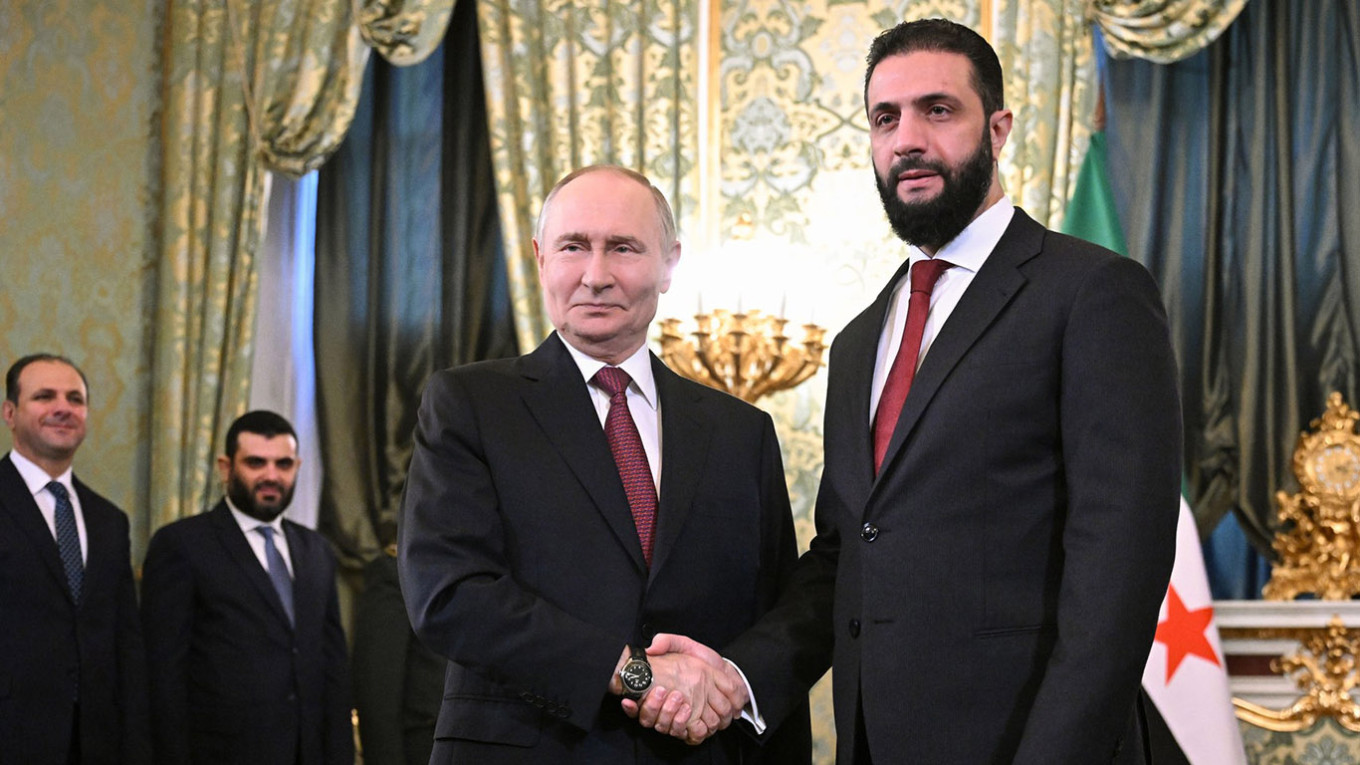
In 2017, amid Russia’s significant involvement in the Syrian Civil War, the Russian Defense Ministry erroneously reported that Syrian rebel leader Abu Mohammed al-Jolani had “lost” an arm due to a Russian airstrike.
Fast forward to October 2025, and the same leader — now known as Ahmed al-Sharaa and serving as the President of Syria — was seen shaking hands with President Vladimir Putin in the Kremlin, both arms intact.
Al-Sharaa assumed power on December 8, 2024, following the overthrow of longtime Kremlin ally Bashar al-Assad by his Islamist militant group, Hayat Tahrir al-Sham (HTS), thus ending over six decades of Assad family rule.
Since then, Moscow has had to rethink its strategy regarding its former ally, which had long been a crucial player in maintaining Russia’s strategic interests in the Middle East.
“Russia has acknowledged that its influence in Syria is no longer what it used to be, and it is prepared to accept this diminished and fragmented presence,” stated Nikita Smagin, a specialist in Russia’s Middle East policy, in an interview with The Moscow Times.
Despite this shift, Syria, with a population of 25 million, remains strategically vital for Russia, serving to help maintain its regional dominance and secure military pathways toward Africa.
HTS is still designated as a terrorist organization in Russia, even though the United States lifted its designation in July 2025.
However, this did not deter Putin from engaging in a two-and-a-half-hour conversation with Al-Sharaa, a former al-Qaeda militant, in October, during which he emphasized that Russia is always influenced by “the interests of the Syrian people.”
Middle East analyst Ruslan Suleymanov noted that this illustrates how rapidly Russia has adjusted its tactics regarding Syria.
“Moscow did not insist on Bashar al-Assad being recognized as a legitimately elected president after his ousting, despite Putin having congratulated him on his win in May 2021 following the presidential election,” he said.
It seems that Russian officials have opened communication with militants loyal to Syria’s new leadership — either directly or through Turkey — even before they fully took control of the nation.
One significant indicator, according to Suleymanov, is that HTS fighters did not approach Russian military bases in Khmeimim and Tartus during their swift offensive against Assad’s forces prior to his ousting.
Experts suggest that Al-Sharaa’s trip to Moscow was motivated by shared interests.
For the new Syrian government, gaining legitimacy and access to Russian economic aid — including fuel, diesel, and help in revitalizing the country’s devastated energy sector — are critical priorities.
In July, Moscow and Damascus agreed to reassess all prior agreements and contracts, with Russia committing to assist in rebuilding Syria’s war-torn economy. Russia is also maintaining the production of Syria’s currency.
From Russia’s viewpoint, accepting a diminished military presence in Syria was a worthwhile trade-off to keep access to its military installations, which are essential for Russia’s operations in Africa, Smagin remarked.
In 2017, Russia and Syria signed a 49-year accord ensuring Moscow access to the Tartus naval facility and the Khmeimim airbase until 2066.
The Tartus port, developed by the Soviet Union during the 1970s and upgraded in the 2010s, has long served as Russia’s primary logistical hub in the Mediterranean, allowing Russian vessels to refuel, restock, and undergo repairs.
Khmeimim, which was established in 2015, became a launch point for Russian airstrikes against Assad’s adversaries and the Islamic State.
However, in early 2025, Syria’s transitional government indicated that it would only retain Russian military bases if they aligned with Damascus’s interests. Consequently, Syria revoked a 2019 agreement regarding the operation of Tartus’ civilian section.
Much of Putin’s private conversation with Al-Sharaa reportedly centered on the future of these bases, with the Syrian leader assuring their continuance.
Nonetheless, Suleymanov mentioned that Russia’s overall military presence in Syria is now “nominal.”
Throughout the Syrian Civil War, which began in 2011 and resulted in the deaths of over 300,000 civilians, Russia stood as Assad’s primary foreign ally.
Human rights organizations have accused Assad of systematic repression, torture, and indiscriminate violence against civilians.
Following Assad’s regime’s collapse, Russia granted him and his family asylum, but details of this arrangement have not been disclosed.
Al-Sharaa has frequently urged Moscow to extradite Assad, and in September, the new Syrian government issued an arrest warrant for him.
Kremlin spokesperson Dmitry Peskov declined to comment on whether Putin and Al-Sharaa addressed Assad’s situation during their October meeting.
Regardless of what happens next, Assad does not appear to be suffering during his current period of exile.
Reports indicate that the Assad family began purchasing property in Russia in 2013 and now owns at least 18 luxury apartments in Moscow. Additionally, it is believed that Assad has transferred at least $250 million from Syria to Russian banks, according to the Financial Times.
Approximately 1,200 former Syrian officers are also said to have fled to Russia following Assad’s downfall. As reported by Reuters, Assad’s former military intelligence chief and a cousin, both now exiled in Moscow, have been allegedly funneling millions of dollars to potential fighters in Syria who they hope will rise against the new government in Damascus and help them reclaim their lost influence.
Suleymanov pointed out that the Kremlin has “simply chosen to overlook Assad,” who is reportedly keeping a low profile and spending hours playing video games online.
“Assad doesn’t give any interviews, even to Russian state media. He has essentially been kept out of the public eye,” Suleymanov noted. “What happened to Assad last year is a personal defeat for Putin, who invested significant efforts and resources to support Assad’s regime.”
While both Russia and Syria claim that Moscow “will play a significant role in the development of a new Syria,” analysts observe that this also aids Damascus in balancing against other key players in the region.
“There is Turkey, the United States, and Israel. Russia, in a sense, serves to balance these three nations, all of which maintain military presences in the area. Thus, stronger ties between Moscow and Syria’s new leadership are mutually advantageous,” Suleymanov stated.
Nevertheless, he added, Russia’s position in the region is not what it was a decade ago, as the invasion of Ukraine has diverted its focus and highlighted its geopolitical miscalculations.
“Putin, personally, is no longer able to support his allies or provide them security as he did a decade ago, when the Kremlin initiated its military operation in Syria,” Suleymanov asserted, adding that Syria’s transitional leaders are simultaneously acknowledging the continued significance of Russia.
As Smagin pointed out, “Moscow has managed to adjust its strategy and now remains an important and legitimate player in the eyes of regional states.”