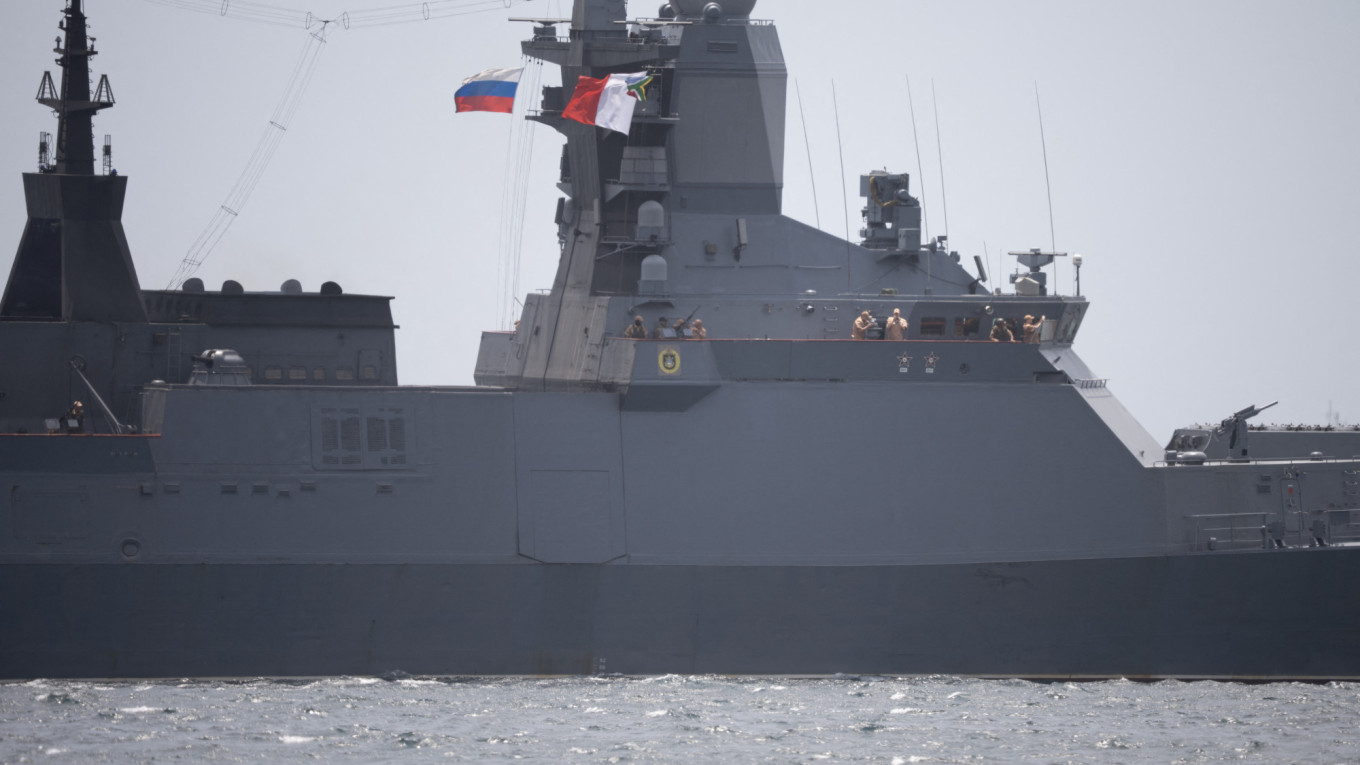
A Russian naval vessel arrived at South Africa’s main naval base on Friday to participate in military exercises alongside Chinese and Iranian ships, potentially straining Pretoria’s relations with Washington further.
These joint exercises involve several countries at odds with the U.S. government and come amid rising tensions following a recent U.S. operation in Venezuela.
Earlier this week, a Chinese destroyer and supply ship, along with an Iranian support vessel, entered South African waters in preparation for the week-long drills scheduled to commence over the weekend.
Journalists from AFP observed the Russian-flagged corvette arriving in False Bay near the Simon’s Town naval base.
The military exercise, dubbed “Will for Peace 2026,” is led by China and includes naval forces from the 11-member BRICS group of developing economies, which has been labeled “anti-American” by former President Donald Trump.
South Africa’s Deputy Defense Minister Bantu Holomisa informed Newzroom Afrika television that the United Arab Emirates was expected to contribute naval assets, while fellow BRICS nations Indonesia, Ethiopia, and Brazil would send observers.
The other members of BRICS include India, Egypt, and Saudi Arabia.
According to South Africa’s defense force, the drills aim to enhance collaboration between the navies by exchanging best practices and improving joint operational capabilities, ultimately promoting the safety of shipping lanes and regional maritime stability.
Regarding the timing of the exercises, Holomisa emphasized that they were planned well in advance of the current geopolitical tensions. Originally slated for November 2025, they were postponed due to a scheduling conflict with the G20 summit in Johannesburg, which the U.S. boycotted, expressing disagreements with South Africa over various international matters. The U.S. also expelled the South African ambassador last year and imposed a trade tariff of 30%.
This week, Washington seized a Russian-flagged oil tanker that it claimed was part of a covert network transporting oil to Venezuela, Russia, and Iran. The U.S. also issued warnings of possible actions against Iran if protestors were killed in the increasing demonstrations sparked by rising living costs.
A representative of South Africa’s Defense Ministry clarified to AFP that the joint military exercises were “completely unrelated to Venezuela.” Holomisa added, “We shouldn’t panic simply because the U.S. has issues with these nations. They are not our adversaries.” He emphasized the importance of focusing on cooperation with BRICS countries to ensure the safety of seas, particularly in the Indian Ocean and Atlantic.
Priyal Singh, a senior researcher at the Institute for Security Studies, remarked to AFP that “Washington has been trying to put Pretoria on its negative list since the onset of the Trump administration.” He noted that the optics of the upcoming naval exercises could be leveraged by Washington policymakers as an example of why its relationship with South Africa merits reassessment.
A small group of Ukrainian protesters gathered as the Russian ship docked, condemning South Africa — which asserts a neutral stance in the conflict between Russia and Ukraine — for allowing the Russian Navy to operate there. Kateryna Fedkina lamented, “They destroyed my city, Kherson, and are systematically erasing it.” She urged South Africa not to engage in military cooperation with Russia, describing it as an aggressive nation.
Additionally, South Africa’s Democratic Alliance party criticized the exercise, calling it misleading to present it as BRICS collaboration when key members Brazil and India were absent. The party accused the government of forging closer military relationships with “rogue and sanctioned countries like Russia and Iran.”
Sarang Shidore, director of the Global South Program at the Quincy Institute in the U.S., noted that this exercise signifies a growing focus within BRICS on security concerns, highlighting that the four participating BRICS nations all have “significant diplomatic or security disagreements with the United States,” sending a broader geopolitical message.