Hello and welcome to Regions Calling, your source for updates on events occurring outside of Moscow, brought to you by The Moscow Times.
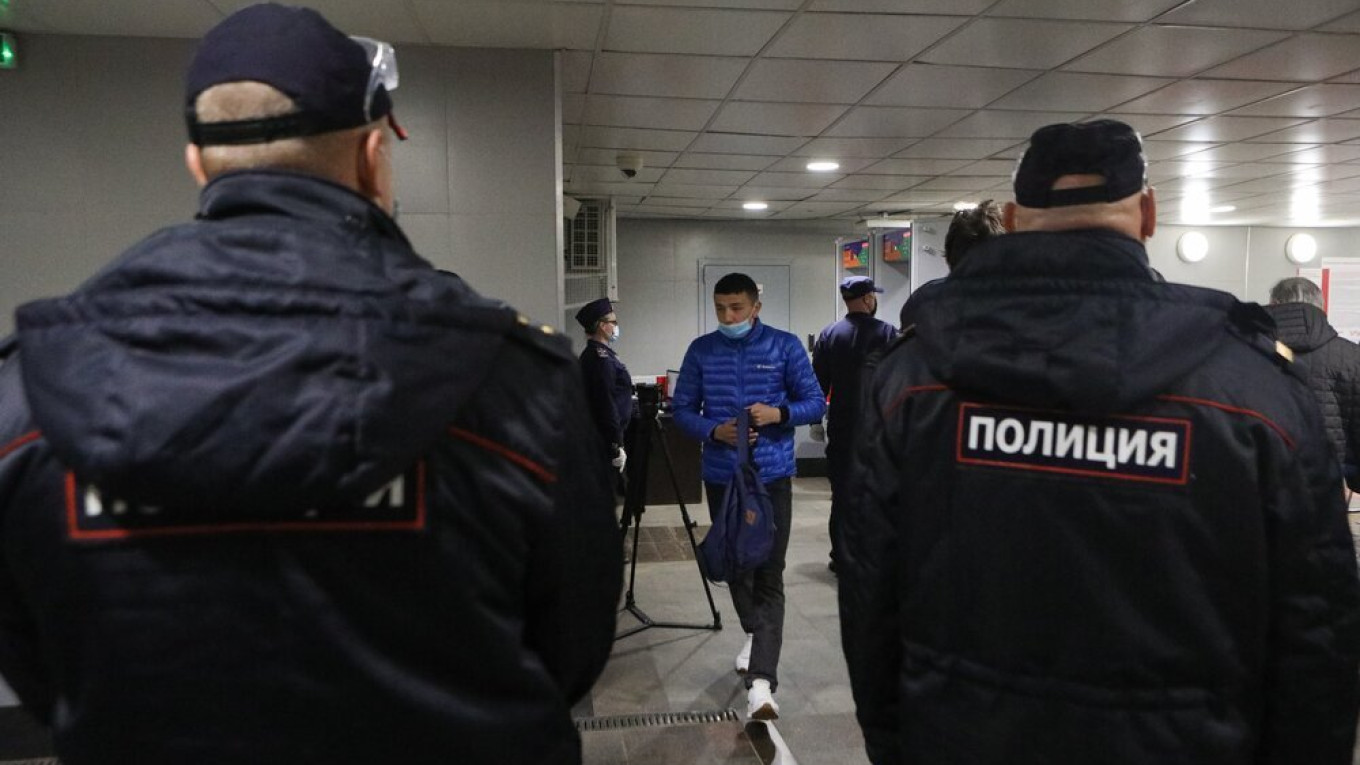
This week, we’re focusing on an incident of racial profiling that took place merely 36 kilometers (22 miles) south of Moscow earlier this month. Its proximity to the capital has not gone unnoticed, with numerous Indigenous Asian communities across Russia, particularly in Buryatia, a republic bordering Mongolia, closely monitoring the situation and the subsequent standoff.
Before diving into that, let’s look at the latest regional news:
Residents of the Kamchatka region in the Far East are still grappling with the aftermath of severe snowfalls that brought the peninsula to a halt earlier this month.
Reports indicate that only about 15% of the roads in the regional capital, Petropavlovsk-Kamchatsky, have been cleared, which is obstructing emergency services and the distribution of food and fuel throughout the city and surrounding areas. On Tuesday, regional governor Vladimir Solodov reached out to the federal government for help.
In a separate incident on Wednesday, a Ukrainian airstrike in the southern republic of Adygea resulted in at least 13 injuries and one death. Independent military analysts and exiled Russian media suggested that video evidence indicated the explosion involved a Russian anti-air missile that had malfunctioned, rather than a Ukrainian drone attack.
Also that Wednesday, an assault on seaport installations in the village of Volna, located in the Krasnodar region, left at least three people dead and eight injured, according to local sources.
In the Sakha (Yakutia) republic, a 16-year-old boy tragically lost his life on Tuesday after being trapped inside a military tank on display at an exhibition showcasing equipment from the ongoing conflict in Ukraine.
Meanwhile, Adam Kadyrov, the 18-year-old son and designated successor of Chechnya’s leader Ramzan Kadyrov, was flown to a hospital in Moscow after a motorcade accident occurred in the capital Grozny over the weekend, as reported by multiple media outlets.
It’s alleged that Kadyrov’s convoy collided with a vehicle while speeding through Grozny and disregarding traffic regulations last Friday. Reports indicate that the other car’s driver was killed, while Kadyrov and many of his entourage sustained injuries that are not life-threatening, according to sources from Novaya Gazeta Europe.
This incident surfaced shortly after alarming reports regarding Ramzan Kadyrov’s quickly declining health.
‘”It Must Not Go Unpunished”: A Buryat Woman Confronts Police Racism’
Maria Tsydenova, hailing from Buryatia, was on her way home from a Christmas gathering in Podolsk on January 8 when she was stopped by a group of police officers demanding to see her identification.
“I was with my adult daughter and her friends. We were… behaving calmly and weren’t disturbing anyone. There was no reason for us to be detained,” commented 41-year-old Tsydenova.
Not possessing her ID, she proposed to verify her identity through the government services app Gosuslugi or asked her daughter to retrieve the documents from just a short distance away. She also recounted how she requested the officers to show their identification and explain why they had stopped her.
Instead, the officers allegedly physically restrained her, “twisted my arms, hit me in the back, struck my head,” and took her to the nearest police station.
Tsydenova reported that she spent nearly 20 hours in detention without access to food or water. An independent medical examiner documented the injuries she sustained during her detention.
“[At the police station] they insulted me in every conceivable way, addressing me as ‘Buryat scum,’ ‘Buryat slut’… They claimed that all Buryats would die on the frontlines of the special military operation and that we would rot in hell, that our nation was destined to vanish,” Tsydenova stated in a viral video, using the Kremlin-sanctioned term for the conflict in Ukraine.
She noted that when she expressed her intention to file a complaint against their behavior, they told her she should complain to the ‘Buryat president and pray to Buryat deities.’
The Buryats, a Mongolic ethnic group native to southern Siberia, were colonized by Russia in the 17th century, with their territory subsequently divided among the present-day Irkutsk and Zabaikalsky regions as well as the republic of Buryatia.
Buryatia, which fell under Moscow’s total control after a brief period of limited autonomy in the 1990s, is one of Russia’s economically disadvantaged areas, despite possessing significant reserves of essential natural resources.
Limited job opportunities and restricted social mobility have pushed many Buryats to seek education and employment opportunities in larger cities across Russia, including Moscow and its suburbs like Podolsk.
The economic marginalization, along with disproportionate conscription, has led to a marked overrepresentation of Buryatia’s residents among those casualties in the Ukraine conflict.
Contrary to what the police communicated to Tsydenova, Buryatia has lacked a president since 2012, and many ethnic Buryats identify as Buddhists.
Law enforcement authorities have refuted Tsydenova’s claims, asserting that her arrest was due to “disorderly conduct while intoxicated in a way that insulted human dignity and public morals.”
“I lived in Moscow for 14 years, so when I heard about what happened to Maria, I felt neither astonished nor shocked,” said Marina Saidukova, a decolonial researcher from Buryatia at the University of Montana.
“Police racism is a daily experience for many Buryat-Mongols and, more generally, for all non-Russian individuals in Russia. Your identity, whether as a citizen, a labor migrant, or an international student, doesn’t change this,” Saidukova explained to The Moscow Times.
Saidukova believes that Tsydenova’s situation should be viewed not as an isolated event, but as indicative of a broader systemic issue in Russia.
She stated that racial profiling in Russia is reinforced by a state ideology that promotes the superiority of those with Slavic features, especially ethnic Russians.
“The security forces comprehend their responsibilities not as lawbreakers but as representatives of state ideology. Their role is to oversee ‘others’ and uphold the racial hierarchy within Russia,” Saidukova pointed out.
These views were shared by notable Buryat activist Viktoria Maladaeva, who expressed feelings of “anger and despair” upon hearing about Tsydenova’s case, as it reminded her of her own mother being detained by police in St. Petersburg around 15 years ago.
“She had gone to the airport to meet a friend and, in her haste, overlooked her passport. The police saw her, a non-Russian woman, running to the subway, stopped her, and took her to the station,” Maladaeva recounted.
According to Maladaeva, her mother was kept in custody for five hours, during which her personal items and phone were confiscated.
“She asserted that she was Buryat and a citizen of Russia, but it was to no avail,” the activist recounted, indicating that the officers presumed that an Asian woman could not possibly be a Russian citizen and must have been residing in the country illegally. “A Kalmyk officer later arrived and, of course, immediately believed her and released her.”
“Every non-Russian person is familiar with experiencing racial profiling or discrimination… We are aware of Maria’s incident now, but how many more happen without any coverage every day?” she added.
Although Russian law does not necessitate citizens to carry identification at all times, random identity checks on non-Ethnic Russian individuals and their arbitrary arrests are widespread, a situation worsened by the state’s crackdown on migrants from Central Asia amid the war.
Last year, a video capturing the detention of a Buryat woman by a volunteer police officer in the Moscow metro sparked public outrage in Buryatia and other Russian republics with significant Asian Indigenous and minority populations.
In response, Buryatia’s Kremlin-appointed leader, Alexei Tsydenov, urged fellow Buryats to always have their identification documents on hand.
“We appear different [from Russians] — that’s an undeniable fact. Please be understanding and calmly present your documents,” Tsydenov stated at the time.
Maladaeva labeled this response “an insult to all Buryats” in an interview with The Moscow Times, emphasizing that possessing a Russian passport does not shield individuals from the intimidation and harassment faced by Buryats.
In this latest incident, the head of Buryatia assured the public that both Russia’s Interior Ministry and Investigative Committee had initiated a formal investigation into Tsydenova’s claims.
“We are monitoring the situation closely. I request everyone to remain calm regarding the developments — we will address everything and provide updates as necessary,” Alexei Tsydenov stated.
Researcher Saidukova believes that the events should elicit more than mere acknowledgment or verbal condemnation from officials; it should escalate into “a political scandal that confronts the issue of systemic racism within law enforcement.”
“With its silence and mere performative reactions, the Russian government is conveying a clear message: ‘This is the cost of having the ‘wrong’ appearance. And this is acceptable,’” Saidukova argued.
Despite facing what seems to be an overwhelming system against her, Tsydenova declared on Sunday her intention to pursue justice in her case, noting that Buryatia’s State Duma deputy, Vyacheslav Markhaev, supports her efforts.
“My aim is to demonstrate that the physical aggression and moral degradation inflicted by police officers are intolerable and must not remain unpunished,” she wrote on her Telegram channel, which she pledged to maintain until a favorable resolution is achieved.
“Today it is me, but it could be any one of you tomorrow,” Tsydenova added.
Alexander Andreyev, the leader of Russia’s Communist Party in the Chuvashia republic, held up a sign reading “Greenland, we are with you! We are Greenland!” while undertaking his traditional Epiphany ice plunge on January 19.
“On a distant northern island, the local Communist Party enjoys significant popularity. We decided to express our solidarity with the Inuit workers in their struggle against American imperialism,” Andreyev stated, referring to members of Greenland’s democratic socialist party, Inuit Ataqatigiit.
The police summoned Andreyev for questioning after photos of his stunt went viral.