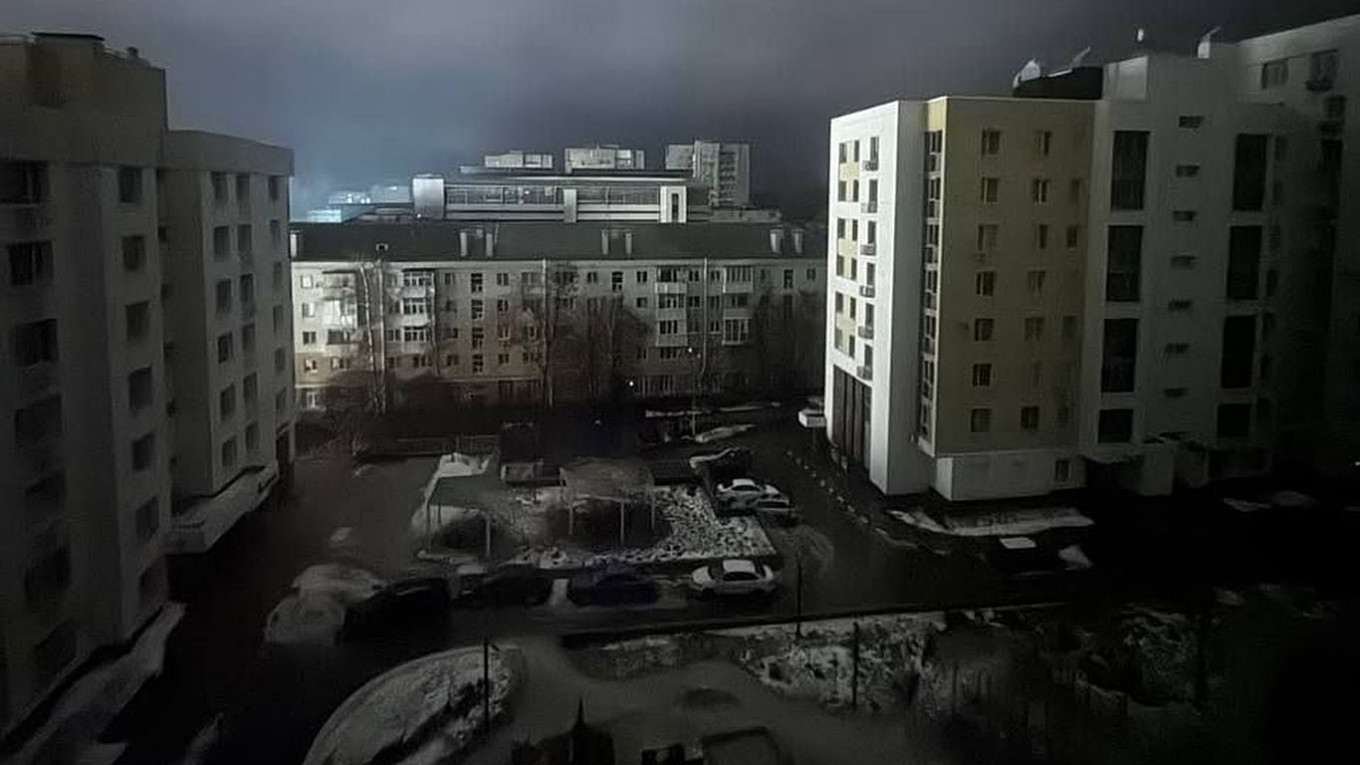
The Belgorod region in Russia was still facing challenges in restoring power, heating, and water supplies on Monday, as frigid temperatures followed a Ukrainian attack that resulted in the area’s most severe blackout since the onset of the full-scale conflict in Ukraine nearly four years ago.
These power outages affected around 1 million individuals in Ukraine’s Dnipropetrovsk region, approximately 250 kilometers away, who also experienced extensive blackouts and heating failures due to Russian military actions.
The Belgorod region, which shares a border with northeastern Ukraine, has been subject to ongoing cross-border shelling and drone assaults since the war began. However, strikes on local energy infrastructure last Friday led to the most significant blackouts the region has seen, leaving over 500,000 inhabitants without power or heat, according to local officials.
Furthermore, around 200,000 people were left without access to water, and mobile communications were interrupted in certain areas.
Residents reported that by Monday, many parts of the region were still lacking reliable utility services. “Everyone I know has been impacted, whether it’s electricity, heating, or water-related issues,” a resident of Belgorod city shared with The Moscow Times. “There’s a degree of panic. People are frightened because this has never happened before.”
She mentioned that mobile internet service remained inconsistent in the city center, while some areas still faced issues with water supply.
The outages coincided with extremely low temperatures and heavy snowfall, with daytime highs around minus 11 degrees Celsius and nighttime lows dropping to minus 18 degrees Celsius.
As authorities worked to restore services, some local residents took to social media to express their discontent with regional Governor Vyacheslav Gladkov for failing to adequately address the utility issues caused by the attack. “It’s been four days since the shelling, and there’s still no water [in our area]… When will we get our water back?” local resident Natalia Simanova expressed in a comment on the VKontakte platform.
Another resident, Irina Sokolova, voiced her frustration on Gladkov’s VKontakte page regarding the power outages affecting heating in the Shebekinsky district, close to the Ukrainian border. “We haven’t had electricity since January 9. [The operator] Rosseti is conducting repairs — thanks for that — but people rely on electric heaters. What are they supposed to do if their heating systems freeze?” she commented.
Images and videos shared on social media on Friday showed darkened apartment buildings and long lines forming at gas stations.
Regional Digital Development Minister Sergei Chetverikov noted that more than 60% of cellular base stations were offline during the blackout.
Governor Gladkov recognized the extent of the damage to the energy infrastructure, describing the situation as “extremely difficult.” On Tuesday, he stated that it would be “impossible to completely reactivate electricity supplies to homes and businesses solely through backup generators” and suggested that residents consider relocating to other regions if they had the means to do so.
By Monday, several shopping centers had announced closures or limited hours; in addition, over 60 industrial facilities were instructed to curtail electricity usage to eight hours daily, specifically between midnight and 8 a.m., according to regional news outlet Pepel.
Some residents also criticized the governor after he recommended that locals purchase their own generators to create electricity. “Many households could buy them, but they are hoping — forgive me — to escape this disaster and therefore haven’t purchased generators,” Gladkov stated regarding the ongoing power outages.
These remarks angered some residents of Belgorod, who accused him of attempting to “shift responsibility” onto the populace instead of taking decisive action. “Your insistence on citizens buying their own generators seems quite cynical. I personally cannot afford that,” said Dina Sharapova in a VK comment. “People did not bring this disaster upon themselves; it was the result of enemy actions. Citizens should be able to count on state protection and assistance — or do you think everything should be left to individuals to handle?”
Another resident, Anatoly Rogozyansky, asserted that “the entire responsibility lies with local authorities.” He continued, “The list of failures from regional authorities is endless, yet you are trying to put the burden onto the people.”
“From the very beginning of the war, we have observed your insufficient engagement with the community — those who have been living alongside the frontlines since day one,” Rogozyansky remarked.
Meanwhile, in Ukraine, a Russian attack has resulted in more than 1 million people in the Dnipropetrovsk region being left without water and heating as temperatures fell below zero.
Additionally, a Russian strike on Kyiv last Friday resulted in at least four fatalities and left half of the city’s residential buildings without heat. The Defense Ministry also reported the use of its touted Oreshnik missile in western Ukraine near NATO’s borders.
Ukrainian President Volodymyr Zelensky accused Moscow of “using the cold weather as a tool of terror.”
Back in Belgorod, residents expressed concerns over the potential for further targeting of local energy facilities. “This sets a very concerning precedent for everyone in the city,” a resident shared with The Moscow Times. “The prevailing atmosphere here reflects a war-induced fatigue, felt more acutely by the residents of Belgorod than by anyone else in Russia,” she concluded.