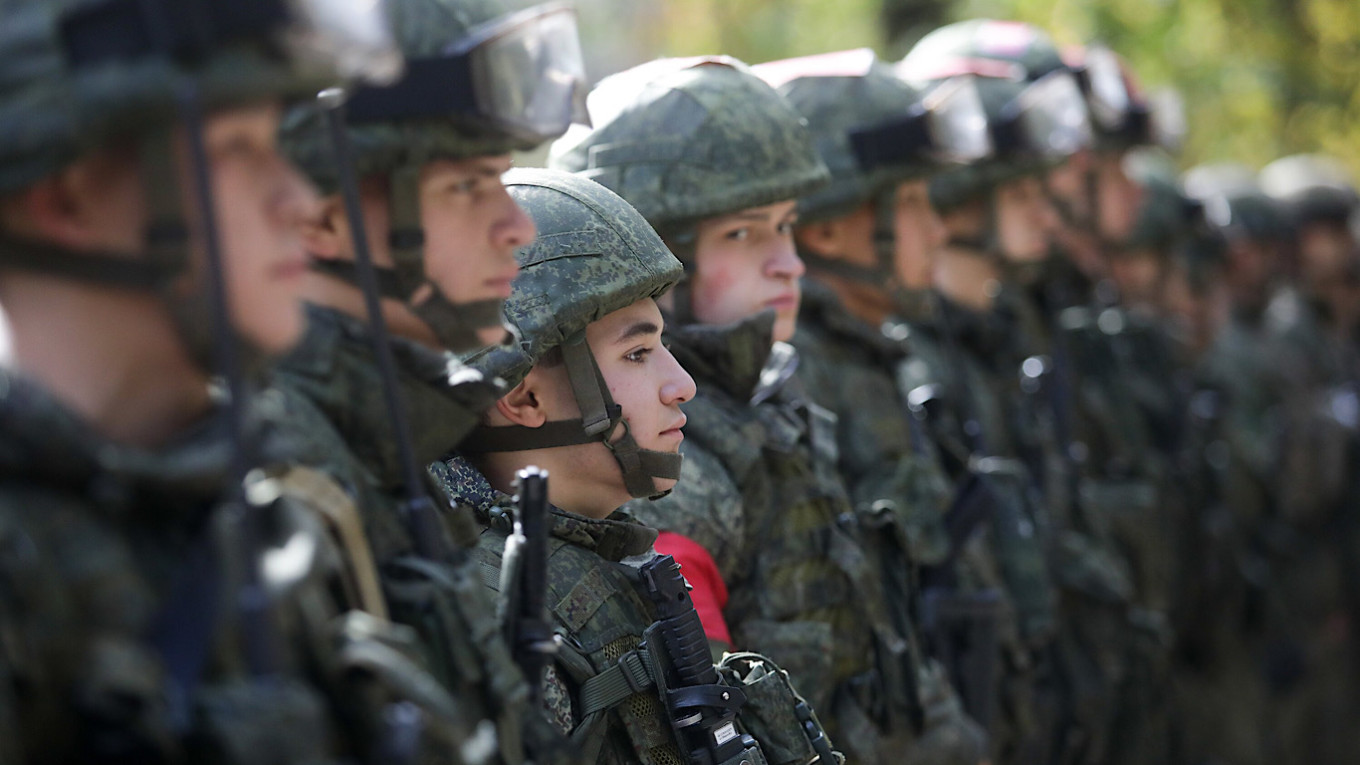
This week, President Vladimir Putin enacted legislation that permits Russian reservists to undergo “special training” aimed at safeguarding critical infrastructure.
Concerns have been raised that this could increase the Russian military’s manpower and enable the Kremlin to dispatch more personnel to the conflict in Ukraine. Conversely, some believe the new law will have minimal impact on the military’s capabilities.
The Moscow Times examines the implications of this new law and how Russia might utilize its reservists.
In 2015, Putin established a mobilization reserve known as the Special Combat Army Reserve, or BARS. This reserve is accessible to individuals who have previously served in the military and have signed a specific “reservist” contract with the Ministry of Defense.
Reservists lead civilian lives while receiving a modest monthly stipend of up to 10,000 rubles (approximately $123). Although not classified as contract personnel, they are obligated to regularly participate in military training to keep their combat skills up to date. Employers of these reservists are compensated for their absence during training sessions.
The exact number of reservists is not disclosed publicly. Recruitment for the reserve intensified in 2021, just prior to Russia’s invasion of Ukraine, causing the estimated size of the reserve to balloon from a few thousand to around 100,000, as reported by the exiled media outlet Meduza.
In the war’s early months, many reservists opted to volunteer as part of BARS battalions and subsequently entered into military contracts with the Defense Ministry.
Joining BARS provided an opportunity for individuals who didn’t meet the Defense Ministry’s enlistment criteria, according to three volunteer soldiers who spoke to The Moscow Times in 2023, as these battalions had more lenient age and health standards.
State Duma Defense Committee Deputy Chairman Alexei Zhuravlev stated last month to the RTVI media outlet that approximately 2 million individuals are part of Russia’s reserves. However, this assertion has been met with skepticism from experts.
Military analyst Alexei Alshansky suggested to The Moscow Times that the actual number of reservists is likely quite small, as many reservists have already been deployed to the frontline and have signed contracts with the Defense Ministry.
“Even in 2022, there weren’t enough BARS members to consider them viable reserves for the Russian military,” he noted, adding that if sufficient reservists had existed, authorities wouldn’t have needed to mobilize people from the streets during 2022.
He further explained that the current extensive campaign to recruit contract servicemen indicates that the available reservists are dwindling.
According to a source from the military commissariat, comments made by Kartapolov may have been inaccurate.
The new bill, which was expedited through the parliament in just one day, states that reservists “may be sent to specialized training sessions to ensure the protection of critically important facilities and other essential infrastructure.”
Sources from the presidential administration and the State Duma indicated that the rapid passage of this document was directed by the Kremlin.
Details regarding the execution of these special training sessions will be determined by the Russian government, according to the legislation.
The Ministry of Defense clarified that the bill pertains solely to reservists and does not entail their deployment to combat zones or overseas service.
“There is no mention of any mobilization,” the ministry asserted.
From a military standpoint, Alshansky argued, it would be counterproductive to send these reservists to the frontlines when more trained contract personnel are stationed there.
However, Putin has previously gone back on his promises, including his assurance not to deploy conscripts in the war, opting only for “professional soldiers” at the front.
Vladimir Tsimlyansky, an official in the Russian General Staff, indicated that reservists would be tasked with securing critical facilities, including energy and transport infrastructure. He noted that their responsibilities would be limited to “countering drones” and confined to their local region.
Since this summer, there have been ongoing drone assaults targeting Russia’s energy and transportation infrastructure, including oil refineries.
At least 15 regions, such as Leningrad, Nizhny Novgorod, Tambov, and Yaroslavl, have initiated efforts to recruit reservists to safeguard these assets. Authorities emphasize that these recruits will not be sent to the front.
Reservists in the Bryansk region, which borders Ukraine, can earn monthly payments ranging from 40,000 to 99,000 rubles ($490-$1,200), based on their military rank, while those in the more distant Perm region receive between 4,000 and 7,000 rubles ($50-$85).
A representative from one of Russia’s largest oil and gas firms revealed to Vyorstka that the company’s security team does not have high hopes for the reservists’ effectiveness.
“Even an additional ten armed individuals would help, but fundamentally, only a proper army air defense can protect us — and the chance of obtaining that is slim,” the source commented.
Experts predict that the Kremlin is likely to recruit more personnel to bolster the military without initiating a new round of mobilization, which might incite widespread public backlash.
The new legislation appears aimed at individuals who may not be inclined to sign a contract with the Defense Ministry but are open to short-term service, according to lawyer Alexei Tabalov, the head of the NGO Shkola Prizyvnika (Conscripts’ School).
Sergei Krivenko, director of the Citizens. Army. Rights group, informed The Moscow Times that this legislation underscores recruitment challenges, as there are insufficient contract soldiers to compensate for military casualties.
“That’s why they’re exploring additional avenues. Reservists are one avenue,” he stated.