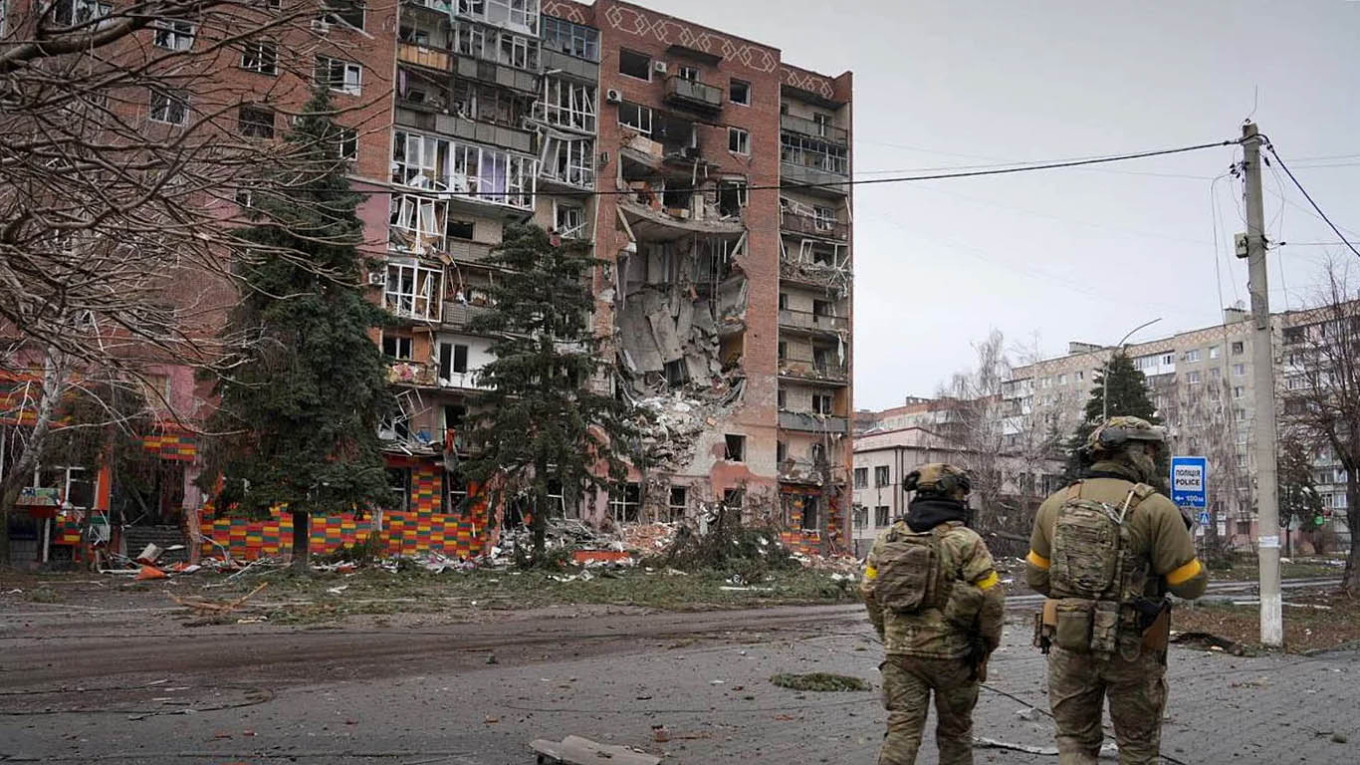
KYIV, Ukraine — Intense combat persists in the eastern city of Pokrovsk as Russian troops continue their extended effort to capture this industrial center in Ukraine’s Donetsk region.
Once inhabited by approximately 60,000 residents, Pokrovsk has endured continuous bombardment for over a year and a half. The conflict for the city has now reached a critical juncture.
Western military experts suggest that Russian forces have steadily advanced into the southern outskirts of Pokrovsk, gradually wearing down Ukrainian defenses and taking advantage of the deteriorating late-autumn weather to move personnel and equipment closer to the frontline. They point out that the battle has evolved into a protracted war of attrition, stretching Ukrainian forces thin.
“The primary issue is logistics,” explained Artem, a Ukrainian drone operator stationed near Pokrovsk, who requested to be identified by just his first name. “The roads are completely blocked by Russian drones. No vehicles can enter or exit the city without being quickly spotted.”
Despite these challenges, Ukrainian units from the 25th, 7th, and 68th brigades continue to maintain control over parts of Pokrovsk and the nearby town of Myrnohrad, which is located about seven kilometers to the east.
Artem reported that clashes have intensified recently as Russian forces resumed mechanized attacks.
“They launch around ten armored vehicles simultaneously toward our positions,” he told The Moscow Times. “Usually, we can eliminate them quickly, but the fog, rain, and low winter clouds slow our response time. We take down most of them, but a few manage to breach our defenses and deploy troops inside the city.”
Military analyst Michael Kofman, a senior fellow at the Carnegie Endowment for International Peace, noted that Ukraine’s 7th Rapid Response Corps — which took over the sector in July — has struggled with worsening conditions and limited resources. Tight maneuverability has forced commanders to shift limited assets from one threatened area to another.
On the ground, Russian forces have pushed into the Shakhta district, which serves as the city’s industrial heart.
“Once they get in, it’s nearly impossible to dislodge them,” Artem said. “They conceal themselves in basements and tunnels, wait for reinforcements, and advance from house to house.”
Like Bakhmut before it, Pokrovsk has become a symbol of Ukrainian resilience, representing one of the last significant cities in southern Donetsk that Russian forces must capture before they can push toward the cities of Druzhkivka, Kramatorsk, and Sloviansk.
During a visit to a military hospital in Moscow at the end of last month, President Vladimir Putin claimed that Pokrovsk was essentially encircled. This assertion was quickly countered by Oleksandr Syrskyi, Ukraine’s top general. He stated in early November that Ukrainian forces “must withstand the pressure of an enemy group numbering in the thousands, which continues to try to infiltrate residential areas and cut our supply routes.” However, Syrskyi clarified, “there is neither encirclement nor blockade of the city.”
Ukrainian President Volodymyr Zelensky echoed this concern, stating that the Russian military’s “primary goal is to take Pokrovsk as swiftly as possible.” He pointed out that the intensity of recent assaults — with 220 attacks over just three days — makes this evident. Military data he referenced indicated that around 314 Russian soldiers are already operating within the city.
Given its significant implications, the battle for Pokrovsk holds considerable political stakes for both Kyiv and Moscow. Similar to Bakhmut and Avdiivka, it raises questions about how much longer Ukrainian commanders will attempt to defend the city and whether they may eventually decide to execute a coordinated withdrawal to defensive positions on the outskirts.
Artem expressed that the situation in nearby Myrnohrad is also worsening and that holding the town is becoming increasingly challenging. He suggested that the high command should order an evacuation, though he fears “it might already be too late.”
His worries are corroborated by open-source investigators who used drone footage to verify the presence of Russian reconnaissance units beyond a major highway connecting Myrnohrad and Pokrovsk, east of the village of Rivne. The video shows Russian soldiers capturing a Ukrainian serviceman.
The capture of that strategic crossroads indicates that Ukrainian forces in the Pokrovsk area and south of Myrnohrad may now be partially encircled.
However, the rapidly changing situation makes it difficult to ascertain whether the front lines have stabilized.
“It’s such chaos that it’s challenging to know where our troops are located,” Artem commented. “The front has become so porous that Russian soldiers can be behind our lines and vice versa. It’s now a battle from house to house.”
This instability, he added, could paradoxically assist trapped Ukrainian forces in escaping on foot if a withdrawal is ordered. “It’s a trek of over ten kilometers under constant drone attack,” Artem noted, “but it is still feasible.”
Artem believes that Ukraine has already achieved a key objective in Pokrovsk: forcing Russia to expend troops and resources in the struggle for over a year, significantly weakening its combat capabilities.
Yet he sees little reason to celebrate. “For the Russians, the lives they send to die hold no value. They will always have more,” Artem explained to The Moscow Times. In his opinion, success should be measured by how much Russian equipment can be destroyed, how defensive lines can be reinforced, and how time can be gained.
Analyst Kofman argues that the current conditions are more favorable for Ukraine than the earlier battle for Avdiivka in 2024.
He notes that Russian troops lack momentum following an offensive that drained much of their combat strength. Their advances are slow, and they cannot maintain intense pressure along the front. Their tactics increasingly rely on small infantry units moving by foot, infiltrating buildings and defensive setups while waiting for reinforcements.
Without the ability to deploy armored vehicles or tanks to capitalize on territorial gains, their attacks remain limited and have yet to achieve a decisive breakthrough, according to Kofman.
Should Pokrovsk fall, Russian forces could launch drones directly from the city, transforming it into a forward operating base to push Ukrainian units further west.
Sébastien Gobert, a French journalist and author of a book on Ukrainian oligarchs, believes that Pokrovsk may be irretrievably lost, and the critical question now is how to prepare for the next significant assault.
“The city has not yet succumbed, but we must begin to derive lessons from this battle,” he stated to The Moscow Times. “We need to consider Ukraine’s capacity for resistance in future engagements, particularly concerning human resources.”
Gobert highlighted ongoing issues in Ukraine’s mobilization, recruitment, and training, problems that emerged in 2022 and 2023 and remain unresolved. Meanwhile, Russia continues to recruit several thousand additional soldiers each month, outpacing Ukraine.
“Pokrovsk represents yet another test for Ukraine,” Gobert asserted. “It will reveal whether the high command opts to preserve its troops or chooses to hold onto the city as it did in Bakhmut until the very end, thereby inflicting maximum casualties on the enemy. The command has faced significant criticism for its prolonged presence.”
He contended that the battle has transformed into a political test as much as a military one — a reflection of trust between Ukraine’s government, armed forces, and society. He believes the military challenge has already been unsuccessful, with Pokrovsk on the verge of capitulating.
What remains to be seen is whether the public and the troops will retain confidence in the leadership of the country after the city falls.
“When Pokrovsk goes,” he added, “the front won’t collapse on its own, but this new challenge will determine Ukraine’s ability to resist and endure in forthcoming battles.”