Zelensky Advocates for Direct Dialogue with Putin Amid Ukrainian Independence Day Turmoil | World | london-news-net.preview-domain.com

Zelensky Advocates for Direct Dialogue with Putin Amid Ukrainian Independence Day Turmoil

Zelensky Advocates for Direct Dialogue with Putin Amid Ukrainian Independence Day Turmoil

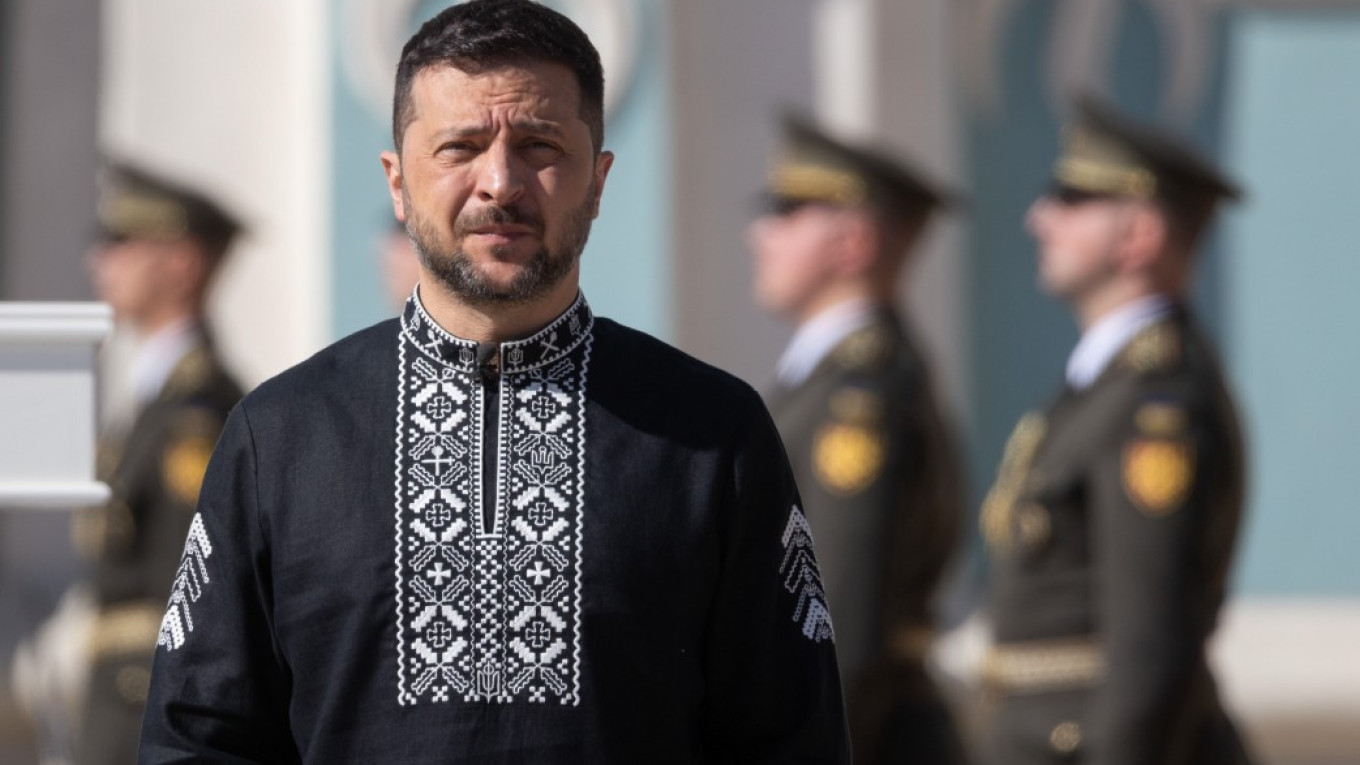
Ukrainian President Volodymyr Zelensky stated on Sunday that a meeting with Russian President Vladimir Putin would represent “the most effective way forward” in light of the stalled diplomatic efforts to resolve the ongoing war, coinciding with celebrations for Ukraine’s Independence Day.

As Ukraine marked its independence amid the fourth year of conflict, it conducted drone strikes on Russia, which ignited a fire at a nuclear power facility.

Following a push from U.S. President Donald Trump to facilitate a summit between Ukraine and Russia, hopes for a peaceful resolution dwindled when Russia, on Friday, dismissed the possibility of an immediate meeting between Putin and Zelensky.

However, Zelensky emphasized on Sunday that “the format of discussions between leaders is the most productive path ahead,” reiterating his calls for a direct summit with Putin.

Russian Foreign Minister Sergei Lavrov earlier accused Western nations of seeking “an excuse to obstruct negotiations” and criticized Zelensky for insisting on an immediate meeting at all costs.

Zelensky committed to “pushing Russia toward peace” during a ceremony attended by U.S. envoy Keith Kellogg, who received the Ukrainian Order of Merit, along with other Western dignitaries.

With the war having resulted in tens of thousands of casualties, Russia has recently reported new territorial gains, including the capture of two villages in the eastern Donetsk region on Saturday.

On Sunday, Ukrainian Commander-in-Chief Oleksandr Syrsky announced that three additional villages had been reclaimed in Donetsk, which has become a central point for peace discussions.

The drone strikes on Russia during Ukraine’s Independence Day included one that was intercepted over the Kursk Nuclear Power Plant in western Russia.

Additionally, Russian officials reported that Ukrainian drones were shot down in areas far from the frontline, including St. Petersburg in the northwest.

Over the port of Ust-Luga on the Gulf of Finland, ten drones were intercepted, causing a fire at a fuel terminal owned by Russian energy company Novatek, according to local authorities.

During the ceremony celebrating the anniversary of Ukraine’s independence from the Soviet Union in 1991, Zelensky remarked: “This is how Ukraine retaliates when its appeals for peace are not acknowledged.”

“Today, both the U.S. and Europe concur: Ukraine has not yet achieved a complete victory, but it will certainly not face defeat. Ukraine has secured its independence. It is not a victim; it is a warrior.”

He also indicated that the presence of foreign troops in Ukraine post-conflict would be “essential” as Kyiv works on potential security assurances with its allies.

Canadian Prime Minister Mark Carney, during his visit to Kyiv, stated that it is not “Russia’s decision how Ukraine’s future sovereignty, independence, and freedom are ensured.”

Zelensky expressed gratitude to global leaders such as Trump, Chinese President Xi Jinping, French President Emmanuel Macron, British King Charles, and Pope Leo for their messages marking the occasion.

Norway announced it would contribute 7 billion kroner (approximately $700 million) as part of a joint commitment with Germany to provide Ukraine with two complete U.S. Patriot missile systems that Germany currently possesses.

The Norwegian government indicated that these systems, which are presently in Germany, would be delivered to Ukraine “as soon as possible.”

Related posts

Naval Maneuvers Highlight BRICS Unity Amid U.S. Tensions

rimmaruslan98@gmail.com

Roskomnadzor Open to Lifting Roblox Ban Pending Compliance with Russian Laws

rimmaruslan98@gmail.com

Regions Calling: Life With No Internet Is the New Normal Текст: Welcome toRegions Calling, your guide to developments beyond the Russian capital from The Moscow Times. In this edition, we examine how frequent — and in some cases permanent — mobile internet outages and restrictions have transformed the lives of ordinary people in Russia’s regions. But first, a look at the latest news: Authorities in the Siberian republics ofKhakassiaandSakha (Yakutia)have cut monetary support to soldiers fighting in Ukraine and their families due to budgetary constraints. Russia’s regions provide one-time payments from their local budgets for signing a military contract, when a soldier receives an injury in combat and in the event of a serviceman’s death. While Sakha authorities did not specify which payments will be aborted, Khakassia will no longer issue one-time payments of 1.1 million rubles ($14,000) to families of deceased soldiers, RFE/RL’s Siberian bureau Sibir.Realiireported. The head of therepublic of Buryatiacalledfor the eradication of cormorants, a large waterbird, from Lake Baikal, citing overpopulation concerns. Different scientists have different positions. Some say [cormorants are] supposed to exist and dont cause any harm. Others say they do. My personal position is that they definitely do, and we must fight them….Not by regulating them, but by eliminating them, Alexei Tsydenov said. Residents of at least two remote settlements have been raising alarm in recent weeks over continued food supply shortages that authorities blame on weather-related disruptions. The village of Nikolskoe, the only inhabited settlement on the Far EastCommander Islands, was leftwithoutfresh supplies of food and necessities, leaving all stores on the island nearly empty. The first delivery of 50 tons of food in over three months reached the island on Thursday,accordingto local media. Residents of Surinda, a reindeer herding settlement in theKrasnoyarsk region,sharedimages of emptying store shelves earlier this week. Locals said the only items still available were spices, tea, cereals and pasta. In Russia’s Regions, Protracted Internet Blackouts Have Long Been the Norm This month, authorities in theUlyanovsk regionintroducedrestrictions on mobile internet access that are due to remain in effect until the end of Moscow’s invasion of Ukraine. The outage was meant to be limited to areas near sensitive government and military facilities, but entire suburbs in the regional capital Ulyanovsk were cut off from mobile internet access, The Moscow Times’ local sources said. Though the Volga River region was the first in the country to impose a permanent mobile internet blackout, recurring cellular internet shutdowns have been a part of daily life in dozens of regions for months, ostensibly for security reasons, according to residents who spoke to MT and local media reports. “It is extremely inconvenient. The jamming is constant. Some parts of the city never have internet. Sometimes I lose GPS while driving and suddenly have no idea where to go next,” said a woman from Ufa, the capital of therepublic of Bashkortostanin the Ural Mountains. She spoke on condition of anonymity. A major oil-refining complex in Ufa owned by Bashneft has been frequentlytargetedby Ukrainian drones, leading to large adjacent areas of the city as well as the city’s only airport being cut off from mobile internet due to security concerns. Jamming of mobile calls is also not uncommon, locals living near the refinery say. “I order taxis through Wi-Fi at home 100% of the time. Otherwise, I use a bus or walk,” said another woman based in Ufa who also requested anonymity. Residents of other regional capitals across Russia have faced a similar plight, with some locals calling their internet-deprived suburbs “an exclusion zone” — as opposed to city centers where internet connectivity is often stable. This is a systemic problem for Russia…We need to come to terms with it and understand that the special military operation is not somewhere 2,000 kilometers away and that we are also participants in these events, Bashkortostan’s head Radiy Khabirovsaidof the outages earlier this month, using the Kremlin-sanctioned term for the war in Ukraine. Ufa residents who spoke with The Moscow Times said the outages have forced them to store more of their money in cash and rely less on taxi apps. Businesses are increasingly switching to SMS messages to schedule appointments and communicate with clients as well. The amount of cash in circulation in Russiaincreasedby 659 billion rubles ($8 billion) between July and September this year, five times more than during the same period last year, according to Central Bank data. Analysts say this trend is directly tied to frequent internet outages that prevent people from paying digitally. The internet shutdowns cost the Russian economy around $295 million per day,accordingto the independent watchdog Internet Defense Society. Bashkortostan alone loses $3.9 million every day. Though many regional administrations have vowed to include banking applications in the so-called “white list” of services meant to remain accessible during shutdowns, users who spoke with MT said they could not connect to these apps most of the time. In addition to banking services and the Mir payment system, “white lists” include government services provider Gosuslugi, Russian tech platform Yandex, social networks Vkontakte and Odnoklassniki, as well as online marketplaces Ozon and Wildberries. These services also function inconsistently during shutdowns, users said. The North Caucasus republic ofIngushetia, Russia’s smallest ethnic republic, has been dealing with mobile internet shutdowns since July and the outages have continued since, according to localreports. Ingushetia’s head Makhmud-Ali Kalimatovsaidthis month that he had largely switched to a landline phone due to frequent jamming. “You know, its a more reliable [mode of communication]. Of course, you can’t carry it with you, but in the evening, you can come home and check in with everyone you need,” Kalimatov said during his annual televised call-in show. Eastward in therepublic of Dagestan, mobile internet jamming has also been nearly constant since August. “I have been living in Moscow for 10 years. Upon arriving in Dagestan, you immediately feel as if you’ve ended up in some kind of [Native American] reservation,” a native of Dagestansaidin a message published by local news outlet Chernovik. “There is no working internet, no electricity, no water or gas, the roads are full of potholes, and the healthcare system is struggling,” they added. Mobile internet shutdowns have been recorded in at least half of Russia’s regions every day in November,accordingto the open-source analytical project Russian Internet Monitor. “I have a feeling that people got used to feeling desperate and helpless, though everyone is willing to help when needed,” said a woman in her 20s from Kazan, the capital of therepublic of Tatarstan. The woman, who requested anonymity, also described the frequent experience of “entering anything from a hookah lounge to a hospital” to find a Wi-Fi connection while moving around the city. “[Internet outages] take away the feeling of certainty and security, especially from the older generation…They stop responding to messages, and it is unclear how to communicate with them — they lose the ability to do things in the usual ways, and they completely lose the desire to bother trying,” she told The Moscow Times. “I’m sure this is how generations drift apart,” she added. St. Petersburgactivist Lena Patyayeva wasarrestedfor staging a single-person protest outside a police station in honor of her disappeared friend Seda Suleimanova. “You gave her away to die. Now live with it. Where is Seda Suleimanova?” read the sign that Patyayeva was holding. The activist has beenactively searchingfor Suleimanova since August 2023, when the Chechen woman was forcibly returned from St. Petersburg to her native republic by the Russian police. Some fear Suleimanova may have been killed in a so-called “honor killing” — a practice in which a woman is murdered by a relative, typically a man, for allegedly bringing shame to her family.

rimmaruslan98@gmail.com

This website uses cookies to improve your experience. We'll assume you're ok with this, but you can opt-out if you wish. Accept Read More