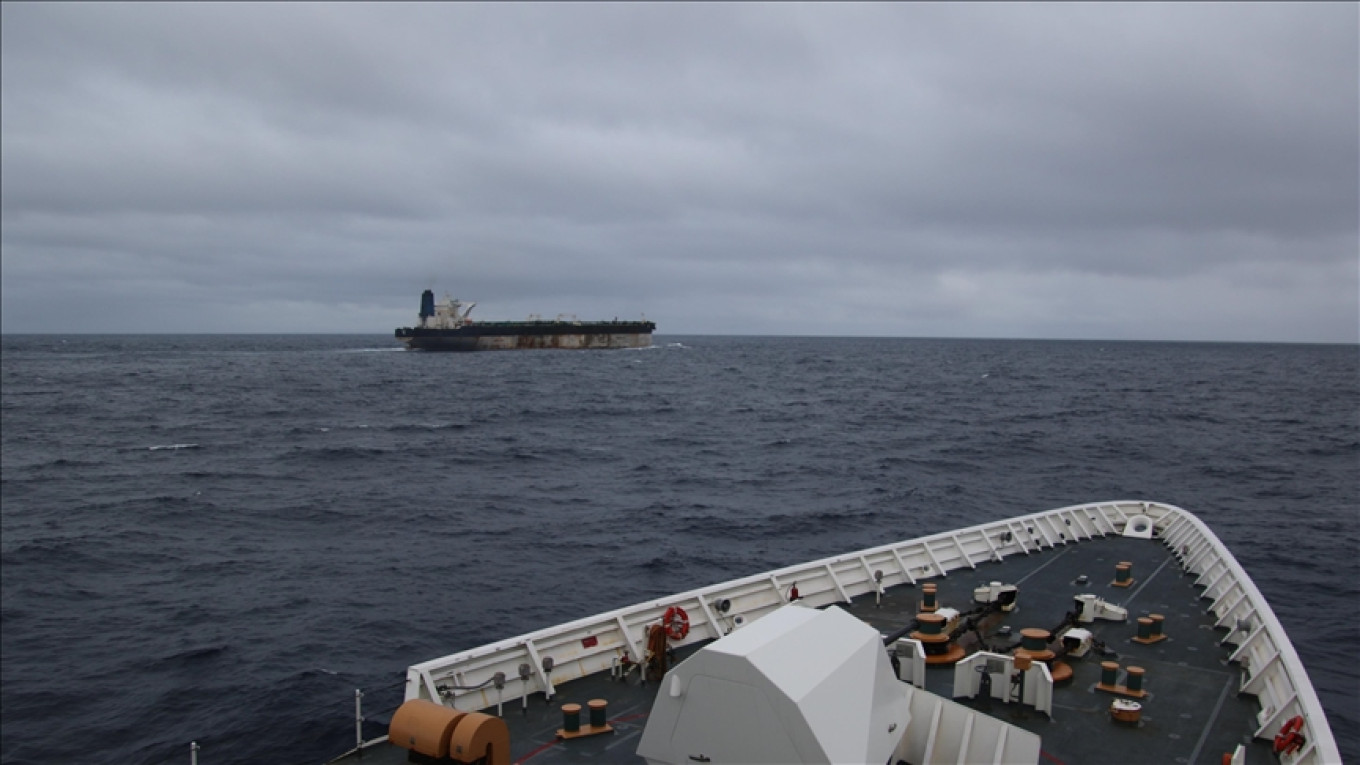
U.S. officials announced on Wednesday that they had captured a large tanker flying the Russian flag, which was associated with Venezuelan oil that is under sanctions, in the North Atlantic. This action could potentially escalate tensions between the two nations.
The vessel, previously referred to as Bella 1 and now known as Marinera, had eluded the U.S. Coast Guard for over two weeks after managing to escape near Venezuelan waters.
Russian naval forces were en route to provide an escort for the tanker at the moment of its capture by U.S. personnel.
This situation represents a rare direct conflict between Washington and Moscow during Donald Trump’s second term, as the U.S. President seeks to bring an end to Russia’s ongoing conflict in Ukraine.
Here are the key details:
In December, the U.S. enforced a naval blockade on Venezuela aimed at intensifying pressure on President Nicolás Maduro’s government, coinciding with his unexpected arrest on Saturday. The block was a significant escalation, inhibiting the movement of all sanctioned vessels entering or leaving Venezuelan ports, thus jeopardizing the country’s crucial oil industry.
On December 20, the U.S. Coast Guard attempted to intercept the Bella 1 for not displaying a legitimate flag. The vessel had previously been sanctioned in July 2024 for allegedly transporting oil and financing Hezbollah, having sailed from Iran.
The ship avoided interception and fled into international waters directed towards Europe.
For two weeks, the Coast Guard chased the tanker while an elite team of U.S. military operatives executed an operation to capture Maduro, a close ally of Russia, and bring him to New York for drug trafficking allegations. On New Year’s Eve, the Kremlin formally requested that the U.S. cease its pursuit, as reported by The New York Times.
In an attempt to disguise the ship’s identity, the crew renamed the Bella 1 to Marinera, re-registered it in a Russian shipping database, and painted a Russian flag on its hull while crossing the Atlantic.
“This was Russia attempting to gain leverage by intervening in the U.S. blockade,” Craig Kennedy, an associate at Harvard University’s Davis Center for Russian and Eurasian Studies, told The Guardian. “However, it ultimately backfired.”
Reports indicate that Russia sent a submarine to accompany the tanker on Tuesday, but it seemed to arrive too late.
Before the escort could reach the tanker, U.S. forces intercepted it in the waters between Iceland and Britain. A Kremlin-affiliated outlet, RT, released footage purportedly from the deck of the Marinera, showing American vessels executing a final effort to stop the ship.
The U.S. European Command stated that the seizure aligns with Trump’s initiative to target sanctioned vessels that threaten the safety and stability of the Western Hemisphere.
The British Defense Ministry confirmed it offered logistical support for this operation.
“This vessel was part of a Venezuelan shadow fleet that has transported sanctioned oil,” White House Press Secretary Karoline Leavitt informed reporters, noting the seizure was conducted under a court order and that legal action could be taken against the crew.
The Russian Foreign Ministry stated on Wednesday that it was monitoring developments closely, calling for the “humane and dignified treatment” of the Russian crew onboard.
The following day, it warned that this action would “only lead to heightened military and political tensions,” expressing concern over Washington’s readiness to create acute international crises.
The Foreign Ministry asserted that the ship was operating “in accordance with international law and under Russian law’s temporary allowance to sail under the flag of the Russian Federation,” and indicated that the vessel was bound for a Russian port, with Moscow having previously informed U.S. officials of its “civilian peaceful status.”
Senator Andrei Klishas, one of the few Russian officials to comment on the event, has described it as “blatant piracy on the high seas” in a post on his Telegram channel.
Since Trump resumed the presidency last January, Putin seems to have sought to downplay public disagreements with him.
Despite the historical tensions between Washington and Moscow, Putin has welcomed what he perceives as Trump’s readiness to negotiate a favorable end to the war in Ukraine for Russia and has attempted to emphasize cooperation over conflict between their nations.
“Trump is clearly disillusioned that the conflict in Ukraine hasn’t reached a resolution, and the tanker’s detention can be interpreted as a signal of limited patience,” independent analyst Konstantin Kalachev shared with the Ostorozhno Media news outlet.
Nevertheless, White House press secretary Leavitt asserted that Trump maintains a “very open, honest, and good” relationship with Putin when asked if the seizure of the tanker would increase tensions with Russia.