Discussing the possibility of Russia’s war extending beyond Ukraine, President Vladimir Putin mentioned this month that his country is prepared for a direct military confrontation with Europe if necessary.
“We do not intend to engage in war with Europe, but should Europe choose to initiate it, we are ready immediately,” he stated.
At the same time, Sergei Chemezov, a longstanding ally of Putin and head of the defense conglomerate Rostec, cautioned Western nations against underestimating Russia’s military-industrial capabilities.
“I’ll put it like this,” he remarked. “Our adversaries couldn’t even fathom such production levels.”
As Russia’s full-scale invasion of Ukraine approaches its fourth anniversary, military spending in the country has surged to unprecedented post-Soviet levels.
However, by 2025, indicators have increasingly suggested a possible slowdown in the defense sector, raising doubts about how long Moscow can maintain its present military production rates amidst ongoing sanctions and financial pressures.
Military expenditures in Russia have skyrocketed nearly 300% since 2021, the year prior to the conflict, climbing from 3.6 trillion rubles (approximately $39 billion) to an anticipated 13.5 trillion rubles (around $147 billion) for 2025.
Attracted by higher wages, workers from other industries have flocked to defense manufacturing. Major firms like the Kalashnikov Concern and the Alabuga drone factory have posted hundreds of job openings, with some production positions offering monthly salaries near 150,000 rubles (about $1,870), nearly twice the national median income.
Official projections indicate that between 600,000 to 700,000 individuals entered the military-industrial sector in 2023-24, bringing total employment in the industry to roughly 3.8 million, or approximately 5% of the nation’s workforce.
“This essentially constitutes a new social contract and an economic framework where growth is propelled by military-associated production,” stated Mathieu Boulegue, a Russia military expert from Chatham House, in an interview with The Moscow Times. “This represents a kind of defense Keynesianism, and this trend is likely to continue influencing the broader economy in the future.”
While this model spurred industrial and economic progress in 2023 and 2024, it now appears to be losing traction.
The Economic Development Ministry projects industrial growth of only 1% in 2025, a significant drop from the 5.6% achieved the previous year.
Additionally, the rate of growth in Russia’s war-related industries is also starting to decelerate.
Production in key sectors related to the war has shown reduced growth rates.
For example, output of fabricated metal products used for munitions saw a rise of 15.9% in the first ten months of 2025, down from 31.6% in 2024. Similarly, production of military-related computer, electronic, and optical goods increased by 13.6%, a drop from 27.9% the previous year.
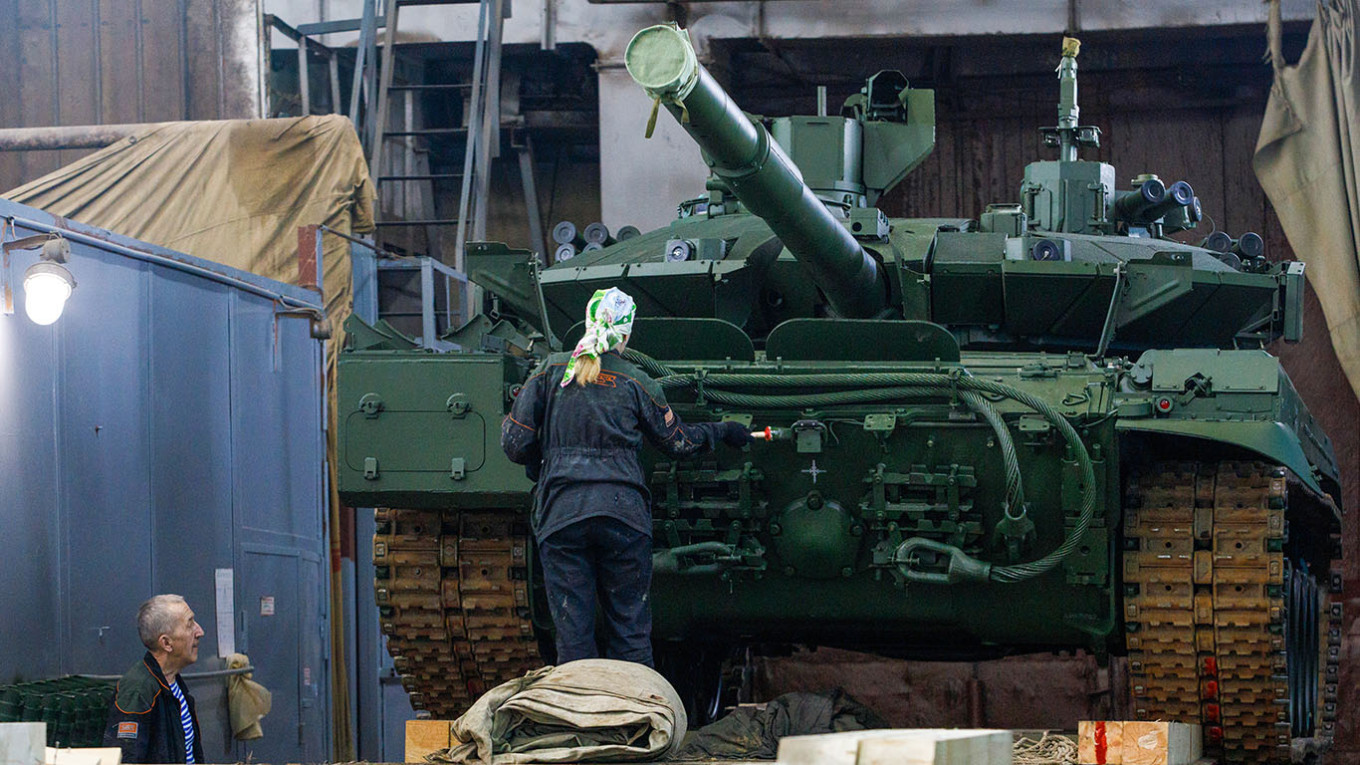
The “other transport equipment” category, which encompasses tanks and drones, has remained relatively stable, growing at 33.1% compared to 34.2% in 2024.
Imports of dual-use goods—items that the West prohibits from being sent to Russia due to their military potential—have also decreased.
Imports of military-related goods from China, Russia’s main supplier, fell by 3.7% year on year to $2.6 billion from January to November 2025, and declined by 14.4% when compared to the same timeframe in 2023.
Other indicators suggest that the temporary boost from increased government military demand is beginning to wear off.
According to the exiled news outlet Novaya Gazeta Europe, recruitment in the defense sector has plummeted to levels not seen since the early days of the war. Analysis of online job listings indicated around 34,500 openings at defense-associated companies in the summer of 2025, down from approximately 52,000 a year before.
Although details about military production facilities remain largely classified, intermittent reports have highlighted ongoing structural issues such as corruption and deficiencies in state procurement processes.
Prosecutors have recently sought to nationalize KIMP, a holding company that provides bearings to defense manufacturers, accusing its owners of enriching themselves “at the expense of the crucial interests of society and the state.”
The United Shipbuilding Corporation, a key player in naval construction, has initiated layoffs at its Rybinsk facility due to a lack of new contracts, while electronics manufacturers Optron-Stavropol and microelectronics firm Angstrem have encountered financial difficulties.
Simultaneously, the government is taking action against companies that do not fulfill their contractual obligations. Since the full-scale invasion of Ukraine, at least 34 individuals have faced criminal charges for failing to comply with state defense contracts.
In a dramatic protest against what he characterized as the state’s “Stalinist-style” treatment of defense suppliers, Vladimir Arsenyev, the director of the Volna Central Scientific Research Institute, self-immolated on Red Square in July 2024.
“The volume of government contracts has significantly increased, that is accurate, but issues with low upfront payments, lapses in government orders, and delays in final payments remain,” a source from a company involved in defense procurement shared with The Moscow Times, speaking on the condition of anonymity.
This, coupled with high-interest rates, creates persistent cash flow problems that leave some factories in uncertain situations, the source added.
Despite these challenges, Boulegue from Chatham House indicated that Russia’s defense sector has not yet hit a critical breaking point.
“Russia possesses sufficient resources to maintain its military output at current, if not elevated, levels for essential items such as drones, tanks, or munitions,” he noted.
However, he also pointed out that sanctions are gradually undermining Russia’s capacity to produce more advanced weapon systems.
“Over time, and influenced by sanctions, Russia may find it progressively more difficult and expensive to acquire advanced components like microelectronics and silicon-based materials needed for electronic warfare, space systems, and precision targeting,” he cautioned.
